
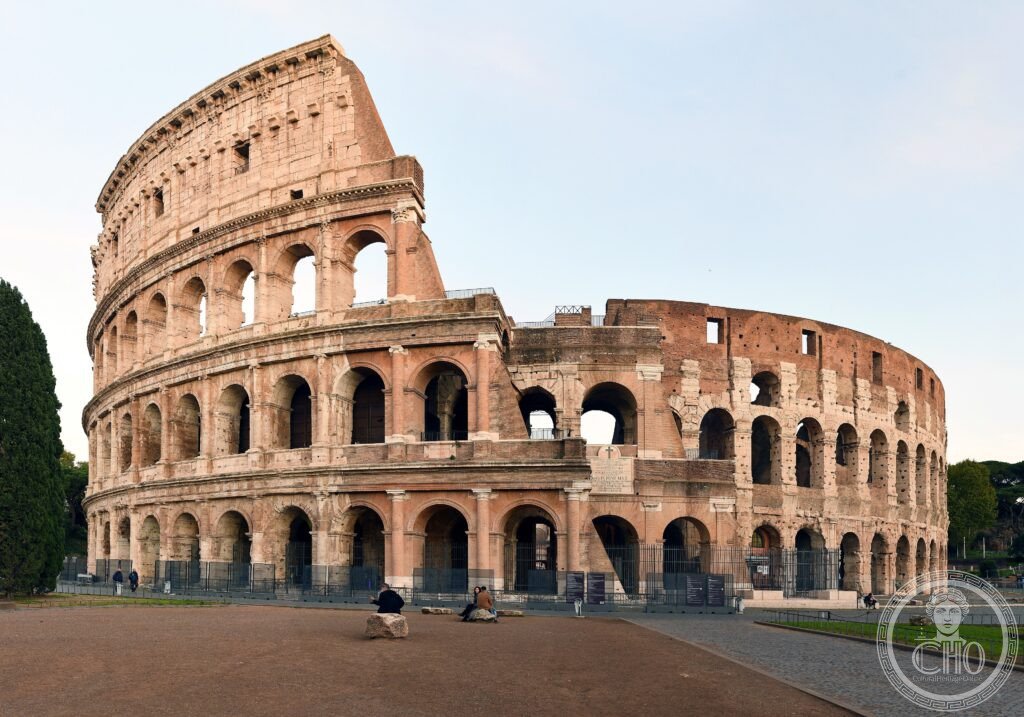
The Colosseum
The largest amphitheatre ever built and the most recognisable ancient monument in the world — the Colosseum, constructed in Rome between 70 and 80 CE by the Flavian emperors Vespasian and Titus, held up to 80,000 spectators for gladiatorial games, animal hunts, and public executions in a building so well-engineered that its retractable canvas awning, underground hydraulics, and crowd management system have no equal in the ancient world.
At a glance
The Colosseum (UNESCO WHS 1980 as part of the Historic Centre of Rome inscription; the most visited ancient monument in the world (approximately 7 million visitors per year — the most attended heritage site in Italy; the most significant site on the most visited tourism itinerary in Europe (the Rome Day 1 itinerary: Colosseum + Roman Forum + Palatine Hill (a single ticket covers all three — the most comprehensive single ancient-Rome archaeological ticket in the world; the Palatine Hill is included and contains the most beautiful ancient garden in Rome: the Orti Farnesiani)); the construction (70–80 CE; the Flavian dynasty: begun by Vespasian (r. 69–79 CE), opened by his son Titus (r. 79–81 CE) with 100 days of inaugural games (the most lavishly opened building in Roman history: 9,000 animals killed in the inaugural games — the most extensively documented inaugural public spectacle in the history of ancient Rome; the programme including animal hunts, gladiatorial bouts, naval battles (naumachia) flooded in the arena — the most hydraulically complex entertainment event in antiquity)); the dimensions (188 m long × 156 m wide × 48 m high; the ground plan area: 24,000 m² — the largest footprint of any building in ancient Rome; the estimated volume: 700,000 m³; the total seating: approximately 50,000–80,000 spectators (the most contested ancient seating count in Roman archaeology; the most frequently compared with modern stadiums: the Colosseum is roughly the size of a modern international rugby stadium).
Key facts
- The construction engineering: the most technically complex building of the Roman world — the materials (the most varied material palette of any single Roman building: the structure used travertine limestone (the main external facade — quarried from Tivoli 30 km east; the most extensively used Roman limestone in any single building); tuff (the inner chambers); Roman concrete (opus incertum and opus reticulatum; the most advanced ancient concrete technology; the concrete aggregate was made from volcanic pumice — the most lightweight structural aggregate in the ancient world; the pumice concrete made the upper vaults lighter than any equivalent stone vault)); the foundations (the most ambitious foundation in ancient Rome: 13 m deep concrete foundations in the former lake bed (the Stagnum Neronis — the artificial lake of Nero’s Domus Aurea was drained to build the Colosseum; the most politically theatrical site-selection decision in Roman history: Vespasian literally drained the tyrant Nero’s pleasure lake and gave the land back to the people as a public spectacle building)); the velarium (the retractable canvas awning: the most complex shade structure in antiquity: 240 wooden masts along the upper rim supported a spider-web of ropes suspending a canvas velarium (awning) over the spectator seating; operated by 1,000 specialist sailors (classiari) from Misenum naval base — the most specialised maintenance crew of any Roman building; the most frequently cited single engineering achievement in the ancient building in Roman popular culture))
- The underground hypogeum: the hidden machinery of the arena — the hypogeum (the underground level: the most impressive single discovery in 20th-century Colosseum archaeology: the system of tunnels, chambers, cages, and lifting mechanisms below the arena floor; the arena floor (the arena sand (harena — the most etymologically descriptive building material: the word “arena” comes from the Latin harena (sand), which was spread over the wooden floor to absorb blood — the most directly named component of any entertainment building); the wooden floor was a recent installation (laid in 2021–2023 for the first time since antiquity — the most historically significant installation of temporary flooring in an ancient monument in Italian history); the 80 lifting shafts (the most mechanically impressive feature: 80 vertical shafts in the hypogeum capable of raising caged animals and scenery to the arena floor; operated by a system of ropes and pulleys — the most complex lifting mechanism in any ancient building; the speed of deployment (an animal could be raised from the hypogeum to the arena in approximately 60 seconds — the most precisely calculated theatrical timing in any Roman spectacle))
- The gladiatorial games: the most complex entertainment industry in the ancient world — the gladiators (the most thoroughly misunderstood aspect of the Colosseum: gladiatorial games were not the daily grind of the arena; they were expensive, carefully staged events that occurred perhaps 50–70 days per year at the Colosseum (the most limited annual spectacle schedule of any major Roman entertainment venue); the gladiators (not slaves to the last: many were free men who signed contracts (the most legally sophisticated voluntary participation in dangerous sport in the ancient world); they received medical care from the most specialised physicians in the Roman world (Galen of Pergamon worked with gladiators in Pergamon before his Rome career — the most practically experienced medical curriculum in ancient medicine)); the munus (the gladiatorial event: the most precisely regulated single sporting event in the ancient world: the referee (the lanista), the rules, the thumbs (the most misunderstood gesture in Roman cultural history: the thumbs-up/thumbs-down tradition is a 19th-century invention (the most confidently stated historical inaccuracy in mainstream Roman cultural heritage); the actual Roman gesture was the pressed thumb (verso pollice, meaning “turned thumb” — the exact meaning is still debated; the most unresolved philological question in Roman gladiatorial studies)); the animal hunts (venationes — the animal hunts are more important than the gladiatorial contests in the long history of the arena: the Colosseum imported North African lions, Asian elephants, bears, leopards, ostriches, crocodiles, and giraffes from across the Roman Empire — the most zoologically diverse single performance venue in the ancient world; the Colosseum may have contributed to the extinction of the North African elephant and the reduction of the Barbary lion population in Roman-period North Africa))
- Heritage: UNESCO World Heritage Site (Historic Centre of Rome with Extraterritorial Properties of the Holy See and San Paolo fuori le Mura), inscribed 1980
- GPS: 41.8902° N, 12.4922° E
History
The building history (the Colosseum was commissioned by Emperor Vespasian (r. 69–79 CE) and opened by his son Titus in 80 CE; the construction (the most precisely planned single building project in Roman history: approximately 100,000 workers (slaves from the Jewish revolt and free Roman builders) over 10 years; the workforce (the most precisely documented Roman building workforce: inscriptions on the construction materials (travertine blocks) record the names of the legions that quarried them — the most direct military involvement in any Roman public building); the later use (the Colosseum was used for gladiatorial games, animal hunts, and public executions from 80 CE until at least the 6th century CE (the last documented gladiatorial contests: 438 CE (the most precisely dated end of gladiatorial games in any Roman arena); animal hunts continued until at least 523 CE)); the medieval period (the most complex single second life of any ancient Roman monument: the Colosseum served as a fortress (the Frangipane family fortified it in the 12th century — the most aggressive private appropriation of a Roman public building in medieval history); a church (12 small chapels built in the passageways in the medieval period); a quarry (described in hero caption); a housing complex (the southern facade contained workshops and housing for centuries)); the modern period (the Colosseum was declared a papal property in 1750 (the most consequential single administrative decision in Colosseum conservation history: the Pope’s decree that the Colosseum was hallowed by the blood of Christian martyrs stopped the quarrying (the most theologically motivated single conservation decision in Roman heritage history))); UNESCO WHS 1980.
What you see
The Colosseum visit (the single most important practical fact about visiting the Colosseum: book in advance or buy the Roma Pass (the combined transport and museum card; the most cost-effective single tourist card in Rome for 2+ days); the queue (without pre-booking: 2–3 hour queue in summer — the most photographed queue in Italian heritage tourism; with pre-booking: 15 min); the timed entry (the most recently changed admission regime in Rome: from 2024, all entry is timed-entry; the earliest morning slots (8:30am) are the most recommended for photography without crowds); the interior levels (the ground floor: the arena level and the first arched tier (access included); the second and third floor: the better views of the interior and the exhibition on gladiatorial culture (ticket supplement); the underground hypogeum: the most interesting single addition to the Colosseum visit (book separately; limited tours; the most recently opened and the most archaeologically impressive section — first fully opened to the public in 2021)); the exterior (the south-western facade: the most complete external view; the arch of Constantine immediately adjacent (315 CE; the most richly decorated Roman triumphal arch; the second most photographed single arch in Rome after the Arch of Titus)).
Practical information
- Getting there: Colosseo Metro Station (Metro Line B; the most directly named metro station in Rome; the most useful single station for any tourist in Rome: the Colosseum, the Arch of Constantine, the Roman Forum entrance, and the beginning of the Via Sacra are all within 2 minutes walk of the station exit — the most convenient single metro station exit for ancient Roman heritage in any European capital); from Fiumicino Airport (FCO; 32 km south-west; Leonardo Express train to Termini station (32 min; the most expensive airport-to-city train in Italy but the fastest and most comfortable); then Metro Line B from Termini to Colosseo (5 stops; 10 min — the most efficient single airport-to-ancient-monument transfer in Europe)); the combined ticket (Colosseum + Roman Forum + Palatine Hill: the most comprehensive single ancient-Rome archaeological ticket; valid 2 consecutive days; includes the Palatine Hill (the most consistently under-visited of the three sites in the combined ticket — the most rewarding surprise of any first-time Rome visit: the Palatine Hill contains the most beautiful garden views in Rome and the imperial palace ruins of Domitian’s Domus Flavia)); the Roma Pass (48h or 72h; includes 2 or 3 museum admissions (the Colosseum can be one) plus unlimited public transport — the most cost-effective single tourist pass in Rome for anyone visiting more than 2 museums))
- The Roman Forum and the Palatine Hill: the heart of the ancient city — the Roman Forum (the most historically layered single open space in Western civilisation: the Forum (400m × 100m) contains temples, basilicas, and arches from the Republic (509–27 BCE) and the Empire (27 BCE–476 CE); the most significant monuments: the Temple of Vesta (the round temple of the Roman goddess of the hearth; the Vestal Virgins tended the sacred flame for 1,000 years — the most consistently maintained single religious ritual in Roman history); the Arch of Titus (81 CE; the most important single monument for understanding the Jewish Diaspora: the interior relief panels depict the sacking of the Jerusalem Temple in 70 CE — the Menorah from the Temple being carried in the triumphal procession — the most frequently reproduced single image in the artistic heritage of the Roman-Jewish encounter); the Rostra (the speakers’ platform where Julius Caesar was eulogised after his assassination on 15 March 44 BCE — the most historically consequential single speechmaking platform in the Roman Forum))
- The Vatican and Piazza San Pietro: the most visited religious site in the world — the Vatican (4 km west of the Colosseum; 20 min walk or taxi; the smallest sovereign state in the world (0.44 km²); St Peter’s Basilica (the most visited religious building in the world; approximately 10 million visitors per year; the nave (212 m long — the second longest nave in any church in the world after St Paul’s Outside the Walls in Rome); the Michelangelo Pietà (the most important single marble sculpture in any church in the world: the 1498–1499 marble group of Mary holding the body of Christ (the only work Michelangelo ever signed — the most precisely authenticated single sculpture in the history of Renaissance art)); the Vatican Museums + the Sistine Chapel (the most visited museum complex in Italy: the Sistine Chapel ceiling (the Michelangelo ceiling: 1508–1512; the most visited single room in any museum in the world — estimated 4+ million visitors per year; the Last Judgment (the altar wall; 1536–1541; the most dramatic single fresco composition in the history of Western art))
Getting there
Metro Line B to Colosseo station (10 min from Termini). Book timed entry online (avoid 2-3h queues). Combined Colosseum + Roman Forum + Palatine Hill ticket. Underground hypogeum: separate booking, limited tours. GPS: 41.8902, 12.4922.
Nearby
- Roman Forum and Palatine Hill — immediately adjacent (200m west; same ticket); the political and residential heart of ancient Rome — described in Practical section; the essential Roman 3-site sequence: Colosseum exterior (30 min) → Arch of Constantine (15 min) → Roman Forum (1h 30min: Temple of Vesta + Arch of Titus + Rostra + Temple of Saturn) → Palatine Hill (1h 30min: Domus Augustana + Domus Flavia + the Orti Farnesiani terrace view over the Forum)
- The Capitoline Museums — 500m north-west; the oldest public museums in the world (1471) and the finest collection of Roman sculpture outside the Vatican — the Capitoline Museums (the two palaces flanking the Piazza del Campidoglio (the Michelangelo-designed piazza — the finest civic piazza design in Renaissance Rome); the equestrian statue of Marcus Aurelius (the only fully preserved Roman bronze equestrian statue in the world; the most important single bronze sculpture in Rome; the original is inside the Palazzo dei Conservatori — the most atmospherically displayed ancient bronze in any European museum; the copy stands in the Piazza del Campidoglio); the Capitoline Venus (the most important full-length female marble figure in the Capitoline collection); the view from the back terrace (the finest view of the Forum Romanum in Rome — the best photography angle for the entire Republican and Imperial Forum seen together))
- The Baths of Caracalla (Terme di Caracalla) — 2 km south; the most completely preserved large-scale Roman public bath complex in Rome and the finest open-air opera venue in Italy — the Baths of Caracalla (built 212–217 CE by Emperor Caracalla; the second largest Roman baths complex in Rome after the Baths of Diocletian (which are larger but largely converted into the church of Santa Maria degli Angeli); 1,600 bathers simultaneously — the most socially egalitarian public building in ancient Rome (senators and slaves bathed in the same water); the floor mosaics (the finest surviving polychrome mosaic programme from any Roman public building in Rome — the most extensive mosaic programme in any Roman bath); the opera (the opera season held in the ruins every summer — the most dramatically staged outdoor opera venue in Italy: the Verdi operas (Aida, in particular, with its elephants) are performed against the towering brick ruins; the most frequently performed single opera in an ancient Roman monument in the world)
Sources
- Wikipedia, Colosseum; Hypogeum of the Colosseum; Gladiator; Velarium, accessed June 2026
- UNESCO, Historic Centre of Rome, the Properties of the Holy See in that City Enjoying Extraterritorial Rights and San Paolo Fuori le Mura, WHS reference 91, inscribed 1980
- Keith Hopkins and Mary Beard, The Colosseum, Profile Books, 2005
Find it on the map
See this place and what’s around it →📷 Diventa un fotografo di Cultural Heritage Online
Condividi le tue foto dei luoghi: restano pubblicate con la tua firma come autore. Più vengono viste, più ti fai conoscere — e presto un concorso premierà le foto più apprezzate.
Accedi o registrati gratis per aggiungere una foto