
Walk Milan with your eyes up and you keep meeting the 1930s: a stripped marble façade, a cage of concrete balconies, a stern stone tower on a famous square. Between the two world wars the city remade itself in a hard new style its architects called Rationalism — Italy’s answer to the Bauhaus. But they built it under Fascism, for a regime that wanted monuments, and the architecture of these years carries that tension in its stone. This is a walk through a difficult, dazzling decade, looked at without flinching.
Italy’s answer to the Bauhaus
In 1926 a group of young architects who called themselves Gruppo 7 declared war on ornament and historical pastiche. They wanted buildings reduced to structure, light and proportion, and their most gifted member was Giuseppe Terragni. His masterpiece is the Casa del Fascio in nearby Como, but in Milan he left the Casa Rustici of 1935 on Corso Sempione: two apartment slabs held apart by a cage of open balconies, so that light and air pour through the middle of the block. In 1935 nothing in the city looked like it, and it still reads as startlingly modern today.
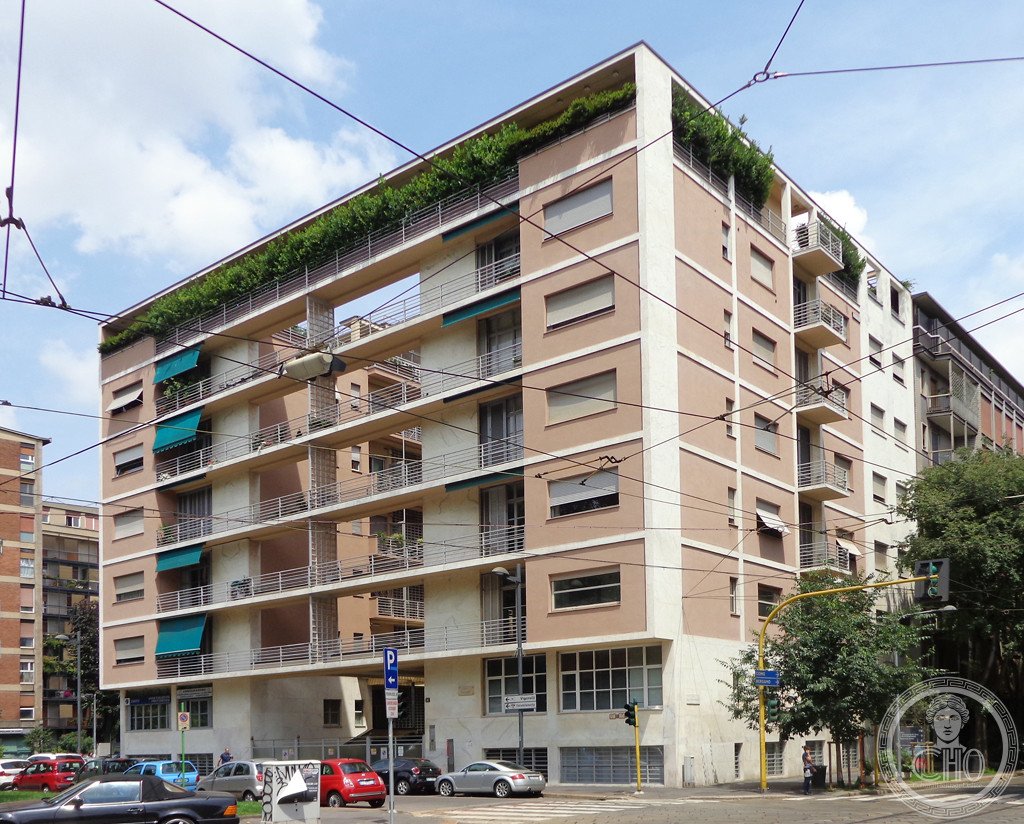
This was the avant-garde wing of Italian architecture, in dialogue with Le Corbusier and the Bauhaus, convinced that a rational, honest building could help make a rational, modern society. The tragedy written into this walk is what that conviction was harnessed to.
The appetite for the new was already deep in the city. Futurism had been launched from Milan in 1909, when the poet Filippo Tommaso Marinetti published a manifesto that worshipped speed, machines and the future and wanted to burn the museums down. Its architect, Antonio Sant’Elia, drew visionary cities of towers and viaducts before dying in the First World War in 1916, his buildings never built — but his drawings haunt everything that followed. That cult of speed is literally on this route: the Vigorelli velodrome of 1935, the “cycling cathedral,” was a temple to exactly the machine-age velocity the Futurists had made into a religion. The Futurist canvases themselves now hang in the Museo del Novecento, inside the Arengario you will pass on the Duomo square.
The regime’s marble
Fascism never fully trusted the Rationalists. The regime preferred grandeur, symmetry and marble — what is often called stripped classicism — and its master was Marcello Piacentini, the most powerful architect in Italy. His Palazzo di Giustizia in Milan, finished in 1940, is a vast monumental courthouse lined with regime-era reliefs and murals, impossible to love easily. Stand in front of it and hold it in your mind beside Terragni’s light balconies from earlier in the day: the same decade, the same city, two opposite faiths about what a building should be.
The truth this walk asks you to sit with is that these were not two separate camps of good and bad architects. The same designers often did both. Talent and complicity ran together, and the buildings are the evidence.
Milan, the design city

Not all of it served power so directly. Giovanni Muzio, the leading figure of the more classical Novecento movement, built the Palazzo dell’Arte in 1933 to house the Triennale — the recurring exhibition of architecture and the decorative arts that, more than anything else, turned Milan into the design capital it remains. Calmer and more measured than Terragni, Muzio was Rationalism in its establishment register. His reworking of the ancient cloisters at the Catholic University, weaving sober 1930s brick into Renaissance fabric attributed to Bramante, shows how tactful the era could also be when it chose.
It is no coincidence that Milan and the word design became inseparable in exactly these years. The Triennale gave the city a stage, and the habit of treating everyday objects, interiors and buildings as a single design culture never left.
Muzio had announced himself a decade earlier with an apartment block the Milanese promptly nicknamed the Ca’ Brutta, the “ugly house,” of 1922 — a deliberately strange, stripped-classical building that scandalised the city and announced that the rules had changed. By the 1930s the strange had become the establishment, and the argument it started was being had on every new façade in Milan.
Propaganda in stone
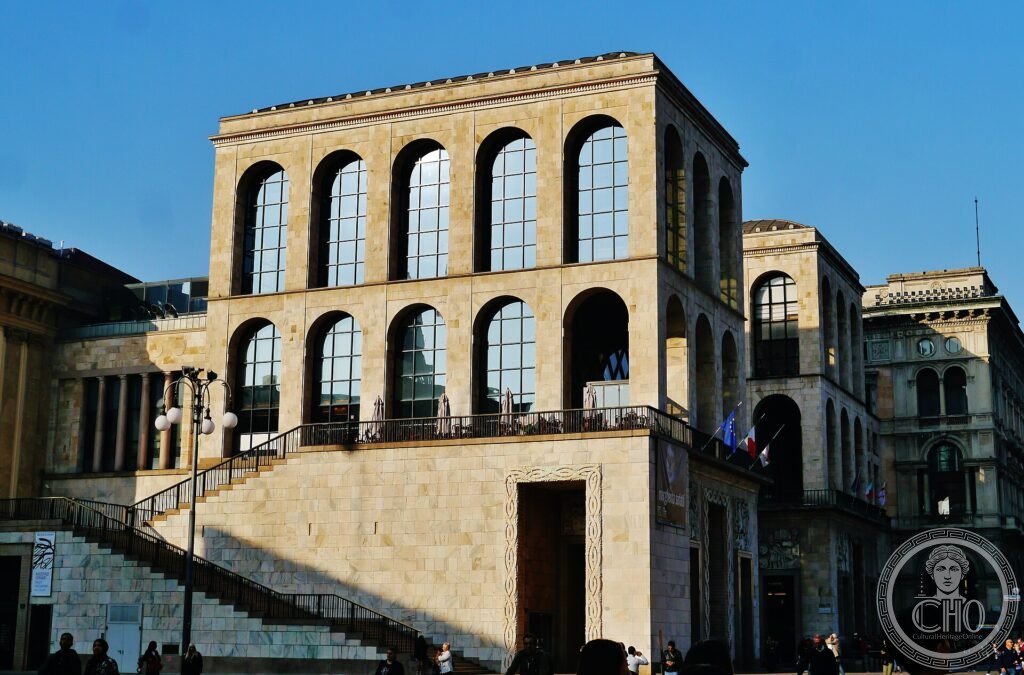
Some of it served power very directly indeed. The Palazzo dell’Informazione on Piazza Cavour, built by Muzio in 1942, was the home of the Fascist press, and its façade carries a mosaic by Mario Sironi, the regime’s great muralist — art that is hard to separate from what it was made to do. On Piazza del Duomo, the twin pavilions of the Arengario were designed in the 1930s as a ceremonial backdrop for rallies; the name itself comes from the medieval word for a speaker’s platform. There is a sharp historical justice in what the Arengario became: one pavilion is now the entrance to the Museo del Novecento, Milan’s museum of twentieth-century art. A building made for propaganda now houses the century’s reckoning with itself.
The gateway
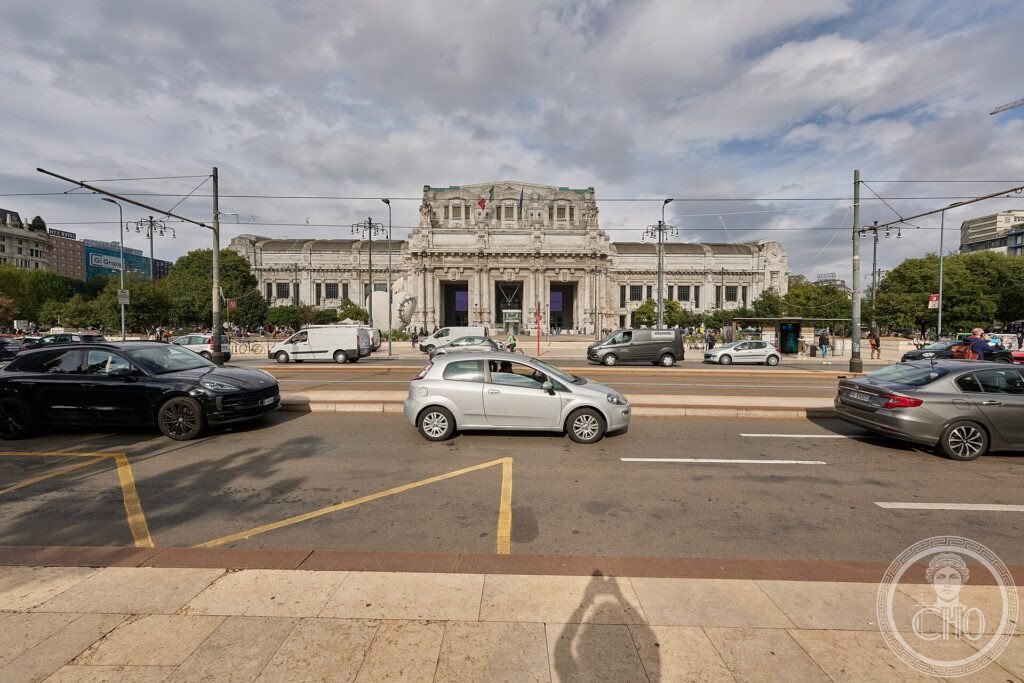
Most visitors meet this architecture before they know it, the moment they arrive. Milano Centrale, opened in 1931, was won in competition by Ulisse Stacchini back in 1912, but the station that was finally built had been inflated by the regime into a monument of national power — a magnificent, slightly overwhelming hybrid of Art Déco, Liberty and Assyrian stone under five great steel-and-glass train sheds. It is the single best overture to the whole walk: stand on the upper concourse, look up at the scale, and you already understand the decade’s appetite for grandeur.
Pagano’s choice
If this walk has a moral centre, it is the campus of Bocconi University, built by Giuseppe Pagano and Gian Giacomo Predaval and finished in 1941. Pagano was one of the leading Rationalists and, for years, a believer in the regime, editing the influential magazine Casabella. Then he broke with Fascism completely, joined the armed Resistance, was arrested and deported, and died in the Mauthausen concentration camp in 1945. His Bocconi is austere, disciplined and humane, and it is the right place to end. The architecture of these years was not made by abstractions. It was made by real people, some of whom paid for their choices with their lives.
How to walk it
Milan’s 1930s landmarks are spread across the city, so this is a metro-and-tram walk rather than a stroll; buy a daily ticket and validate it. The central stretch from the Triennale through Parco Sempione to the Duomo is the most walkable; use the metro for the longer hops out to Sant’Ambrogio and Bocconi. Many of these are working buildings — a courthouse, a university, an office — so look with discretion. And do the day the Milanese way: well-dressed, unhurried, and ended with an aperitivo. Milan effectively invented the modern aperitivo in these very years, and Camparino in Galleria, the Liberty-era bar on the Duomo square open since 1915, is the place to raise the first glass.
For the generation that came just before — the architects who loved exactly the ornament the Rationalists tore away — follow the thread back to our Vienna 1900 Secession walk. The two RoadBooks are two halves of the same European argument about how a modern building should look.
Is the architecture free to see?
Mostly, yes. Almost everything on this route is read from the street or is a public or semi-public building you can enter for nothing — the station, the Bocconi campus, the cloisters, the Arengario’s square. The one paid interior worth the ticket is the Museo del Novecento inside the Arengario, for its Futurist rooms and the framed view of the Duomo.
How long does the Milan Rationalism walk take?
A full afternoon into the evening. The buildings are spread out and joined by metro rides, and several — the Triennale, the Museo del Novecento — reward real time inside. If you have only a half-day, do the Parco Sempione cluster, from the Casa Rustici to the Triennale, and the Duomo.
How should I think about Fascist-era buildings?
Honestly, and without either glamour or denial. These buildings are historical documents of a dictatorship as well as works of architecture, and the best way to visit them is to hold both facts at once. Milan itself does this — turning the Arengario into a museum of the century is exactly that gesture.
When is the best time to go?
Spring and autumn are kindest for a long city walk. Milan can be humid in high summer and foggy in winter. Aim to reach the last stops in the early evening, when the aperitivo ritual that ends the route is in full swing.
Walk it yourself. We have turned this route into a free CHO RoadBook — the nine stops in order, a map, and downloadable GPX and KML tracks for your phone: the Milan Rationalism RoadBook.
Sources
- Triennale di Milano — history of the Palazzo dell’Arte and the Triennale exhibitions.
- Museo del Novecento, Milan — the Arengario building and its conversion.
- FAI / Fondazione Bocconi — Giuseppe Pagano and the Bocconi campus.
- Ferrovie dello Stato / Grandi Stazioni — Milano Centrale and Ulisse Stacchini.