

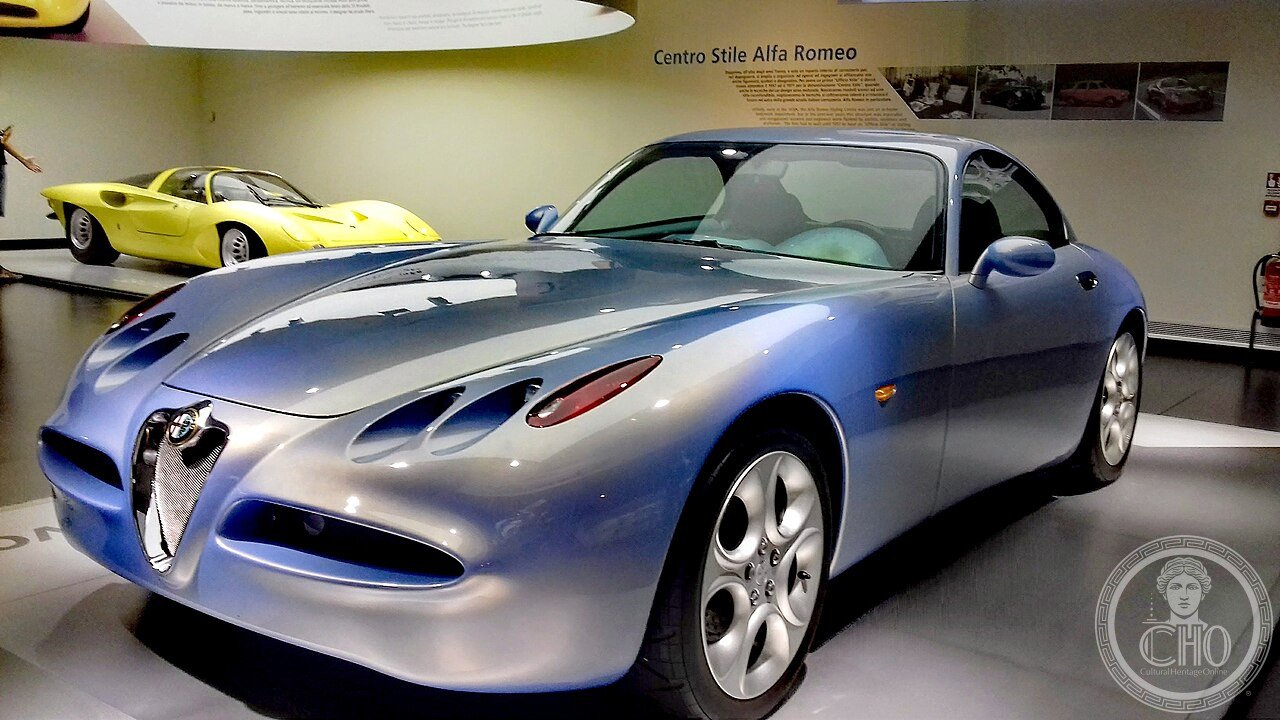
In the former factory complex where Alfa Romeo built cars until 2002, the museum preserves 256 vehicles and 150 historic engines — from the 1910 racing cars that gave Alfa its reputation to the Nuvola and Brera concepts that proved Italian design still had something to say a century later.
At a glance
The Museo Storico Alfa Romeo occupies 4,800 square metres over six floors inside the former Centro Direzionale at Viale Alfa Romeo, Arese, on the site where Alfa Romeo produced cars until 2002 and engines until 2005. Designed by architects Vito and Gustavo Latis and inaugurated on 18 December 1976, it is one of the oldest purpose-built automotive heritage museums in Italy. Closed in 2011 and reopened in June 2015 after a major renovation, it today displays 69 vehicles drawn from a collection of 256 cars and 150 engines, with examples of every model Alfa Romeo has assembled since 1910, including prototypes, competition cars, and concept vehicles — 60 per cent of which remain roadworthy.
Key facts
- Opened: 18 December 1976; reopened 30 June 2015
- Architects (original): Vito and Gustavo Latis
- Exhibition area: 4,800 m² across 6 floors
- Collection: 256 vehicles, 150 engines; 69 on display
- Address: Viale Alfa Romeo, 20020 Arese (MI)
- GPS: 45.5574, 9.0461
- Website: museoalfaromeo.com
History
Alfa Romeo’s history in Arese began in 1960, when the company transferred its main production from the historic Portello site in Milan to the new plant north of the city. By the time of the plant’s peak production years in the 1970s, the Arese facility employed tens of thousands of workers and produced cars ranging from the Giulia to the Alfetta and the 164. The museum was inaugurated in 1976 at the initiative of Giuseppe Luraghi, the manager who had rebuilt Alfa Romeo after World War Two and who understood that the company’s racing and road-car heritage constituted a cultural asset as much as a commercial one.
The museum closed in February 2011 as the Arese site was partially sold for commercial redevelopment — a closure that provoked a sustained campaign by enthusiasts and collectors, supported by the Lombardy regional government, to prevent the dispersal of the collection. A complex legal process involving Fiat (by then Alfa Romeo’s parent company) and the Italian Ministry of Cultural Heritage — which successfully argued to preserve the entire vehicle collection intact — concluded with the museum’s reopening on 30 June 2015 following a two-year renovation. The surrounding factory land has been partly converted into a commercial centre; the museum building, its heritage designation secured, stands as the anchor of the remaining industrial site.
Alfa Romeo as a brand was founded in 1910 (initially as ALFA — Anonima Lombarda Fabbrica Automobili) on the site of a former Darracq factory in Portello, Milan. Its competition record — twelve Formula One world championship wins, three Le Mans victories, countless class wins from the Mille Miglia to the Targa Florio — makes its archive one of the most significant in European motorsport history.
What you see
The six exhibition floors are organised into four thematic areas, moving through the company’s history from its 1910 origins to the present. The ground floor features the early racing cars that established Alfa Romeo’s international reputation in the 1920s and 1930s — the P2, the 8C 2300 Monza, the 12C — followed by the road cars of the pre-war period. Upper floors move through the postwar decades: the Giulietta Spider and Berlina, the Giulia TI and Sprint, the Montreal, the 156 and 147 of the 2000s.
The museum’s design highlights are concentrated in the prototype and concept car sections: the Alfa Romeo Nuvola (1996), the Brera (2002), the Kamal (2003), and earlier experimental vehicles like the Carabo (1968, Bertone) and the Iguana (1969, Italdesign). These cars represent the intersection of Alfa Romeo’s engineering culture with the Italian coachbuilding studios — Bertone, Pininfarina, Zagato, Italdesign — that defined mid-century automotive design as a discipline.
Practical information
- Opening hours: Check current times at museoalfaromeo.com
- Admission: Ticketed; combined options available
- Time needed: 2–2.5 hours for a full visit
- Highlights: 8C 2300 Monza, Giulia Spider, Montreal, Nuvola concept, Carabo (Bertone)
- Archive: The Centro Documentazione Storica, with historic photographs and promotional material, is based in the same complex
Getting there
Arese is 13 km north-west of Milan’s city centre. By metro: take line M1 (red) to Rho Fiera, then a short taxi or bus connection. By car: exit the A8 at Lainate or Arese, following signs for the Alfa Romeo complex. A new suburban railway link (the Rho–Arese line) has been discussed but was not yet operational at publication; check current public transport options. From the Fiera Milano expo centre: 10 minutes by car.
Nearby
- Fiera Milano (Rho) — 5 km south, Italy’s largest exhibition centre (host of Salone del Mobile, EICMA)
- Sacro Monte di Varese — 25 km north, UNESCO World Heritage Sacred Mountain with pilgrimage chapels
- Milan Expo 2015 site — now MIND (Milano Innovation District), 8 km south
- Pinacoteca di Brera, Milan — 14 km south-east, one of Italy’s great painting collections
Sources
- Wikipedia (Italian): Museo storico Alfa Romeo
- Museo Storico Alfa Romeo: museoalfaromeo.com
- Wikimedia Commons: File:Alfa Romeo Nuvola (Arese), Flaviomacal, CC BY-SA 3.0
- Nominatim / OpenStreetMap: GPS 45.5574, 9.0461
Find it on the map
See this place and what’s around it →

Historical events at this place (2)
📷 Become a Cultural Heritage Online photographer
Share your photos of places: they stay published under your name as the author. The more they're seen, the more you get noticed — and soon a contest will reward the most appreciated photos.
Log in or sign up free to add a photoIs this page about you?
This page is read by travellers and heritage enthusiasts who find it on Google. Tell us how you are connected to this place and we will take it from there.