
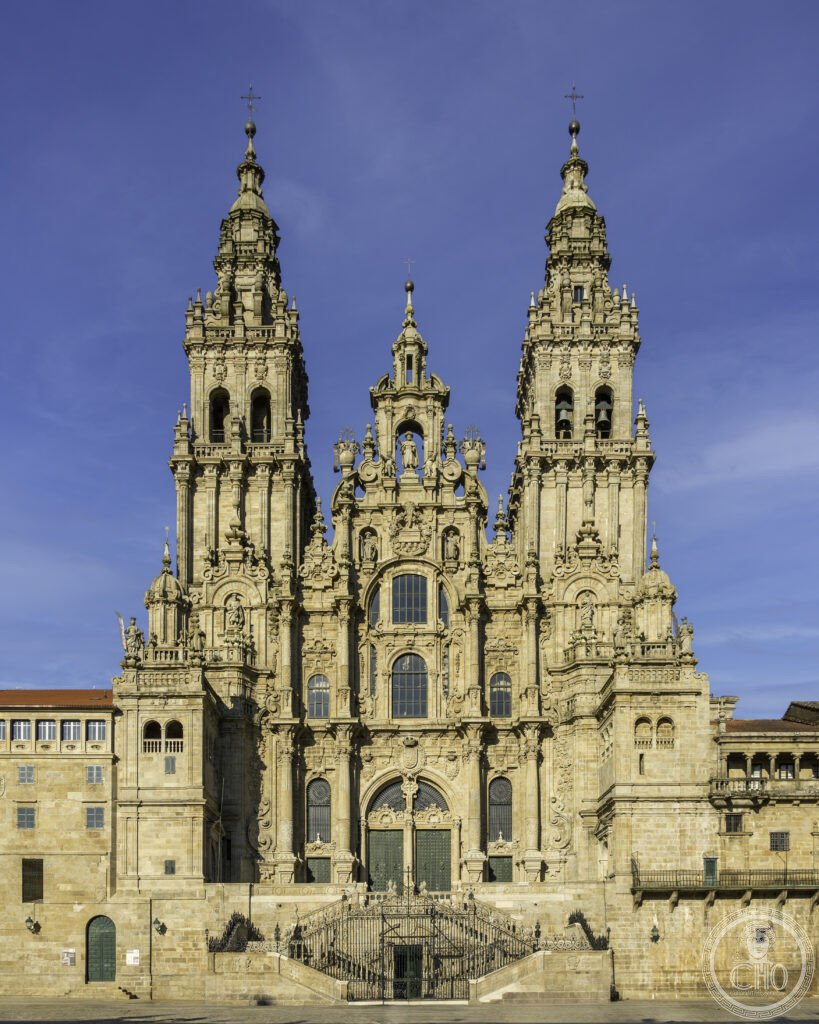
The most important Christian pilgrimage destination in western Europe and the terminus of the Camino de Santiago. Santiago de Compostela, where the bones of St. James the Apostle are said to rest beneath a Romanesque-Baroque cathedral of exceptional magnificence, has been drawing pilgrims from across Europe since the 9th century and now attracts over 350,000 annual pilgrims completing the Camino, making it simultaneously the world’s most ancient and most active long-distance pilgrimage.
At a glance
The Old Town of Santiago de Compostela (UNESCO WHS 1985; the inscribed zone covers the historic city centre of approximately 2 km²; population of the Santiago de Compostela municipality approximately 97,000) is the capital of the autonomous community of Galicia in north-western Spain, approximately 65 km from the Atlantic Ocean and approximately 20 km from the Portuguese border. The city is built on granite (the building material for every major structure in the old town; the cathedral, the colonnaded ruas (streets), the fountains, the arcaded market, the hospice, and the university are all built in the distinctive grey-green granite of Galicia; rain-darkened granite is the defining visual texture of the city). The Praza do Obradoiro is the main square in front of the cathedral, and its name means “workshop plaza”, after the yard where the cathedral stonemasons worked. It is the largest and most magnificent ecclesiastical square in Spain, closed on four sides: the cathedral to the west, the Pazo de Raxoi, the 18th-century Baroque city hall, to the north, the Hostal dos Reis Católicos to the south — built by Ferdinand and Isabella between 1499 and 1511 as a hospital for exhausted pilgrims and now a five-star parador, the most historically significant hotel in Spain — and the Colexio de San Xerome, the façade of the university rector’s building, to the east. Here every Camino route converges. Pilgrims arriving after 100–800 km on foot sit down on the cobblestones, take off their boots and weep, and that scene, repeated hundreds of times a day in the season from April to October, is the emotional centre of Santiago for visitors who have not walked the Camino and have never seen anything like it.
Key facts
- The Camino de Santiago. The most walked long-distance pilgrimage in the world: a medieval road network still in continuous daily use. The Camino de Santiago, the Way of St. James, is the network of pilgrimage routes converging on the city. The main one, the Camino Francés or French Way, starts at Saint-Jean-Pied-de-Port in the French Basque Country at the foot of the Pyrenees and runs approximately 790 km through Pamplona, Burgos and León before descending into Galicia, crossing the mountains on day 1 by the Puerto de Ibañeta pass at 1,057 m. It was the most important pilgrimage route in medieval Europe, walked by 1 million+ pilgrims a year at its peak and still by 100,000+ a year in the 15th century, after the devastations of the Black Death. The modern revival began in the late 20th century: approximately 400 pilgrims a year in 1987, when the route was relaunched as a cultural itinerary, against 350,000+ a year in 2024. The motivations have shifted from religious to spiritual, physical, environmental and secular, and approximately 40–50% of today’s pilgrims describe themselves as non-religious. To receive the Compostela, the official certificate of completion, a pilgrim must walk at least the final 100 km, or cycle 200 km. Other routes exist: the Camino Portugués, 620 km from Lisbon or 240 km from Porto, increasingly popular; the Camino del Norte along the northern coast, 830 km; and the Vía de la Plata from Seville, 1,000 km and the most solitary of the main ways.
- The Pórtico de la Gloria. The supreme achievement of Romanesque sculpture in Spain: the most complex sculpted doorway in medieval Europe. The Pórtico de la Gloria, the Glory Porch, was the main ceremonial entrance to the cathedral and is now an interior one, reached from the Praza das Praterías, since the Baroque west facade of the Obradoiro conceals the original Romanesque door inside. Master Mateo — Maestro Mateo, a sculptor of unknown origin, attributed to Galician, French or Flemish birth — designed and executed it with his workshop, working from 1168 to its completion in 1188; his identity is known only from the Cathedral archives and from the inscription on the lintel, Anno: Era M CC XXV. The portal is triple-arched. On the central tympanum Santiago sits enthroned, St. James shown as a pilgrim on the main central column, which bears the Tree of Jesse genealogy of Jesus in high relief. The surrounding arches carry the 24 Elders of the Apocalypse with their musical instruments, each a portrait of a different individual playing a different instrument: the most important early source for the appearance of 12th-century musical instruments. On the reverse of the central column sits Master Mateo himself, the Santo dos Croques, the Saint of Headbutts, whose stone head visitors traditionally touch with their foreheads to acquire the sculptor’s wisdom; 800 years of touching have worn it smooth, and the practice is now restricted to protect the stone.
- The Botafumeiro: the most theatrical ceremony in European church ritual. The Botafumeiro — Galician for “smoke expeller” — is the giant censer suspended from the vault of the cathedral: 80 kg in weight, approximately 1.6 m tall, holding approximately 40 kg of charcoal and incense, hung from a pulley system on a rope 65 m long fixed to the vault of the transept. 8 priests, the tiraboleiros, pull that rope in a coordinated sequence to set it swinging in an ever wider arc, which on feast days reaches approximately 65 m across the transept. At the top of each swing the censer passes approximately 2 m above the heads of the congregation, at a maximum speed of approximately 68 km/h. The original purpose was practical: in the medieval period it masked the smell of the thousands of unwashed pilgrims crowded into the church, and the smoke still fills the transept in approximately 3 minutes. It has failed spectacularly at least twice. In 1499 a rope broke and the censer flew out of the north door of the transept, narrowly missing Princess Catherine of Aragon, who was present; a similar accident happened in 1622. The Botafumeiro swings at the Pilgrim’s Mass (held daily at noon; the Botafumeiro is only deployed during specific feasts and when paid for by pilgrimage groups (approximately EUR 400 donation); the standard daily Pilgrim’s Mass does not use the Botafumeiro).
- Heritage: UNESCO World Heritage Site, Santiago de Compostela Old Town, inscribed 1985.
- GPS: 42.8804° N, 8.5454° W.
History
The discovery of the tomb of St. James (allegedly; c. 820 AD; the hermit Pelayo found a field of stars (Campus Stellae → Compostela) leading to a tomb; Bishop Teodomiro identified it as the tomb of St. James the Apostle; Alfonso II of Asturias ordered the first chapel to be built over the tomb). The first cathedral (829 AD; built over the tomb; destroyed by the Moorish general Al-Mansur in 997 AD (the most devastating Viking/Moorish raid on Galicia; Al-Mansur did not destroy the tomb itself — reportedly out of respect for the saint — but he carried the cathedral bells to Córdoba on the backs of Christian slaves; the bells were returned to Santiago on the backs of Muslim slaves by Ferdinand III in 1236 when Córdoba was reconquered)). The current Romanesque cathedral (construction began 1075 under Alfonso VI; the central Romanesque nave was completed approximately 1120; the Pórtico de la Gloria (Master Mateo, 1168–1188)). The medieval pilgrimage peak (11th–13th centuries; the most important period; the route system was mapped and described in the Codex Calixtinus (c. 1140; the world’s first travel guidebook); the pilgrimage united all of Western Christendom in a shared practice). The Baroque transformation (17th–18th century; the addition of the Obradoiro facade (Fernando de Casas Novoa; 1738–1750)). The modern revival (1987–present). UNESCO WHS 1985.
What you see
The approach to the Praza do Obradoiro comes from the Rúa do Franco, the last 200 m of the Camino Francés, and turns on the moment when the Obradoiro towers appear above the rooftops: many pilgrims stop there, take off their backpacks and sit a long time looking at the facade before going nearer. In the Cathedral Interior, the 12th-century Romanesque Nave is the grandest Romanesque interior in Spain, with three aisles and a vault of approximately 22 m — the highest Romanesque vault in the country. The Pórtico de la Gloria is now protected behind glass and needs a timed entry: the restoration of 2018 removed centuries of grey paint and brought back the original 12th-century polychromy, and the colours — red, yellow, blue, green — are a revelation after generations of assuming the sculpture was bare grey stone; the whole scheme is now documented in high-resolution photographs. The High Altar carries a silver-gilt Baroque altarpiece of 1658 by Juan de Lorenzana, with the seated figure of Santiago Peregrino, the pilgrim St. James, at the top, and the tradition of embracing it from behind: pilgrims climb a narrow staircase behind the altar and hug the statue. Below is the Crypt with the reliquary of St. James, and above, on the Roof Walk, a guided tour crosses the exterior stone roof over the nave for the view down into the Praza do Obradoiro.
Practical information
- Getting there: Santiago de Compostela Airport (SCQ; Rosalía de Castro Airport; 12 km from the city centre; bus connection every 30 min to the bus station (45 min; approximately EUR 3); Iberia, Vueling, and Ryanair from Madrid, Barcelona, and other Spanish cities; limited international connections (London Heathrow with Iberia; Amsterdam; Zurich); the best approach is: train from Madrid-Chamartín (AVANT or Alvia; 5h 30 min–6h; approximately EUR 40–80; two trains daily); from Porto (Comboios de Portugal + Renfe; approximately 4–5h with change in Vigo Urzaiz); from Vigo (1h by train; 35 min by car; 30 km south)).
- The Jacobean Year: the most significant occasion in Santiago’s calendar. Año Santo Compostelano (Holy Year or Jubilee Year; a year when July 25 (the Feast of St. James) falls on a Sunday; the indulgence associated with the Compostela (the pilgrimage certificate) is doubled in a Holy Year; the Puerta Santa (Holy Door; the door on the east side of the cathedral, between the cathedral and the Praza da Quintana; the door is opened only in Jacobean Years and closed again at the end of the year with a ceremonial bricking-up); the next Jacobean Years after 2021 are 2027 and 2032; in Jacobean Years, the number of pilgrims increases by approximately 30–50% compared to normal years; in the 2021 Holy Year (which was extended into 2022 because of Covid), approximately 438,000 pilgrims completed the Compostela; the 2027 Holy Year will be the most significant in living memory).
- Galician food and wine: the finest seafood cuisine in Spain. Galicia is the origin of the most important Spanish seafood tradition. Pulpo á feira (pulpo a la gallega; Galician-style octopus; boiled octopus sliced onto a wooden plate, dressed with olive oil and smoked paprika and coarse salt; the standard preparation in every restaurant and market in Santiago; the best is eaten at the Mercado de Abastos (the covered market; the most important food market in Galicia; open Tuesday–Sunday morning; the octopus sellers in the market serve it from their stalls; the experience of eating pulpo á feira at a wooden table in the market with a glass of Ribeiro white wine is the defining Galician food experience)). Percebes (goose barnacles; the most expensive seafood in Spain (approximately EUR 80–150 per kg; the difficulty and danger of harvesting them from the exposed Atlantic rocks of the Costa da Morte accounts for the price); the flavour is intensely saline and oceanic). Albariño (the white wine of Galicia; produced in the Rías Baixas appellation (south of Santiago; 30 km); the most important white wine produced in Spain; aromatic, high-acid, with stone fruit and Atlantic mineral character).
Getting there
Santiago Airport (12 km; bus 45 min). Train from Madrid (5h 30 min). Train from Porto (4–5h). GPS: 42.8804, -8.5454.
Nearby
- Finisterre (Fisterra) and the Costa da Morte. 90 km west of Santiago (1h 30 min by road; 3h 30 min by bus; many pilgrims walk a further 4–5 days after arriving at Santiago to reach the traditional physical end of the Camino). The westernmost point of continental Iberia and the most atmospheric end-point of the pilgrim journey. Finisterre, Fisterra in Galician, is “the end of the world”, finis terrae in Latin: the cape at the western end of the Costa da Morte. That “Coast of Death” is the most dangerous shoreline in Spain for shipwrecks, with over 100 ships lost since the 18th century, and the name records a plain reality of Atlantic storms, granite reefs and no natural harbour. The lighthouse, the light at 0 km, marks the symbolic terminus of the Camino, with a 0-km stone at its base where pilgrims traditionally burn a piece of clothing or their boots as an offering at the end of the journey. The sunset here is the most emotionally significant in Spain, and what the pilgrims who arrive in time for it feel is difficult to describe to anyone who has not made the walk.
- Rías Baixas wine region and the Atlantic coast. 30–60 km south-west of Santiago (40 min–1h by car). The finest white wine region in Spain and the most beautiful ría (estuary) coastline on the Iberian Peninsula. The Rías Baixas are the four tidal estuaries of southern Galicia. The Ría de Arousa is the largest, and on it stands Padrón, the small town that grows the Galician peppers — pimientos de Padrón, eaten whole, pan-fried in olive oil with salt, mildly spicy, with one in ten hot. Then come the Ría de Pontevedra and the Ría de Vigo. The Ría de Baiona is the most historically significant: the three caravels of Columbus are traditionally said to have entered it on their return from the Americas in 1493, and Martín Alonso Pinzón, captain of the Pinta, died at Baiona 15 days after that landfall, before Columbus himself got back to Palos. Through the same country runs the Albariño wine route, the A Estrada-Cambados-Vilagarcía de Arousa circuit, with the finest Albariño estates and tasting rooms open daily in summer.
- A Toxa (La Toja) Island and Pontevedra. 75 km south-west of Santiago (1h by car). The most famous spa island in Spain and the finest medieval old town in Galicia after Santiago. A Toxa (an island in the Ría de Arousa connected to the shore by a bridge; the Gran Hotel La Toja (1907; the most famous spa hotel in Galicia; the thermal waters of La Toja were discovered in the 19th century); the Chapel of San Caralampio (the exterior walls entirely covered in scallop shells — the symbol of the Camino de Santiago; the most bizarre and most beloved shell-decorated building in Galicia)). Pontevedra (the old city; the finest medieval city in Galicia after Santiago; the Praza da Peregrina (the pilgrimage church of the Virgin Peregrina (Pilgrim Virgin); a Baroque building in the shape of a scallop shell); the Alameda park; the Archaeological Museum).
Sources
- Wikipedia, Santiago de Compostela. Cathedral of Santiago de Compostela. Camino de Santiago, accessed June 2026.
- UNESCO, Santiago de Compostela Old Town, WHS reference 347, inscribed 1985.
- Robert Harbison, Eccentric Spaces, MIT Press, 2000 (for the Pórtico de la Gloria).
Find it on the map
See this place and what’s around it →📷 Become a Cultural Heritage Online photographer
Share your photos of places: they stay published under your name as the author. The more they're seen, the more you get noticed — and soon a contest will reward the most appreciated photos.
Log in or sign up free to add a photo