
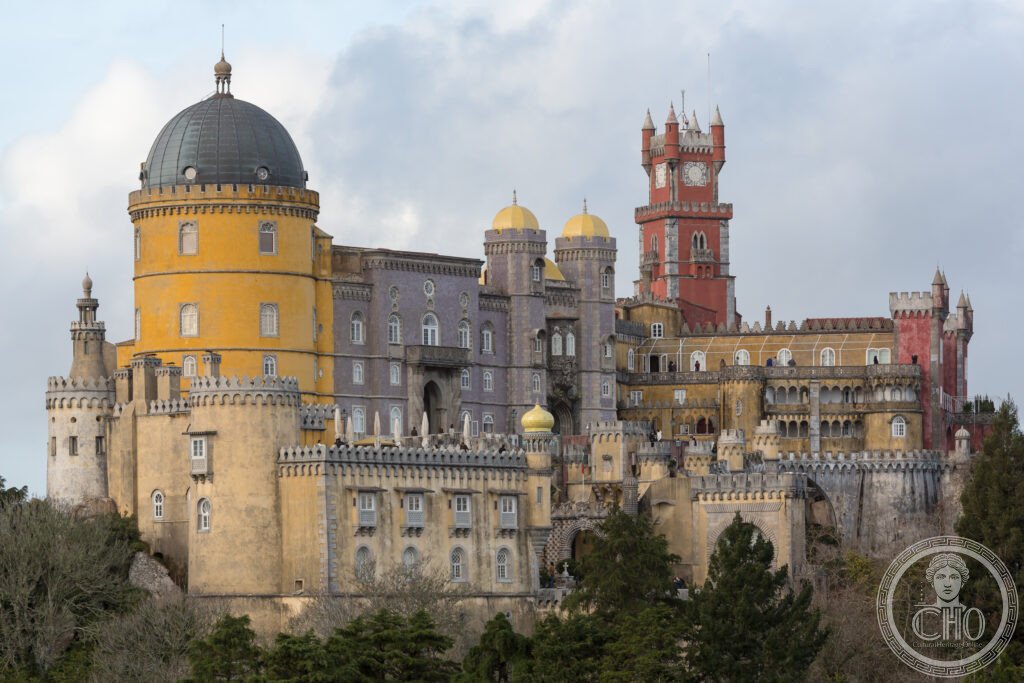
The most extravagant royal playground in Europe and one of the most romantically exotic cultural landscapes in any country. Sintra, a mountain town 40 minutes from Lisbon, is the site where Portuguese royalty and 19th-century Romantic visionaries built the most flamboyant collection of palaces, gardens, and villas in Iberia, from a hilltop castle that looks like a Grimm Brothers illustration to an underground spiral well encoding Rosicrucian initiation ritual in stone.
At a glance
The Cultural Landscape of Sintra (UNESCO WHS 1995; a cultural landscape combining natural, architectural, and garden heritage; the inscribed zone covers 9,449 hectares of the Serra de Sintra and the surrounding forest and town; population of the Sintra municipality approximately 380,000; the historic centre itself is a small town of approximately 40,000 with an extremely dense concentration of palaces, gardens, and quintas (country estates)) is located in the Sintra-Cascais Natural Park approximately 40 km west-northwest of Lisbon. The Serra de Sintra is a small granite massif rising to approximately 540 m from a flat coastal plain; its highest point, the Cruz Alta on the summit ridge, stands approximately 540 m above sea level and approximately 520 m above the Lisbon plain around it. The mountain makes its own weather. The prevailing Atlantic westerlies carry moisture off the ocean, the ridge intercepts it, and the result is a wetter, cooler climate — 200–300 mm more rain a year than Lisbon, and a cap of cloud on summer mornings — that supports a dense Atlantic forest of pine, oak, chestnut and European cork oak. That forest was long a royal hunting ground. The romantic landscape of wooded slopes with palaces showing through the trees drew the Romantic-era artists and intellectuals, who made Sintra the fashionable European resort of the 19th century: Lord Byron came in 1809 and called it the “glorious Eden” of Sintra in Childe Harold’s Pilgrimage, Richard Strauss visited, Hans Christian Andersen visited, and countless British Romantics on the Grand Tour followed.
Key facts
- The Pena Palace. The most extravagant building in Portugal: a deliberate synthetic Romantic fantasy. The Palácio Nacional da Pena was built between 1842 and 1854 on the summit of the Cruz Alta, at approximately 529 m, and is the most visited monument in Portugal, with approximately 2.5 million visitors a year. King Fernando II commissioned it: born Prince Ferdinand of Saxe-Coburg-Gotha and a first cousin of Prince Albert, consort of Queen Victoria, he was the Portuguese equivalent of Albert both in his aesthetic interests and in his idea of royal cultural patronage. The German engineer and architect Baron Wilhelm Ludwig von Eschwege designed it. The result synthesises in one building a Manueline-Gothic tower left over from the 16th-century monastery that stood here before, a Moorish dome and horseshoe arch, a Renaissance loggia, a Baroque portal and a walkway of Mudéjar azulejo tiles. The whole composition carries its original 19th-century colours, yellow and red: the yellow stood for limestone and the red for brick, so that the paint itself declares the building materials of the medieval structures absorbed into the Romantic rebuild. It served as the summer residence of the Portuguese royal family from its completion until the revolution of 1910 ended the monarchy. The interior (the original royal apartments; largely intact from the 19th century; the Deer Room (the most important room; azulejo tile hunting scene panels from the 16th-century monastery); the Arab Room (a Moorish fantasy interior); the kitchen).
- Quinta da Regaleira. The most mysterious building in Sintra: a garden of initiatory symbolism. Quinta da Regaleira is a palace and park built between 1904 and 1910 by António Augusto Carvalho Monteiro, a Brazilian-born Portuguese millionaire who made his fortune in the coffee trade and then spent it on an estate at Sintra saturated with Rosicrucian, Masonic, Templar and Hermetic symbolism; the Italian scenographer and architect Luigi Manini designed it for him. Its most famous element is the Initiation Well, the Poço Iniciático: an underground spiral staircase that descends approximately 27 m into the earth through nine landings — the nine levels of Dante’s Inferno, the nine circles of Masonic initiation, nine being the defining number throughout the Quinta. The bottom of the well connects to the garden through a series of tunnels and grottos, and initiates would go down, cross them and come back to the surface: a symbolic death and rebirth. Walking the spiral downward, with the circle of daylight above shrinking and the tunnels branching in several directions below, is one of the most memorable architectural experiences in Portugal. The Palace (a Neo-Manueline, Neo-Gothic, and Romantic hybrid building that contains the heraldic devices and initiatory symbols of Carvalho Monteiro on every surface).
- The Moorish Castle: the oldest surviving fortification in Sintra. The Castelo dos Mouros was built by the Moors in the 8th–9th century AD on the summit ridge of the Serra de Sintra. Approximately 450 m of wall survive, and its most dramatic stretch runs along the knife-edge of granite with the Atlantic Ocean visible to the west and the Pena Palace to the east. Afonso Henriques, the first King of Portugal, took it in 1147. The walls are entirely walkable, a circuit of approximately 45–60 min along the ridge that gives the finest views reachable on foot anywhere in Sintra. It is far less visited than the Pena Palace despite sharing the same hilltop, and a joint ticket covers both.
- Heritage: UNESCO World Heritage Site, Cultural Landscape of Sintra, inscribed 1995.
- GPS: 38.7975° N, 9.3912° W.
History
The Serra de Sintra has been sacred to the people of the Iberian Peninsula since prehistoric times (there are multiple megalithic structures on the mountain; the name “Sintra” may derive from the Latin “Cynthia” — a name for the Moon goddess, suggesting the mountain had a pre-Roman religious association with the moon). Roman villa remains near the current Sintra town. Moorish castle (8th–9th century; the castle was a strategic fortification on the approach route to Lisbon). Christian reconquest (1147; Afonso Henriques; the founding of the National Palace of Sintra (the oldest parts date to the 10th–11th century Moorish period; substantially expanded by João I (r. 1385–1433) and Manuel I (r. 1495–1521)); the royal hunting forest (the Serra de Sintra was the exclusive royal hunting forest of the Portuguese kings from the 14th to the 19th century; the forest and gardens were planted by the kings); Fernando II and the Romantic period (1840s–1880s; the most important period of building in Sintra; the Pena Palace; the Monserrate Palace (another Fernando-era Romantic villa in the forest below the Pena Palace); Lord Byron’s visit (1809; his description of Sintra as “this glorious Eden” in Childe Harold’s Pilgrimage made Sintra famous across educated Europe); António Augusto Carvalho Monteiro and the Quinta da Regaleira (1904–1910)); UNESCO WHS 1995).
What you see
The visit to Sintra is most efficiently organised as a circuit: the Historic Town Centre (the National Palace of Sintra (the oldest surviving royal palace in Portugal; the two conical kitchen chimneys — the most recognisable landmark of the Sintra town centre; visible from anywhere in the valley below; the interior: the Magpie Room (the ceiling painted with magpies, each holding a rose in its beak and a scroll reading Por Bem (For Good) — the motto added by João I after a courtier caught the King kissing a lady-in-waiting and he pre-emptively declared the kiss done “for good reason”; the story is apocryphal but widely told); the Swan Room; the Blasão Room)). Quinta da Regaleira (15 min walk; the Initiation Well; allow 2h minimum for the palace and full gardens). Moorish Castle and Pena Palace (take the yellow tuk-tuk or historic tram up the mountain; the joint visit to both takes 3–4h; arrive before 10am to avoid queues). The village of Colares (10 km north-west of Sintra; the Colares wine region; one of the few areas in Europe where the grape vines survived the 19th-century phylloxera plague because they are planted in the deep sand near the Atlantic coast where the root-eating louse cannot survive).
Practical information
- Getting there from Lisbon: the best-connected heritage day trip in Iberia. The Comboios de Portugal (CP) regional train from Lisbon Rossio station to Sintra (41 min; trains every 15–20 min; approximately EUR 2.30 one way; the Lisbon rail network Viva Viagem card (also used on the Lisbon Metro) is valid for the Sintra train; the most convenient and economical option; the Sintra train station is 10 min walk from the National Palace). The car (40 km from central Lisbon; 45 min–1h depending on traffic; the A37 motorway to Sintra; parking in Sintra town centre is extremely limited in summer (July–August) — park at the Portela de Sintra car park (on the outskirts of the town) and walk or take the historic tram).
- Sintra queues and crowd management: the Pena Palace sees 2.5 million visitors per year. Book tickets online in advance (visitsintra.travel; the official booking platform; timed-entry to the Pena Palace and to the Quinta da Regaleira; the Moorish Castle is less crowded and usually has no queue). Arrive at the Pena Palace at opening (9:30am) or after 4:30pm (the day-tripper and coach groups arrive at 10:30–11am and leave by 4pm; the palace at 5pm with the afternoon light on the yellow walls and the Lisbon coast visible in the distance is the finest experience available). The high season (June–September) requires booking weeks in advance. Shoulder season (October–April) is much quieter and the misty mountain atmosphere in November–March is more romantic than the summer crowds.
- Cascais and the Estoril Coast: the most elegant resort coast in Portugal, 30 min from Sintra. The Estoril Coast runs approximately 15 km west of Lisbon between Estoril and Cascais, the most glamorous stretch of Portuguese coastline. At Estoril stands the Casino Estoril, the largest in western Europe: during World War II this was the espionage capital of the continent, because neutral Portugal was where the British, German, Spanish and American intelligence services all watched one another, and Ian Fleming, who visited in 1941, put the casino into his novel Casino Royale. Cascais was a fishing village before it became the summer residence of the Portuguese royal family in the 19th century, and it is the most attractive seaside town near Lisbon. 10 km west of it lies the Praia do Guincho, a wild Atlantic beach backed by sand dunes, the most dramatic on this coast, used for the car chase in the James Bond film On Her Majesty’s Secret Service, 1969.
Getting there
Train from Lisbon Rossio station (41 min, EUR 2.30). Car from Lisbon 40 km. GPS: 38.7975, -9.3912.
Nearby
- Cabo da Roca. 15 km west of Sintra (20 min by car or bus 403 from Sintra train station). The westernmost point of continental Europe. Cabo da Roca, Cape Roca, is the westernmost point of the Eurasian mainland, 140 m above the Atlantic. Its lighthouse dates from 1772, one of the oldest still working in Portugal, and its beam carries 29 nautical miles out to sea. At the cape an inscription in Portuguese and English reads “Here ends the land, here the sea begins”, from Luís de Camões, Os Lusíadas. The lighthouse office issues a certificate stating that you have stood at the westernmost point of Europe, approximately EUR 12, with your name and the date: a popular and entirely unofficial travel credential. What stays with you is the view — the cliffs, the Atlantic horizon, the rocks at the foot of the wall and the sound of the waves 140 m below: the most elemental seascape in Portugal.
- Mafra National Palace. 30 km north of Sintra (40 min by car). The largest building in Portugal and one of the most extravagant acts of royal vanity in European history. The Palácio Nacional de Mafra, UNESCO WHS 2019, was commissioned by João V of Portugal, one of the wealthiest monarchs of 18th-century Europe, whose money came from the Brazilian gold found in Minas Gerais in 1698 and a large part of which went into this building. It was raised between 1717 and 1730 and puts royal palace, Franciscan convent and basilica into a single immense composition: 1,200 rooms, 156 staircases, 4,700 doors and windows, 13 years of work and over 45,000 labourers at the peak. The church is a Baroque basilica of extraordinary richness behind a 114-metre facade, with six large pipe organs — the finest set in Portugal, tuned in pairs so that they can be played simultaneously in dialogue. The library is the most important Baroque library in the country, 36,000 volumes kept at constant humidity, and its pest control is the only natural one in use anywhere: the bats that live in it eat the insects that would otherwise destroy the books, and it has never been treated with pesticides.
- Setúbal and the Arrábida Natural Park. 50 km south of Sintra (1h by car via Lisbon; the most beautiful stretch of coastline near Lisbon). The limestone sea cliffs and turquoise waters of Arrábida. Arrábida Natural Park covers approximately 35 km of coast between Setúbal and Sesimbra, where the limestone ridge of the Serra da Arrábida, 501 m, drops steeply into the sea: the most Mediterranean-looking landscape in Portugal. The colour of the water is unusual for the country — a turquoise blue that comes from the limestone sea floor, the clarity of the Atlantic here and the absence of river runoff. The main beach is the Portinho da Arrábida, a sheltered cove with clear water, with limited access in July and August, when the park road closes at 9am at weekends and the beach can be reached only by boat. Above it stands the Convento da Arrábida, a 16th-century Franciscan house built into the cliff face, active until 1834, whose remains are reached by a walking path.
Sources
- Wikipedia, Sintra. Pena Palace. Quinta da Regaleira, accessed June 2026.
- UNESCO, Cultural Landscape of Sintra, WHS reference 723, inscribed 1995.
- José Cardim Ribeiro (ed.), Sintra: Palácio Nacional, IPPAR, Lisbon, 2001.
Find it on the map
See this place and what’s around it →
📷 Become a Cultural Heritage Online photographer
Share your photos of places: they stay published under your name as the author. The more they're seen, the more you get noticed — and soon a contest will reward the most appreciated photos.
Log in or sign up free to add a photo