
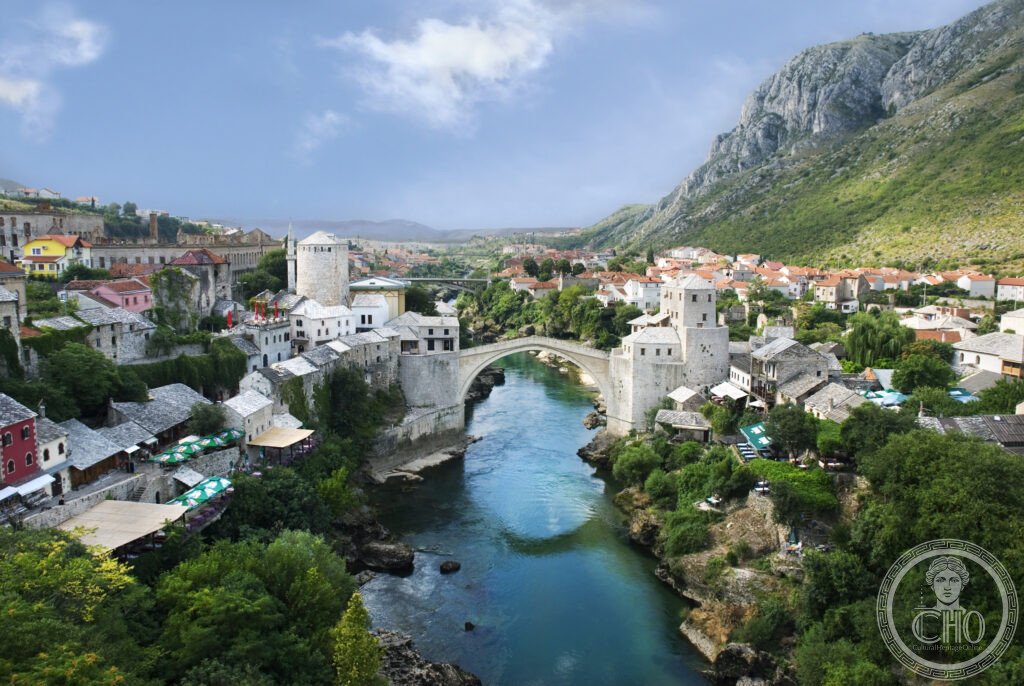
The Stari Most of Mostar is the most emotionally charged historic monument in the Balkans and the most powerful symbol of post-war cultural reconstruction in Europe. This Ottoman arch bridge of extraordinary elegance was built in 1566 and deliberately destroyed by forces of ethnic nationalism in 1993. It was rebuilt in 2004 using the same stone and the same techniques as the original, transforming a war crime into an act of cultural reconciliation that stands as the world’s most important example of heritage reconstruction.
At a glance
The Old Bridge Area of the Old City of Mostar (UNESCO WHS 2005) comprises the Stari Most and the cluster of Ottoman and Mediterranean-style buildings in the old city core on both banks of the Neretva at the bridge. It is located in southern Bosnia and Herzegovina, in the Herzegovina region, approximately 130 km south-west of Sarajevo. The city takes its name from the bridge: “Mostar” derives from the South Slavic word “most” (bridge) and “stari” (old). The city has been a crossing point on the Neretva since at least the medieval period, and the Ottoman bridge replaced an earlier suspension bridge. The old city on both banks of the Neretva, including the Kujundžiluk (Coppersmiths’ Street) on the east bank, the tower of Koski Mehmed-Pasha Mosque on the east bank, and the Tara Tower and Helebija Tower at the bridge ends on the west bank, retains a large portion of its Ottoman urban fabric despite the destruction of the 1992–1996 Bosnian War. The most visible and lasting legacy of the war in Mostar is the division of the city: the east bank is predominantly Bosniak (Bosnian Muslim), the west bank is predominantly Bosnian Croat. The two communities use different currencies (Bosnian mark and Euro), different schools, different telephone networks, and different football clubs. The bridge physically connects the two sides of the river, but the social and institutional division of the city remains one of the most intractable post-war legacies in the former Yugoslavia.
Key facts
- The construction of the Stari Most: the supreme achievement of Ottoman stone bridge engineering. The Stari Most (the Old Bridge) was commissioned by the Ottoman Sultan Suleiman the Magnificent and designed and built by Mimar Hayruddin, a student of the great court architect Mimar Sinan, who designed the Süleymaniye Mosque in Istanbul and hundreds of other buildings across the Ottoman Empire. Construction ran 1557–1566. The bridge replaced an earlier wooden suspension bridge; the “old bridge” in the town name dates to this earlier structure. The tenelija limestone used for the construction is a local stone from the quarries above the city, the same material used for the Roman mausoleum at Diocletian’s Palace in Split, also built with the same stone. The stone is so soft when freshly quarried that it can be cut with a hand saw; it hardens and strengthens as it loses moisture, a process that takes approximately 5 years to complete. By the time the bridge was complete, the stone had the compressive strength of granite. The arch was the widest single-span stone arch in the Ottoman Empire at the time of construction. The mathematical solution for the arch geometry was so sophisticated that it was attributed in local tradition to sorcery. The proportions of the arch are deliberately designed to appear circular from the river bank, since the approach angle creates an optical illusion of circularity, while the actual arch is slightly pointed, a Gothic arch rather than a Roman semicircle.
- The destruction and reconstruction: the most important cultural reconstruction project of the late 20th century. The Stari Most was deliberately destroyed on 9 November 1993 by the Croatian Defence Council (HVO) using anti-tank cannon rounds, approximately 60 direct hits over two days; the bridge endured for two days before collapsing. The destruction was ordered by Croatian Bosnian military commander Slobodan Praljak, who was subsequently convicted of war crimes by the International Criminal Tribunal for the former Yugoslavia (ICTY) and famously swallowed poison in the courtroom at the moment of sentencing in 2017, dying shortly after. UNESCO and the World Monuments Fund led the reconstruction project (2002–2004). The same tenelija limestone was quarried from the original quarry, and the original Ottoman construction techniques, including the self-tensioning arch system, were used; specialist craftsmen were trained in traditional stone cutting methods. The bridge was reopened on 23 July 2004 in a ceremony attended by heads of state from the region as a symbol of post-war reconciliation. UNESCO inscribed it as a World Heritage Site in 2005, one year after the reopening.
- Bridge diving: the most spectacular traditional athletic competition in the Balkans. The Mostari, the traditional Mostar bridge divers, have practised the competition, skakanje s Starog mosta, “jumping from the Old Bridge”, since the bridge was built in the 16th century. A competition is held annually in July, the Stari Most Diving Competition, organised by the Mostar Diving Club, founded 1664, one of the oldest sporting clubs in the world. Competitors dive 21 metres into the Neretva; the water is approximately 3 metres deep at the diving point in summer, and the temperature is approximately 12°C, a major part of the challenge. The dive is a headfirst plunge, not a feet-first jump, and the diver must enter the water in an exact vertical posture to avoid injury. The competition attracts tens of thousands of spectators, and divers also perform unofficial dives for tourists throughout the summer for cash.
- Heritage: UNESCO World Heritage Site, Old Bridge Area of the Old City of Mostar, inscribed 2005.
- GPS: 43.3375° N, 17.8148° E.
History
Mostar was a medieval crossing point on the Neretva. The Ottoman bridge was commissioned by Suleiman the Magnificent and built by Mimar Hayruddin (1557–1566). The city grew as an Ottoman commercial centre; the čaršija (bazaar) was one of the most important in Herzegovina. Austrian Habsburg rule followed (1878–1918), then Yugoslavia (1918–1992). The Bosnian War (1992–1996) brought the siege of Mostar by Serb forces in 1992, followed by the Croat-Bosniak conflict of 1993–1994, and the destruction of the bridge on 9 November 1993. The Washington Agreement (1994) ended the Croat-Bosniak fighting but left the city institutionally divided; the Dayton Agreement (1995) ended the war. The bridge was reconstructed 2002–2004, and UNESCO inscribed it as a World Heritage Site in 2005. The city remains divided along ethnic lines in 2026, with separate Bosniak and Croat institutions still operating in many sectors of public life.
What you see
The approach to the bridge from the Kujundžiluk, the coppersmiths’ street, the main cobblestone approach from the east bank, with stalls of copper and silver goods, hand-embroidered textiles, and local crafts, leads to the bridge platform. The bridge itself is 29 m long and 4 m wide. The surface is the original cobblestones, heavily polished by 500 years of foot traffic before the destruction; the reconstruction uses the same cobblestone pattern, and they are extremely slippery in wet or cold weather, so exercise caution when crossing. The Tara Tower, at the west (Croat) end of the bridge, is one of the two original toll towers built with the bridge, and the Mostar Diving Club maintains its headquarters here. The Helebija Tower, at the east (Bosniak) end, is now a small museum. The Koski Mehmed-Pasha Mosque, 150 m east of the bridge, is a 17th-century mosque with a balcony on the minaret that gives the finest view of the bridge from any point in the city. The Kajtaz House is a complete 16th-century Ottoman residential house with original interiors, the most important example of Ottoman domestic architecture in Bosnia.
Practical information
- Getting there: Mostar is 130 km south-west of Sarajevo, 2h by road, or 2h 30 min by train on the Sarajevo–Ploče line, one of the most scenic railway journeys in the Balkans, passing through the Neretva canyon. From Dubrovnik it is 160 km north-east, 2h 30 min by road, the most popular day trip from Dubrovnik. From Split it is 190 km north, 3h by road through the Dalmatian hinterland. There is no airport in Mostar; the Mostar Airport handles a small number of charter and seasonal flights, and the nearest international airports are Dubrovnik (DBV; 160 km) and Split (SPL; 190 km). Most visitors approach by road or by the Sarajevo–Ploče train.
- Context for visiting: the human dimension of the war damage is the most important thing to understand before visiting Mostar. The old city of Mostar was almost entirely destroyed during the siege of 1992, by Serb forces, and the Croat-Bosniak conflict of 1993–1994; the west bank was heavily damaged and the east bank was devastated. The buildings you see in the old city today are largely reconstructed after the war, and the Stari Most is the symbolic centrepiece of this reconstruction. The bullet holes and shrapnel damage visible on many buildings outside the UNESCO-reconstructed core are real; they are not preserved for dramatic effect but because the owners have not had the resources to repair them. The memorial to Bosniak victims in the east-bank cemetery, the Šehitluci war cemetery, immediately visible from the Kujundžiluk approach to the bridge, should be visited as part of any serious engagement with Mostar.
- The diving show: genuine and not primarily for tourists. The daily diving show at the Stari Most sees the Mostari divers jump from the bridge for a collected fee of approximately EUR 25–30. The divers collect money from the crowd, and when enough is collected, the dive takes place; it can take 20–45 min to collect enough, and the wait is part of the experience. The traditional competitive annual diving event takes place in late July, when the divers enter the 12°C Neretva headfirst from 21 metres. The technique is visible from both banks and from the bridge itself; photographing from the east-bank balcony of the Koski Mosque is the best angle for the dive.
Getting there
Train or road from Sarajevo (2h–2h 30 min). Road from Dubrovnik (2h 30 min). No direct international flights. GPS: 43.3375, 17.8148.
Nearby
- Kravice Waterfalls — 50 km south-west of Mostar, 1h by road. This is the most beautiful inland waterfall in Bosnia and Herzegovina. Kravice is a semicircular canyon waterfall on the Trebižat River, approximately 25 m high and 120 m wide. The pool below the falls is clear enough to swim in, and swimming is allowed and popular in summer. The spray from the falls creates a permanent rainbow in the afternoon light. The surrounding vegetation, beech forest, wild figs, pomegranates, gives the canyon a southern European rather than Dinaric character. It is much less known internationally than Plitvice but comparable in immediate visual impact. The site has very limited facilities, a parking area and a few snack stalls, so arriving early morning is essential in summer to avoid the coaches.
- Sarajevo — 130 km north-east of Mostar, 2h 30 min by train. This is the most historically complex city in the Balkans and the city where World War I began. Sarajevo has a population of approximately 340,000. The Baščaršija is the Ottoman old bazaar, the covered market streets, with the Sebilj fountain, the most atmospherically complete Ottoman commercial district in the Balkans outside Istanbul and Skopje. The Assassination Spot, the Latin Bridge, at the corner of Appel Quay and Franz Josef Street, is the spot where the Archduke Franz Ferdinand of Austria and his wife were shot by Gavrilo Princip on 28 June 1914; a plaque marks the spot, and the Sarajevo 1914 Museum, next to the Latin Bridge, is the most important museum on the assassination and the lead-up to World War I in the world. The Gazi Husrev-beg Mosque (1531) is the most important Ottoman mosque in the Balkans outside North Macedonia. The destroyed Holiday Inn is the yellow building on Sniper Alley, the boulevard on which Sarajevo was systematically sniped from the surrounding mountains during the 1992–1995 siege, the longest siege of a capital city in the history of modern warfare: 1,425 days, approximately 14,000 killed, with the city remaining under siege from Serbian forces for 44 months. The tunnel museum, the Tunnel of Hope, at Butmir, preserves the 800-metre tunnel built under the Sarajevo airport in 1993 to bring food, medicine, weapons, and people in and out of the besieged city.
- Blagaj Tekke — 12 km south-east of Mostar, 20 min by road. This is the most dramatic dervish monastery setting in the Balkans. Blagaj is a village in the Neretva valley, with the Bektashi dervish monastery (tekke) built in the 16th century directly at the source of the Buna River, which emerges from a sheer 200-metre limestone cliff at the rate of approximately 43 cubic metres per second. The monastery, a two-storey timber Ottoman building with a prayer room and dervish cells, sits on a rock ledge between the cliff and the spring. The spring is crystal clear, as the water comes directly from the karst system without surface contamination. The setting, the rushing spring, the sheer cliff, the Ottoman building, the reflections in the still pool before the spring, and the beech forest on the cliff above, is the most dramatically beautiful natural architecture site in Bosnia and Herzegovina.
Sources
- Wikipedia, Stari Most; Old Bridge Area of the Old City of Mostar; Slobodan Praljak, accessed June 2026.
- UNESCO, Old Bridge Area of the Old City of Mostar, WHS reference 946rev, inscribed 2005.
- Dijana Hadžimuhamedović, Waiting for Elijah: Time and Encounter in a Bosnian Landscape, Berghahn Books, 2019.
Find it on the map
See this place and what’s around it →📷 Become a Cultural Heritage Online photographer
Share your photos of places: they stay published under your name as the author. The more they're seen, the more you get noticed — and soon a contest will reward the most appreciated photos.
Log in or sign up free to add a photoIs this page about you?
This page is read by travellers and heritage enthusiasts who find it on Google. Tell us how you are connected to this place and we will take it from there.