
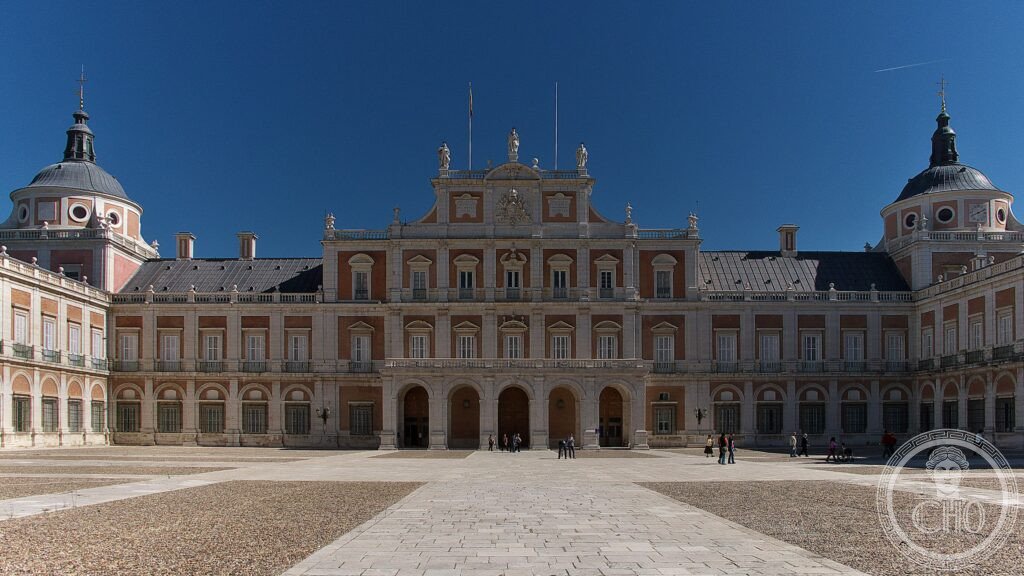
The most complete royal landscape in Spain and the place that inspired one of the most famous pieces of orchestral music ever written. The Aranjuez Cultural Landscape encompasses the Royal Palace, its Baroque gardens, and the surrounding irrigated agricultural land along the Tagus River at Aranjuez, a royal site used by the Spanish monarchs as their spring residence from the 16th century and the setting for Joaquín Rodrigo’s Concierto de Aranjuez (1939).
At a glance
Aranjuez (population approximately 60,000; 47 km south of Madrid; accessible from Madrid Atocha station in 45 minutes by Cercanías train) occupies the confluence of the Tagus (Tajo) and Jarama Rivers, creating an exceptionally fertile and well-watered oasis on the dry Castilian Meseta. The site was developed as a royal hunting ground and agricultural estate by the Habsburg kings (Carlos I and Felipe II), with the current Palace (a large Baroque structure with classical French-influenced gardens) built by the Bourbons in the 18th century. The cultural landscape designated by UNESCO (WHS reference 1044; inscribed 2001) includes: the Royal Palace (the central building; built 1752–1771; the palace interior includes the famous Chinese Porcelain Room, the Smoking Room in Moorish Revival style, and the State Apartments). The gardens (the Jardín de la Isla on the Tagus island; the Parterre in formal French style in front of the palace; and the Jardín del Príncipe, the longest English landscape garden in Spain, stretching 4 km along the Tagus). The Casa del Labrador (the Neoclassical “Peasant’s House” built for Carlos IV in 1794 in the Jardín del Príncipe; the most extravagantly decorated royal room in Spain — the Platinum Room and the Billiard Room with rare marble tables). And the historic town of Aranjuez (with its regular grid street plan, unchanged since the 18th-century Bourbon reconstruction, and its Casa de Marinos/Royal Barge House with the surviving royal barges).
Key facts
- The Concierto de Aranjuez: the most famous Spanish orchestral work in the world. Joaquín Rodrigo (1901–1999; born in Sagunto, Valencia; nearly blinded at age 3 by diphtheria; studied in Paris under Paul Dukas in the 1930s; composed the Concierto in 1939, the year of the end of the Spanish Civil War and the beginning of the Franco regime) composed the Concierto de Aranjuez for guitar and orchestra in 1939. The work is structured in three movements, with the second movement (Adagio) being the most celebrated: its opening melody, played by the oboe over a sparse guitar accompaniment, is one of the most recognizable melodies in the orchestral repertoire (later adapted as the jazz standard “Sketches of Spain” by Miles Davis in 1960; and as the pop song “Perhaps Love” by John Denver; the tune has been used in over 100 films and television programmes). Rodrigo always maintained that the Concierto was inspired by his honeymoon in Aranjuez in 1933 and by the memory of the gardens and the scent of the flowers. The Concierto was dedicated to his wife Victoria Kamhi and remains the most performed and recorded guitar concerto in history. The Rodrigo family home in Madrid is now a museum (Calle Rodrigo de Vivar, Madrid).
- The gardens of Aranjuez: the most extensive royal garden complex in Spain. The Aranjuez gardens are divided into three distinct zones, each with a different historical origin and style: the Jardín de la Isla (the oldest; created by Felipe II in the 16th century on a natural island in the Tagus; formal Renaissance layout with fountains, box hedges, and ancient plane trees; the “Fountain of Bacchus” and the “Fountain of Neptune” are the most spectacular; the island setting gives it an intimacy the other gardens lack). The Parterre (the French formal garden in front of the palace; laid out by Felipe V in the early 18th century; the symmetrical pattern of box hedges, roses, and gravel paths, with the Tagus visible beyond; the “Fountain of Narcissus” in the centre). And the Jardín del Príncipe (the English landscape garden, 4 km long, running east from the palace along the Tagus; created for the future Carlos IV in the 1760s; designed in the “natural” English style with serpentine paths, artificial lakes, and the Casa del Labrador at the far end).
- The strawberries and asparagus of Aranjuez: the continuation of royal agriculture. The fertile Tagus river flood plain at Aranjuez was developed by the Spanish monarchy as an intensive agricultural estate, with irrigation channels feeding the alluvial soils. The Aranjuez Fresa (strawberry; Fragaria × ananassa; grown in the local sandy-loam soil in the traditional manner with mulch of pine straw) is one of the most prized seasonal products in Spain. The Fresa de Aranjuez has a Protected Geographical Indication (PGI). The strawberry season (April–June) coincides with the spring court season when the royal family traditionally used the palace. The Aranjuez white asparagus (also PGI) and the Aranjuez pear are the other traditional products. The Fresa season is also when the Tren de la Fresa (“Strawberry Train”) runs from Madrid Atocha to Aranjuez (a heritage steam train decorated with 1920s coaches; the journey includes strawberry tastings served by costumed hosts; typically operates on weekends from May to early June).
- Heritage: UNESCO World Heritage Site, Aranjuez Cultural Landscape, inscribed 2001.
- GPS: 40.0364° N, -3.6035° W.
History
The site was a royal hunting ground under the medieval Castilian kings. Carlos I (the Holy Roman Emperor Charles V) developed the first palace at Aranjuez in the 1540s. Felipe II (who built El Escorial) continued and expanded the gardens. The palace burned in 1665 and was rebuilt. Felipe V commissioned the current Baroque palace in the early 18th century. The current building was largely completed by Fernando VI and Carlos III in 1752–1771. The Mutiny of Aranjuez (March 17–19, 1808) took place in the gardens. A revolt by supporters of Fernando VII against the prime minister Godoy, forcing Carlos IV to dismiss Godoy and setting off the chain of events that led to the Napoleonic invasion. The French occupied the palace during the Peninsular War (1808–1814). The Tren de la Fresa heritage railway to Aranjuez opened in 1851 (the first railway in the Iberian Peninsula after the Lisbon–Carregado line). UNESCO WHS 2001.
What you see
The Palace interior (guided tour required; approximately 1h 30 min; the Chinese Porcelain Room, where the entire wall surface is covered in Chinese-influenced tiles from the Real Fábrica del Buen Retiro, is the most extraordinary room; the Smoking Room — a tiny Moorish Revival fantasy chamber created in 1851 in exact imitation of the Alhambra — is the most surprising). The Parterre garden (free access; the classic postcard view of the palace facade from the garden). The Jardín de la Isla (small entrance fee; the most intimate garden; best in spring when the rose hedges are in bloom). The Jardín del Príncipe (free access to most of the garden; the Casa del Labrador at the end requires a separate ticket and guided tour — the Platinum Room and the Billiard Room are worth it). And the Casa de los Marinos (the Royal Barge House; the surviving 18th-century royal barges are remarkable for the level of craft and gilding).
Practical information
- Admission: Royal Palace interior: approximately €9. Gardens (Parterre and Jardín de la Isla): approximately €5 combined. Jardín del Príncipe (exterior): free. Casa del Labrador: approximately €7. Open Tuesday–Sunday (closed Monday). Hours vary by season (9am–6pm in winter, 9am–8pm in summer; verify on the Patrimonio Nacional website before visiting). The gardens are particularly crowded on spring weekends (especially during the Fresa season in May).
- Getting there: from Madrid Atocha station: 45 minutes by Cercanías train C-3 (the most comfortable and traffic-free approach; trains run approximately every 30 minutes; adult round trip approximately €7). By car from Madrid: 47 km south via the A-4 motorway (toll; approximately 45 minutes in normal traffic; the road passes through the table-wine country of the Manzanares river). By car the site is easily combined with the Royal Monastery of El Escorial (70 km north-west) in a “royal circuit” day trip from Madrid. The Tren de la Fresa heritage railway (weekends only, May–June; departs Madrid Atocha; the costumed hosts serve strawberries on the train; the experience is theatrical rather than efficient — the journey is 2h each way).
- Toledo combination: Aranjuez is 40 km north of Toledo (30 min by car; Toledo is a UNESCO WHS city; see separate CHO place card for the Cathedral, the Alcázar, and El Greco). The combination of Aranjuez (morning; the palace and gardens) and Toledo (afternoon and evening; the Cathedral, the Synagogue of Santa María la Blanca, El Greco’s house and the Church of Santo Tomé with the “Burial of the Count of Orgaz”) makes the most culturally dense single-day excursion from Madrid possible.
Getting there
From Madrid Atocha by Cercanías train C-3 (45 min, every 30 min). By car: 47 km south via A-4 (45 min). GPS: 40.0364, -3.6035.
Nearby
- Toledo. 40 km south of Aranjuez (30 min by car). The most culturally rich small city in Spain and one of the most important medieval cities in the world. Toledo was the capital of the Visigothic Kingdom (from 542 to 711), the capital of Castile-La Mancha, and the “City of the Three Cultures” (the place where Christians, Jews, and Muslims lived and worked together most productively in medieval Iberia; the School of Toledo was the main centre for the translation of Arabic and Greek scientific and philosophical texts into Latin in the 12th–13th centuries, which is how most of ancient Greek knowledge entered medieval Christian Europe). See separate CHO place card for Toledo. UNESCO WHS 1986.
- El Escorial Monastery and Royal Palace. 70 km north-west of Aranjuez (1h by car). The most grandiose royal building in Spain and the principal residence of Felipe II. The Real Sitio de San Lorenzo de El Escorial (begun 1563; completed 1584; architect Juan de Herrera and Juan Bautista de Toledo; the austere Herreran style, characterised by severe grey granite facades, slate roofs, and the almost total absence of decoration, was named after this building) is the largest Renaissance building in the world in terms of floor area (approximately 33,000 m²; 206 metres × 161 metres). It combines a royal palace, a monastery, a mausoleum for the Castilian kings, a basilica, a library (with one of the finest collections of medieval illuminated manuscripts in Spain — the illuminated manuscripts from the Biblia de Alba, a 15th-century Spanish Hebrew-Castilian Bible, are the finest; visitors see only a small selection), and a college. The Royal Pantheon (beneath the basilica; a domed circular chamber in black marble and gilt bronze) contains the bodies of almost all the Spanish monarchs from Carlos I to Alfonso XII. UNESCO WHS 1984.
- Consuegra Windmills and Don Quixote country. 70 km south-east of Aranjuez (1h by car; the La Mancha plateau; the classic landscape of Cervantes). The 11 white windmills on the ridge above Consuegra (La Mancha, Castile; one of the most photographed landscapes in Spain) and the ruined Templar castle alongside them are the primary scenic destination in the Don Quixote literary landscape of La Mancha. The windmills still function (guided tours inside one windmill during the annual saffron festival in October; the Consuegra saffron harvest is one of the finest in Europe). The landscape of flat red earth, sunflowers, and saffron crocus fields that Cervantes used as the setting for Don Quixote’s adventures extends in all directions from Consuegra across the great central plateau.
Sources
- Wikipedia, Aranjuez. Royal Palace of Aranjuez. Concierto de Aranjuez. Joaquín Rodrigo, accessed June 2026.
- UNESCO, Aranjuez Cultural Landscape, WHS reference 1044, inscribed 2001.
- Patrimonio Nacional, Real Sitio y Villa de Aranjuez, official website accessed June 2026.
Find it on the map
See this place and what’s around it →📷 Become a Cultural Heritage Online photographer
Share your photos of places: they stay published under your name as the author. The more they're seen, the more you get noticed — and soon a contest will reward the most appreciated photos.
Log in or sign up free to add a photo