
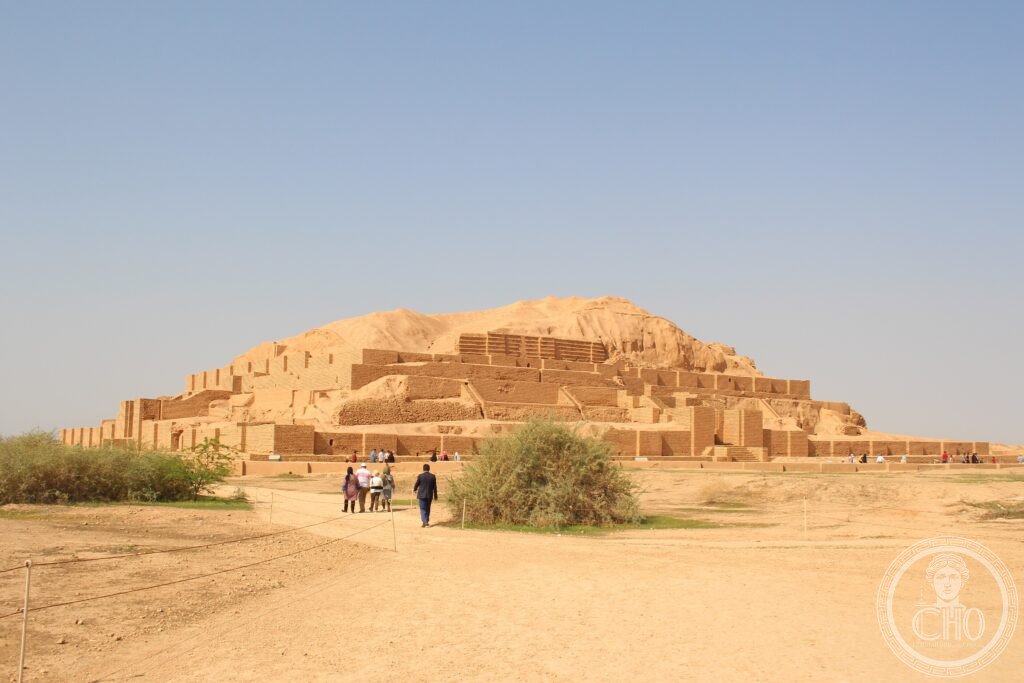
The best-preserved Elamite ziggurat and the oldest standing religious monument in Iran. Chogha Zanbil (ancient Dur Untash, the “City of Untash”), built around 1250 BC by the Elamite king Untash-Napirisha in what is now Khuzestan Province in south-western Iran, is the most complete surviving example of Elamite sacred architecture and one of the few ziggurats ever built outside the Mesopotamian heartland. It was the first Iranian site to be placed on the UNESCO World Heritage List in 1979.
At a glance
Chogha Zanbil lies 40 km south-east of the ancient city of Susa (Shush) and 80 km north of Ahvaz (the provincial capital of Khuzestan) in the flat alluvial plain of south-western Iran. The climate is extremely hot in summer (July average highs of 47°C) and the site is best visited in the cooler months (October–March). The nearest city for accommodation is Ahvaz (80 km; approximately 1h 30 min by car). The ziggurat stands at the centre of three concentric walled enclosures covering approximately 100 hectares in total. The innermost enclosure (containing the ziggurat) is 400 × 400 metres. The outermost enclosure (the outer city wall) was never completed and is the most visible evidence that the city was abandoned before it was fully finished. The name “Chogha Zanbil” is Bakhtiari Persian for “basket mound” (chogha = mound or hill, zanbil = basket), describing the shape of the ziggurat viewed from above.
Key facts
- King Untash-Napirisha and the Elamite Civilisation: the most ambitious building project of the Elamite kingdom. The Elamite civilisation (c. 3200–539 BC) occupied the territory of modern Khuzestan (the Iranian lowlands, corresponding to ancient Susiana) and the Zagros foothills. Its capital was Susa (Shush), one of the oldest cities in the world (inhabited continuously from c. 4200 BC). The Elamites were the principal rivals of Mesopotamian civilizations (Sumer, Akkad, Babylon, Assyria) and alternately fought, traded with, and influenced them throughout the Bronze Age. King Untash-Napirisha (r. c. 1275–1240 BC), the most powerful ruler of the Middle Elamite period, built the city of Dur Untash (“City/Fortress of Untash”) as a completely new religious capital. The city was intended as a shared sacred space for the gods of both the Elamite highlands and the Mesopotamian-influenced lowlands, with a large temple dedicated to the divine couple Inshushinak and Napirisha (the two principal Elamite deities) at the centre. The city was largely abandoned after the death of Untash-Napirisha and appears never to have been fully completed.
- The ziggurat (the “Tower Temple”): the best-preserved ziggurat in the ancient Near East. The Chogha Zanbil ziggurat is of a type specific to Elam (as opposed to the Mesopotamian ziggurat type). The Mesopotamian ziggurats (such as the famous one at Ur) were built as solid terrace platforms supporting a small temple at the top, constructed layer by layer from the bottom up. The Elamite ziggurat at Chogha Zanbil was constructed differently: the lowest level was built as a complete walled enclosure, then a second complete walled enclosure was built inside the first and on top of it, and so on for each successive level. This construction method means that each level is a structurally independent building rather than a platform, which is why the Chogha Zanbil ziggurat has survived comparatively well. Three of the original five levels survive to the current height of approximately 25 metres (reduced from an estimated original height of 52 metres). The exterior is built entirely of sun-dried mud brick faced with kiln-fired brick, with elaborate terracotta glazed tile decoration and inscribed bricks (the name of Untash-Napirisha appears on the inscribed bricks that line every third course of the facade). The four entrance stairways to the lowest level are among the best-preserved examples of Elamite monumental stone staircase design.
- The 22 temples and the three enclosures: the religious city of Dur Untash was designed to accommodate multiple cults within a single sacred precinct. Beyond the inner enclosure (containing the ziggurat), the middle enclosure contained 13 temples dedicated to the major deities of the Elamite pantheon: temples of Inshushinak (the city god of Susa), Napirisha (the supreme deity of the Elamite highlands), Kiririsha (the great goddess), Adad (the Mesopotamian storm god, showing Mesopotamian religious influence), Nin-Hursag, Simut, Ishnikarab, and others. Some of the temples in the middle enclosure have yielded the most important examples of Elamite glazed brick decoration (polychrome terracotta panels with human and divine figures) ever found. The outer enclosure contained the royal palace complex and residential areas for the temple priests and administrators. Water was brought to the site by a sophisticated underground aqueduct system (qanat) from the Dez River, approximately 40 km away.
- The destruction by Assurbanipal (640 BC) and the exceptional preservation: the paradox of Chogha Zanbil. The Assyrian king Assurbanipal destroyed Susa in 640 BC after a decade of wars against Elam. Chogha Zanbil was looted and partially burned. However, because the city was largely abandoned before completion and was not rebuilt after the Assyrian destruction, it was covered by the accumulation of desert dust and soil over the following 25 centuries, preserving the mud-brick structures far better than any inhabited city would have been. The site was first identified from aerial photographs by a British oil company geologist (E.A. Speiser) in 1935. The first systematic excavations were conducted by the French archaeologist Roman Ghirshman from 1951 to 1962. Ghirshman’s excavations uncovered the ziggurat, the temples, and the palace complex and established Chogha Zanbil as one of the best-preserved Bronze Age cities in the world. It was the first Iranian site to be inscribed on the UNESCO World Heritage List, in 1979.
- Heritage: UNESCO World Heritage Site, Tchogha Zanbil, inscribed 1979 (first Iranian UNESCO WHS).
- GPS: 32.0097° N, 48.5218° E.
History
Dur Untash was founded c. 1250 BC by Untash-Napirisha. Construction of the ziggurat and the 22 temples began immediately. The city was not completed at the time of Untash-Napirisha’s death (c. 1240 BC). His successors partially occupied the royal quarter but did not complete the outer enclosure. The Assyrian king Assurbanipal destroyed the Elamite cities including Susa and Dur Untash in 640 BC. The site was abandoned and buried under desert sedimentation. Identified from aerial photography 1935. Excavated by Roman Ghirshman 1951–1962. UNESCO inscription 1979. Subsequent excavations by Iranian archaeologists continue.
What you see
The access road from Susa (40 km) passes through flat agricultural land before the three concentric walls of the outer enclosure become visible. The site entrance is through the outer gate (reconstructed). The approach through the middle enclosure gives views of the temple ruins and the scattered inscribed bricks (reading “I, Untash-Napirisha…” on the edge of every third course). The ziggurat dominates the innermost enclosure. The four monumental stairways (one on each face) are accessible. The western stairway is the best-preserved. The polychrome terracotta animal-guardian figures at the base of the ziggurat (the bronze horns and bronze winged animals on either side of the main entrance stairway) are original Elamite terracotta work. The site museum (small, inside the outer enclosure) displays the most important objects found in the excavations (glazed terracotta panels, cylinder seals, jewelry, inscribed objects).
Practical information
- Admission and opening hours: approximately 500,000 Iranian Rials (check current rate given Iranian currency volatility; approximately €2–6 at tourist rates). Open daily 8am–5pm (winter), 7am–6pm (summer). The site is very remote with no shade. Bring water, sunscreen, and a hat. Temperatures exceed 45°C from May to September. The ideal visiting season is November to March. A local guide (available at the site entrance) is strongly recommended for the full cultural and archaeological context. Guided tours in Persian (with some English capability) can be arranged. The journey from Ahvaz (80 km, 1h 30 min) or from Susa (40 km, 50 min) on the main highway. No food or water is sold at the site.
- Getting there: most visitors approach from Ahvaz (the provincial capital, with flights from Tehran, Mashhad, and other Iranian cities). From Ahvaz take the main road north towards Dezful/Susa. After approximately 40 km take the signed turn-off to the east for Chogha Zanbil. The total distance from Ahvaz to Chogha Zanbil is approximately 80 km. From Susa (the other major site in Khuzestan) Chogha Zanbil is 40 km south-east on a signed road. The combination of Susa + Chogha Zanbil is the standard day-trip circuit from Ahvaz. Iranian visas and the standard Turkmenistan-Iran double security briefing apply to all foreign visitors. Women must wear hijab throughout Iran.
- The Khuzestan archaeological circuit: Chogha Zanbil is one of three major UNESCO WHS in Khuzestan Province: Susa (Shush; ancient Susa, capital of the Elamite and later Achaemenid Empire; the Achaemenid palace of Darius the Great and the Palace of Artaxerxes II are at Susa; the tomb of the prophet Daniel is venerated here in a modern shrine; UNESCO WHS as part of the “Susa” inscription, 2015), and the Shushtar Historical Hydraulic System (Shushtar; a complex of canals, water mills, and dams built in the Sassanid period, c. 3rd century AD; UNESCO WHS 2009; the most complete surviving Sassanid-era water engineering system in Iran).
Getting there
From Ahvaz (80 km north, 1h 30 min by car). From Susa/Shush (40 km south-east, 50 min). Nearest airport: Ahvaz. GPS: 32.0097, 48.5218.
Nearby
- Susa (Shush). 40 km north-west of Chogha Zanbil (50 min by car). One of the oldest cities in the world and the capital of the Elamite Empire. Susa (ancient Shush; modern Shush) was one of the most important cities of the ancient Near East. Continuously inhabited for at least 6,000 years (from approximately 4200 BC). The Achaemenid Persian kings (Darius I, Xerxes, Artaxerxes) maintained their principal winter residence here (the Apadana of Susa, where Darius I built a great palace described in the inscriptions as bringing materials from all parts of his empire — cedar from Lebanon, gold from Sardis and Bactria, lapis lazuli from Sogdia, ivory from Ethiopia — is partially excavated). The Code of Hammurabi (one of the earliest known legal codes; the stele is now in the Louvre, Paris) was found at Susa during French excavations in 1901. The tomb of the Prophet Daniel (venerated by Jews, Christians, and Muslims) is in the modern city. The Louvre excavated Susa from 1884 to 1979 (one of the longest continuous archaeological excavations in history) and the site museum in Tehran holds the key finds. UNESCO WHS (Susa) 2015. See separate CHO place card.
- Pasargadae. 500 km north-east of Chogha Zanbil (5h by car via Shiraz). The first dynastic capital of the Achaemenid Persian Empire and the tomb of Cyrus the Great. Pasargadae (founded c. 546 BC by Cyrus II, “the Great”, founder of the Achaemenid Persian Empire) was the first planned Persian imperial capital (preceding Persepolis by approximately 30 years). The principal surviving monument is the Tomb of Cyrus the Great (Mausoleum of Cyrus; c. 530 BC; a plain limestone chamber raised on a stepped platform of six courses; the original inscription above the chamber door — reported by Greek sources as “O man, whoever you are and whenever you come, for I know that you will come, I am Cyrus, who gave the Persians their empire; do not, therefore, begrudge me this little earth that covers my bones” — has not survived). Alexander the Great visited the tomb after the conquest of Persia and reportedly wept. UNESCO WHS 2004. See separate CHO place card.
- Persepolis. 600 km north-east of Chogha Zanbil (6h by car via Shiraz). The ceremonial capital of the Achaemenid Persian Empire (see separate CHO place card, UNESCO WHS 1979).
Sources
- Wikipedia, Chogha Zanbil. Untash-Napirisha. Elamite civilization, accessed June 2026.
- UNESCO, Tchogha Zanbil, WHS reference 113, inscribed 1979.
- Roman Ghirshman, Tchoga Zanbil (Dur-Untash), vol. I–IV, Paul Geuthner, Paris, 1966–1968.
- Wouter Henkelman, The Other Gods Who Are, Nederlands Instituut voor het Nabije Oosten, 2008 (Elamite religion).
Find it on the map
See this place and what’s around it →📷 Become a Cultural Heritage Online photographer
Share your photos of places: they stay published under your name as the author. The more they're seen, the more you get noticed — and soon a contest will reward the most appreciated photos.
Log in or sign up free to add a photo