
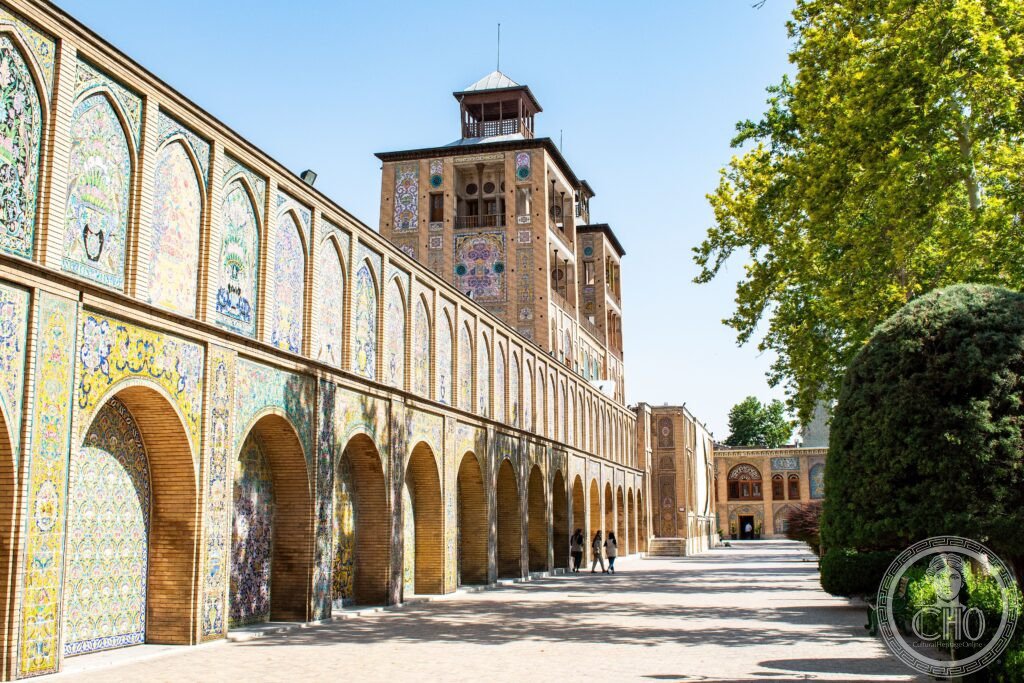
The most important royal palace of Qajar Iran and a uniquely Iranian response to the challenge of European modernity — the Golestan Palace (Rose Garden Palace), the principal residence and ceremonial centre of the Qajar shahs in Tehran from the late 18th to the early 20th centuries, combines traditional Persian architectural forms (iwan portals, mirror-tile decoration, garden pavilions, Persian tilework) with European Baroque and Rococo decorative elements absorbed by Naser al-Din Shah during his three trips to Europe, creating an architecturally unprecedented hybrid that is the definitive monument of 19th-century Iranian court culture.
At a glance
The Golestan Palace complex occupies approximately 5.7 hectares in the historic centre of Tehran (the Baharestan district, near the Iranian Parliament), enclosed within high walls that originally marked the northern edge of the 17th-century city of Tehran. The complex contains 17 palace buildings (palaces, reception halls, museums, and service buildings) arranged around a formal Persian garden (the Golestan, or Rose Garden). The most important buildings for visitors are the Marble Throne Hall (Takht-e Marmar), the Mirror Hall (Talar-e Aineh), the Ivory Hall (Talar-e Adj), the Brilliant Hall (Talar-e Borli–Numa), and the Museum of Gifts (with collections of Qajar royal gifts and state objects). The complex is open to visitors and is the most important single museum destination in Tehran.
Key facts
- The Marble Throne Hall (Takht-e Marmar, “Marble Throne”): the most politically significant space in the Golestan Palace and the site of the great ceremonies of the Qajar state — the Takht-e Marmar is an open-air iwan (vaulted porch) on the north side of the garden court, containing the famous Marble Throne (the name “Takht-e Marmar” refers to both the room and the throne); the throne (sometimes called the “Sun Throne” or “Naderi Throne”) is a raised marble platform approximately 3 metres long and 2 metres wide, made of yellow marble from Isfahan and decorated with 65 figures carved in bas-relief around its sides and back; it is claimed (without firm historical evidence) that Nader Shah of Persia sat here after returning from India with the looted Peacock Throne; the Qajar shahs received ambassadors, held coronations, and conducted the ceremonies of the Nowruz (Persian New Year) from this throne; Reza Shah Pahlavi (the founder of the Pahlavi dynasty) was crowned here in 1926, ending the Qajar era
- The Mirror Hall (Talar-e Aineh): the most visually extravagant room in the Golestan Palace and the masterpiece of the Iranian mirror-tile (aineh-kari) decorative tradition — the mirror-tile technique (aineh-kari) was developed in Persia in the 17th century as an adaptation of the European fashion for mirrored rooms (inspired by Versailles) to Persian materials and craftsmanship: instead of large mirror plates (which could not be manufactured at the required scale in Iran), Persian craftsmen used small convex mirror tiles (made from broken glass and polished metal fragments) set in plaster, creating a continuously reflective surface that scatters light in all directions; the Mirror Hall of the Golestan Palace (built under Fath Ali Shah, elaborated under Naser al-Din Shah with European crystal chandeliers) covers the ceiling and walls entirely in this material; the effect when lit by the chandeliers is of a glittering, faceted cave; the Mirror Hall was used for formal receptions and, later, as a throne room for smaller-scale ceremonies
- Naser al-Din Shah (r. 1848–1896) and the encounter with Europe: the most internationally connected of the Qajar shahs and the man most responsible for the current appearance of the Golestan Palace — Naser al-Din Shah made three official state visits to Europe (1873, 1878, 1889), visiting Britain, France, Germany, Austria-Hungary, and Russia; he was deeply impressed by European monarchy, court ceremony, art, and technology; he brought European craftsmen to Iran, imported European furniture and decorative objects (the Belgian crystal chandeliers of the Mirror Hall and the Brilliant Hall, the European oil paintings that fill the Golestan Palace collections), and ordered the enlargement of several palace buildings in a hybrid European-Persian style; he also introduced photography to Iran: he was given a camera during his first European trip and became an avid photographer; the Golestan Palace holds one of the most important collections of 19th-century Iranian photography, much of it taken by the Shah himself; Naser al-Din Shah was assassinated at the Shah Abdol-Azim shrine near Tehran on 1 May 1896 by Mirza Reza Kermani, a follower of the Islamic modernist reformer Jamal al-Din al-Afghani; his death set in motion the political crisis that led to the Constitutional Revolution (1905–1911) and ultimately the downfall of the Qajar dynasty
- The Brilliant Hall (Talar-e Borli–Numa): the finest ceremonial room of the late Qajar period, combining Persian and European decorative styles — the Brilliant Hall (also called the “Hall of Mirrors and Lights”) was built in the late 19th century and represents the most successful fusion of European Baroque interior design with Persian decorative arts in the Golestan Palace complex; Belgian crystal chandeliers alternate with mirror-tile decoration on the ceiling; the floor is covered with Persian carpet; the European-style oil portraits of Qajar shahs (in oil on canvas, a medium introduced to Iran under Fath Ali Shah) line the walls; the French-style neoclassical plasterwork on the cornices and door frames contrasts with the dense Persian arabesque tilework of the lower walls
- Heritage: UNESCO World Heritage Site, Golestan Palace, inscribed 2013
- GPS: 35.6808° N, 51.4208° E
History
A Safavid-period caravanserai and garden (the Chenar Garden) occupied the site from the 17th century; the Qajar dynasty chose Tehran as their capital in 1786 (under Agha Mohammad Khan Qajar, the founder of the dynasty); the Golestan Palace was built and modified continuously throughout the Qajar period (1789–1925); the principal Qajar buildings date from the reigns of Fath Ali Shah (1797–1834) and Naser al-Din Shah (1848–1896); Reza Shah’s coronation was held in the Marble Throne Hall in 1926; the Palace was used as a government building after the fall of the Qajar dynasty; it was opened as a museum in 1981 after the Islamic Revolution; UNESCO inscription 2013.
What you see
Enter from the main gate on the south (Baharestan Square side); the rose garden (Golestan; the rose is the national flower of Iran; the most fragrant time to visit is May–June when the garden roses are in bloom) is in the centre of the complex; the Marble Throne Hall (Takht-e Marmar) is on the north side of the garden (the most photographed space; the open-air iwan framing the throne against the garden background is the defining image of Qajar royal architecture); the Mirror Hall is in the north-west range (the most dazzling interior; visit in the afternoon when the chandeliers are lit against the maximum light from the garden); the Museum of Gifts (Kakheh Hedayaya) houses the collection of gifts presented to the Qajar court by foreign powers; the Photography Collection is housed in a separate building and covers the remarkable Qajar-period photography collection assembled by the court photographers and by Naser al-Din Shah himself.
Practical information
- Admission: approximately 500,000 Iranian Rials (equivalent varies; approximately €3–8 depending on exchange rate; note that Iran operates dual exchange rates and tourist-oriented pricing; check current admission at the time of visit); open daily except Monday, 9am–6pm; guided tours in English are available (book at the entrance); the palace is busiest at weekends and Iranian public holidays (Nowruz, 21 March, is the peak period when the palace is closed for national ceremonies); women visitors should follow Iranian dress code (headscarf and modest clothing required)
- Getting there: Tehran Metro: take Line 1 (north-south, red line) to Imam Khomeini station (the main interchange station in central Tehran; the palace is approximately 500 metres east of the station on Panzdah-e Khordad Street); by taxi from the Airport: approximately 30–45 min from Imam Khomeini International Airport (approximately 35 km south of the city centre) or approximately 20 min from Mehrabad Airport (7 km west of the centre; domestic flights only); note that driving and taxi services in Tehran are affected by severe urban congestion, especially during morning and evening peak hours
- Tehran museum circuit: the Golestan Palace anchors a circuit of the most important museums and historic sites of central Tehran: the National Museum of Iran (Muzeh-ye Melli-ye Iran; 500 metres south of the Golestan; the most important archaeological museum in Iran, covering prehistory through the early Islamic period; the key exhibits include the Salt Man of Zanjan, the pottery of the Sialk culture, and the Achaemenid-period gold objects); the Grand Bazaar of Tehran (extending south from the area of the Golestan Palace; the largest covered bazaar in the world, covering approximately 10 km of vaulted passages; founded in the Safavid period, expanded in the Qajar period; the caravanserais, mosques, and madrasas within the bazaar are architecturally important); and the Sa’dabad Palace Complex (in the northern hills of Tehran; the summer residence of the later Qajar and Pahlavi shahs; now a museum complex of 18 palaces in a forested park)
Getting there
Tehran Metro Line 1 to Imam Khomeini station (500m walk). By taxi from Imam Khomeini International Airport (35 km, 30–45 min). GPS: 35.6808, 51.4208.
Nearby
- Naqsh-e Jahan Square, Isfahan — 380 km south of Tehran (3h 30 min by bus, 2h 30 min by train); the greatest Islamic public space in the world and the supreme monument of Safavid architecture — the Naqsh-e Jahan Square (Image of the World Square; completed c. 1620 by Shah Abbas I) is one of the largest city squares in the world (560 × 160 metres) and is enclosed on all four sides by perfectly proportioned Safavid buildings: the Royal Mosque (Masjed-e Shah; the most magnificent mosque in Iran; built 1611–1629; the entrance portal is set at a 45° angle to the square to orient the prayer hall correctly toward Mecca), the Sheikh Lotfallah Mosque (the most refined and intimate mosque interior in Iran; built as the private mosque of the royal women’s apartments; the dome tiles shift in colour from cream at dawn to apricot at sunset), the Ali Qapu Palace (the monumental gateway-palace on the west side; the music room, with its extraordinary plaster niches cut in the shape of musical instruments, is the finest interior in the complex), and the Qaysarieh Portal (the entrance to the Isfahan Grand Bazaar); UNESCO WHS 1979; see separate CHO place card
- Persepolis — 870 km south of Tehran (7h by bus; 1h by plane); the greatest monument of the Achaemenid Empire and the most important pre-Islamic site in Iran — Persepolis (Takht-e Jamshid, “Throne of Jamshid”; founded c. 515 BC by Darius I; completed by Xerxes I and Artaxerxes I) was the ceremonial capital of the Persian Empire and the site of the great Nowruz (New Year) ceremony attended annually by delegations from all 28 satrapies of the empire; the terrace (460 × 300 metres) is covered with the remains of the Apadana (the audience hall; 36 columns, each 20 metres tall; the processional staircases with their carved reliefs of tributary nations are the most important sculptural ensemble of Achaemenid art), the Hall of a Hundred Columns (the largest single room at Persepolis), the Gate of All Nations (the ceremonial entrance), and the residential palaces; UNESCO WHS 1979; see separate CHO place card
- Takht-e Soleymān (Throne of Solomon) — 450 km north-west of Tehran (5h by car via Zanjan); the most important Zoroastrian fire temple in Iran and one of the most mysterious ancient sites in the Iranian plateau — Takht-e Soleymān (also known as Shiz) is a natural volcanic crater lake surrounded by a walled enclosure containing the ruins of a great fire temple (Azar Goshnasp, one of the three holy fires of Zoroastrianism, dedicated to warriors and kings; the Sasanid kings made a ritual pilgrimage to the temple on foot after their coronation to give thanks) and an Ilkhanid-period palace (built c. 1270 by the Mongol Il-Khan Abaqa, who was attracted by the site’s ancient prestige); the crater lake (its depth unknown; estimated at 100+ metres; the overflow feeds the sanctuary fountains; the water is warm and slightly mineralized) is a natural phenomenon of extraordinary visual power; UNESCO WHS 2003
Sources
- Wikipedia, Golestan Palace; Naser al-Din Shah Qajar; Qajar dynasty, accessed June 2026
- UNESCO, Golestan Palace, WHS reference 1422, inscribed 2013
- Abbas Amanat, Pivot of the Universe: Nasir al-Din Shah Qajar and the Iranian Monarchy, 1831–1896, University of California Press, 1997
- Sheila R. Canby, The Qajar Portraits, Azimuth Editions, 1998
Find it on the map
See this place and what’s around it →📷 Become a Cultural Heritage Online photographer
Share your photos of places: they stay published under your name as the author. The more they're seen, the more you get noticed — and soon a contest will reward the most appreciated photos.
Log in or sign up free to add a photoIs this page about you?
This page is read by travellers and heritage enthusiasts who find it on Google. Tell us how you are connected to this place and we will take it from there.