
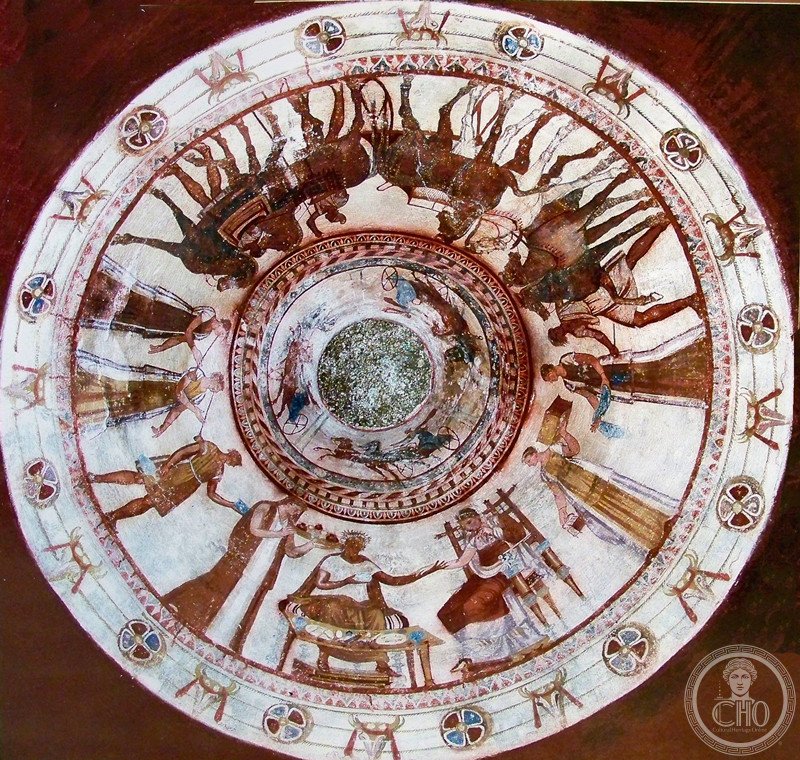
The finest Thracian painted tomb in the Balkans and one of the most important examples of 4th-century BC figurative painting in the entire ancient world — the Thracian Tomb of Kazanlak (Тракийска гробница край Казанлък), discovered in 1944 in the Valley of Roses in central Bulgaria, contains extraordinary fresco paintings of a Thracian aristocratic funeral feast that have survived 2,300 years in vibrant colour inside a sealed underground burial chamber; the ochre, terracotta, blue, and white pigments of the feasting couple, their attendants, their musicians, and their racehorses are among the most intact examples of Classical-era fresco painting outside Greece.
At a glance
Kazanlak (population approximately 40,000) is in the Valley of Roses (Розова долина), the long valley of the Tundzha River between the Balkan Mountains (Stara Planina) to the north and the Sredna Gora range to the south; this is the most important rose-growing region in the world (the Rosa damascena var. trigintipetala cultivar has been grown here commercially since the 17th century for rose attar/rose oil production). The UNESCO inscription of 1979 covers the Thracian Tomb of Kazanlak (the painted burial chamber) and the Thracian necropolis that surrounds it (a field of burial mounds extending over 2 km, containing approximately 200 burial mounds of Thracian aristocrats dating from the 4th to the 2nd century BC). The original tomb is permanently closed to the public (the moisture and CO₂ from visitor breath would damage the frescoes); a full-scale replica of the entire tomb (the dromos corridor, the antechamber, and the circular burial chamber) was built 100m from the original in the 1970s–1980s and is open to visitors.
Key facts
- The tomb structure (4th–3rd century BC): the Kazanlak tomb is a round-chamber tomb (a typological form widespread in Thrace and closely related to the Macedonian barrel-vaulted chamber tombs of the same period — the Tomb of Philip II at Vergina in northern Greece is a closely contemporary and closely related monument) consisting of three connected spaces: the dromos (a rectangular corridor, approximately 2 metres wide and 1.5 metres high, approximately 3 metres long, leading from the outside world to the antechamber; its walls and ceiling are plastered and painted with a procession of horse-drawn chariots and armed riders — a funeral procession); the antechamber (a small rectangular vestibule, approximately 1.5 x 1.5 metres, with painted walls showing a frieze of races and athletes); and the circular burial chamber (approximately 3.2 metres in diameter, with a corbelled dome rising to approximately 2.5 metres at the apex; the interior surface is entirely painted with the funeral banquet fresco); the circular chamber was sealed at the time of burial (the blocking stone was displaced by the WWII earth-moving equipment that discovered the tomb in 1944), preserving the interior atmosphere that maintained the frescoes for 2,300 years
- The funeral banquet fresco (the main chamber painting): the central composition of the burial chamber fresco occupies the frieze band (approximately 60 cm high) that runs around the full circumference of the chamber above the plinth; the scene shows a Thracian aristocratic couple in the ritual of the funeral banquet — the man (the deceased lord) and his consort (or wife) recline on a couch, holding hands; the man extends his right hand forward in a gesture of greeting or farewell; the woman is shown in three-quarter profile, her face painted with the ochre-and-white skin tone convention of 4th-century BC Greek painting (the female face is lighter than the male); attendants stand behind the couple bringing food and gifts; in the outer ring of the frieze, a horse procession (grooms leading racehorses) winds around the circumference of the chamber (horse racing was the paramount aristocratic sport of the Thracians, and racehorses were frequently depicted in Thracian royal tombs and on Thracian gold and silver vessels); the colour palette of the fresco — terracotta red, ochre yellow, azurite blue, lead white, carbon black, green earth — is fully intact; the quality of the painting (the foreshortening of the horses, the naturalistic rendering of the human faces, the subtle modelling of drapery) is consistent with Greek workshop training, suggesting the painter was either Greek or Thracian-trained in the Greek manner (the Odrysian Thracian kingdom of the 4th century BC was deeply enmeshed with the Greek world, through trade, political alliance, and cultural exchange)
- The Thracian people and the Odrysian Kingdom: the tomb belongs to the Odrysian Thracian aristocracy — the Odrysians (Ὀδρύσαι) were the dominant Thracian tribe of the south-eastern Balkans from approximately 480 to 100 BC, ruling a large kingdom that at its height under King Sitalces (431–424 BC, contemporary and ally of Athens) stretched from the Danube to the Aegean; Kazanlak was in the core territory of Odrysian Thrace; the 4th-century BC was the apogee of Odrysian culture: Thracian kings patronised Greek artists, hosted Greek philosophers, imported Greek luxury goods (the famous Panagyurishte gold treasure, found 65 km south-west of Kazanlak in 1949, is the finest surviving example of Thracian goldwork, combining Thracian religious iconography with Greek rhyton drinking-vessel forms), and were buried in elaborate tumuli with extraordinary grave goods; the Kazanlak tomb’s occupant has not been identified by inscription, but the quality and scale of the tomb indicate a very high-status individual, possibly a regional ruler or member of the Odrysian royal family
- The Valley of Roses (Rosa damascena cultivation since 17th century): the Kazanlak Valley is the world’s most important source of rose attar (rose oil), the concentrated essential oil extracted from the Rosa damascena flower by steam distillation and used as the primary ingredient in perfumery (French haute parfumerie relies on Bulgarian rose attar as a base note: Chanel No. 5, Dior J’Adore, and many other classic fragrances use Kazanlak rose oil); the Rosa damascena var. trigintipetala (the Kazanlak rose, so named for the city) was introduced to the valley by Ottoman traders from Persia approximately 1650 AD; the rose harvest (the Bere) takes place in late May and early June (typically 3–4 weeks), when the roses are picked at dawn before the volatile aromatic compounds are lost to the morning heat; approximately 3,000 kilograms of rose petals are needed to produce 1 kilogram of rose attar (the highest-value agricultural product in Bulgaria); the Rose Festival in Kazanlak (the first weekend of June) is the main cultural festival of the region, including the crowning of the Rose Queen
- Heritage: UNESCO World Heritage Site, Thracian Tomb of Kazanlak, inscribed 1979
- GPS: 42.6137° N, 25.3964° E
History
The Kazanlak tomb was built in the 4th or early 3rd century BC (the stylistic analysis of the frescoes is consistent with late 4th-century BC Greek workshop practice, suggesting a date approximately 330–300 BC; the tomb has not been dated by carbon-14 or dendrochronology as the organic materials were not preserved); the burial was that of a Thracian aristocrat (identity unknown; no inscription was found in the tomb) and possibly his consort (the double occupancy of the funeral feast scene has been interpreted both as a couple and as the deceased accompanied by a divine figure); the tomb was subsequently sealed (the blocking stone was put in place and the entrance was covered with earth; a tumulus — a burial mound of earth — was raised over the tomb, reaching a height of approximately 4–5 metres; the tumulus was one of approximately 200 burial mounds in the Kazanlak Valley Thracian necropolis); the tomb was accidentally discovered in June 1944 by Bulgarian military engineers digging defensive earthworks during WWII; archaeologists from the National Archaeological Institute in Sofia were immediately called and excavated the tomb in 1944–1945; the discovery was a sensation in Bulgarian cultural life (the frescoes were the most significant Thracian artistic discovery in history) and UNESCO recognition followed rapidly with the original 1979 inscription; the original tomb was declared permanently closed to protect the frescoes in the 1960s, and the full-scale replica was built in 1972–1988; the Thracian Tomb of Sveshtari (85 km north-east of Kazanlak, near Isperih; a 3rd-century BC tomb with extraordinary caryatid reliefs of Thracian women supporting the entablature of the burial chamber, the finest Thracian architectural decoration in existence) was also inscribed as UNESCO WHS in 1985.
What you see
The visitor complex is approximately 100m from the original sealed tomb: the replica (built 1972–1988) replicates the original dromos, antechamber, and circular chamber at 1:1 scale with copies of all the frescoes made using the same pigments as the originals; the quality of the copies is remarkable (the replica was made by Bulgarian artists who worked directly from the original before it was sealed, and the pigment and brushwork techniques have been replicated with considerable fidelity); the effect of standing inside the circular chamber and reading the funeral feast frieze going around the dome is very close to the original experience. The nearby Iskra Museum of History and Art (in Kazanlak city centre, 3 km from the site) has a good collection of Thracian artefacts from the Kazanlak Valley necropolises, including bronze vessels, fibulae (brooches), and ceramic goods from the burial mounds.
Practical information
- Admission: approximately 6 BGN (approximately €3) for the replica; the original sealed tomb is not accessible to any visitors under any circumstances; the on-site exhibits and explanatory panels are in Bulgarian with some English; open daily (with seasonal variation in hours; check Kazanlak municipality website for current times)
- Getting there: Kazanlak is 200 km east of Sofia (2h 30 min by car on the A1 “Trakia” motorway to Stara Zagora, then 60 km north on road I-6) or 2h 30 min by train from Sofia (direct service via Karlovo; the mountain railway through the Shipka pass area is scenic); from Plovdiv (Bulgaria’s second city, with a large Roman/Byzantine/Ottoman old town) 120 km south-west (1h 30 min by car); the tomb site is 3 km from the Kazanlak city centre (taxi or 30 min walk)
- The Rose Festival and the Shipka Pass: Kazanlak is best visited during the Rose Festival (first weekend of June) when the rose harvest is in full swing and the Valley of Roses is in full flower; the Shipka Pass (20 km north of Kazanlak, the main road pass through the Balkan Mountains) is the site of the Battle of Shipka Pass (1877–1878), the most decisive engagement of the Russo-Turkish War that led to Bulgarian independence; the Shipka Freedom Monument (1934, on the summit of Shipka Peak above the pass, visible for 50 km; a massive neo-Byzantine tower marking the graves of Russian soldiers and Bulgarian volunteers who died defending the pass against repeated Ottoman assaults in the winter of 1877–1878) is the most visited non-urban historical site in Bulgaria
Getting there
Sofia: A1 motorway + road I-6 (200 km, 2h 30min) or train (2h 30min via Karlovo). Plovdiv: 120 km south-west (1h 30min). Tomb site 3 km from Kazanlak centre. GPS: 42.6137, 25.3964.
Nearby
- Shipka Freedom Monument and Pass — 20 km north of Kazanlak (25 min by car); the defining monument of Bulgarian national memory — the Shipka Pass was the scene of three of the most critical engagements of the Russo-Turkish War of 1877–1878 (the war that ended 500 years of Ottoman rule over Bulgaria); in August and September 1877, a small force of Russian soldiers and Bulgarian volunteers (approximately 7,500 men under General Radetsky) held the Shipka Pass against a much larger Ottoman army (approximately 40,000 men under Süleyman Pasha) in a series of desperate defensive battles; the failure of the Ottoman army to retake the pass was a decisive moment in the war; the Shipka Freedom Monument (1934, neo-Byzantine style, 32 metres high, built on Shipka Peak at 1,326 metres altitude above the pass) marks the Russian and Bulgarian graves and commemorates the battles; the views from the summit (on foot, 1 hour from the road, or by road from Gabrovo on the north side) across the Valley of Roses to the south and the Danube plain to the north are the finest viewpoints in central Bulgaria
- Kalofer and Ivan Vazov’s Valley — 30 km west of Kazanlak (35 min by car); the birthplace of Ivan Vazov (1850–1921), the most important Bulgarian writer and the author of “Under the Yoke” (Pod Igoto, 1893), the foundational novel of Bulgarian national identity (it describes the April Uprising of 1876 against Ottoman rule) — Kalofer is a small mountain town in the Stryama River valley below the Balkan Mountains; the Kalofer Monastery (founded 10th century; the current buildings 18th century) is where Ivan Vazov was born and educated; the Kalofer National Revival Museum (the house of Vazov’s birth) is the main cultural tourism draw
- Panagyurishte and the Thracian Gold Treasure — 65 km south-west of Kazanlak (1h by car); the site of the greatest discovery of Thracian goldwork in history — the Panagyurishte Gold Treasure (discovered 1949 by workers at a tile factory) consists of 9 gold objects of exceptional quality produced in the 4th century BC: eight rhyta (drinking horns) in the form of animal heads (goat, stag, deer, horse — each approximately 15 cm high, made of solid gold, the interiors gilded) and an amphora-rhyton with the handle composed of a standing centaur and the body decorated with mythological reliefs (the Judgement of Paris, Hercules and the Cerynean Hind) in repoussé; the treasure is now in the National History Museum in Sofia; a replica set is displayed in the Panagyurishte History Museum
Sources
- Wikipedia, Thracian Tomb of Kazanlak; Odrysian Kingdom; Valley of Roses, accessed June 2026
- UNESCO, Thracian Tomb of Kazanlak, WHS reference 44, inscribed 1979
- Alexander Fol and Ivan Marazov, Thrace and the Thracians, Cassell, 1977
- Ivan Venedikov and Teofil Gerasimov, Thracian Art Treasures, Sofia Press, 1975
Find it on the map
See this place and what’s around it →📷 Become a Cultural Heritage Online photographer
Share your photos of places: they stay published under your name as the author. The more they're seen, the more you get noticed — and soon a contest will reward the most appreciated photos.
Log in or sign up free to add a photoDo you manage this place?
This page is read by travellers and heritage enthusiasts who find it on Google. Keep it accurate — and make it work for you. Free for non-profit heritage institutions.