
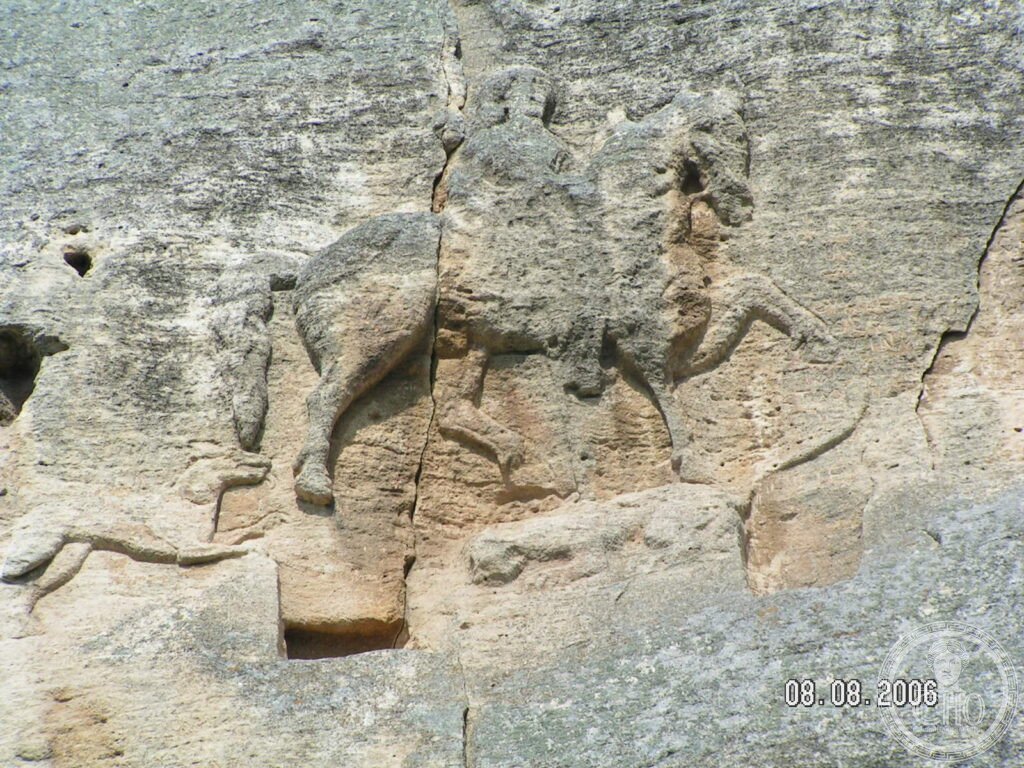
The most unusual monumental sculpture in Europe — the Madara Rider (Мадарски конник) is a large bas-relief carved approximately 710–715 AD into a vertical limestone cliff 23 metres above the ground of the Madara plateau in north-eastern Bulgaria; the image of a mounted horseman with a lion beneath his horse’s hooves and an eagle above is the only medieval rock relief of its kind in Europe; it is the national symbol of Bulgaria (on the 1, 2, and 5 euro-cent coins that Bulgaria has minted in preparation for eurozone entry) and has been listed as a UNESCO World Heritage Site since 1979.
At a glance
The Madara plateau is 16 km east of Shumen (the main city of north-eastern Bulgaria, 100 km west of Varna on the Black Sea coast). The Madara archaeological reserve (covering the plateau) includes the rock relief, the three Greek inscriptions beside it, the remains of a medieval Bulgarian fortress on the plateau summit, pre-Christian Thracian rock-cut shrines, and a small site museum. The relief is viewed from a platform at the base of the cliff, approximately 23 metres below the carving; binoculars are helpful for seeing the detail of the three Greek inscription panels (which are to the right of the relief). The UNESCO inscription of 1979 was one of the original cohort of World Heritage Sites inscribed at the second session of the World Heritage Committee (the same year as Auschwitz, Stonehenge, and the Wieliczka Salt Mine).
Key facts
- The relief (c. 710–715 AD, Khan Tervel): the Madara Rider is carved in low relief into the vertical face of a limestone cliff (the Madara plateau is a high tableland that ends in a series of steep limestone cliffs on the east and south sides; the cliff where the Rider is carved is approximately 100 metres high, and the relief is positioned about 23 metres above the base of the cliff) — the main figure is a mounted horseman (approximately 2.6 metres high) in profile, facing right (east); the horse rears slightly, its legs planted on the body of a lion (which the horseman has just speared; the spear is visible penetrating the lion’s back); above the horseman, an eagle flies (representing the divine favour or the kingly authority that accompanies the victorious ruler); a dog runs at the horse’s heels (a hunting dog, suggesting the scene was conceived as a royal hunt as well as a military triumph); the carving combines Thracian (lion hunt as royal symbol), Byzantine (the Adventus formula of the triumphant emperor on horseback), and Inner Asian (the eagle as symbol of heavenly mandate, widespread in steppe nomadic cultures) iconographic traditions in a single image — making it a uniquely cosmopolitan monument for 8th-century Europe
- Khan Tervel and the Byzantine connection: the Madara Rider is most commonly attributed to the commission of Khan Tervel of Bulgaria (reigned c. 700–721 AD) — Tervel was the most successful of the early Bulgarian Khans; in 705 AD he allied with the exiled Byzantine Emperor Justinian II (Rhinotmetos, “the Slit-Nosed”, who had been exiled to Crimea and had had his nose cut off by his predecessor) and led a Bulgarian army to Constantinople, restored Justinian to the Byzantine throne, and received as a reward the territory of Zagoria (now part of north-eastern Bulgaria and north-western Thrace) plus the personal title of “Caesar” (the second highest title in the Byzantine court, granted for the first time to a foreign ruler) and gifts of vast wealth; in 717–718 AD, Tervel played a crucial role in repulsing the Arab siege of Constantinople (a siege that, had it succeeded, would have given the Arab Caliphate control of Europe’s most powerful city) by attacking the Arab land forces from the rear; the Madara Rider is believed to commemorate these victories
- The three Greek inscriptions: three panels of text carved in Greek are visible on the cliff face adjacent to the Madara Rider; the inscriptions are dated to approximately 705–814 AD (the earliest inscription is from Khan Tervel’s reign, 705 AD; the second and third are from the reigns of Krum, 803–814 AD, and his successors); the inscriptions are written in the Greek alphabet (the official language of Byzantine diplomacy and, by extension, of early Bulgarian court culture before the introduction of the Cyrillic alphabet in the 860s) and record military campaigns, diplomatic correspondence, and treaty terms between the early Bulgarian Khans and the Byzantine Emperors; they are the earliest direct documents of Bulgarian state history and among the oldest surviving inscriptions from any medieval European state
- The pre-Christian Thracian sanctuary: the Madara plateau was a sacred site of the ancient Thracians (the indigenous population of the Balkans before the Roman conquest) centuries before the Bulgarian relief was carved; Thracian rock-cut shrines (small niches, carved channels for libation, and altar platforms cut into the limestone) are distributed across the plateau; the Thracians venerated high places (the Madara plateau is the highest point in the Ludogorie uplands) and carved sacred symbols into the limestone; the overlap of Thracian pre-Christian and early medieval Bulgarian sacred topography makes the Madara plateau a palimpsest of Balkan religious history spanning 2,000+ years
- Heritage: UNESCO World Heritage Site, Madara Rider, inscribed 1979; national symbol of Bulgaria; depicted on Bulgarian 1, 2, and 5 euro-cent coins
- GPS: 43.2796° N, 27.1300° E
History
The Madara plateau was inhabited continuously from the Neolithic period (ceramic fragments from approximately 4000 BC have been found on the plateau) through the Bronze Age, the Thracian Iron Age (from approximately 800 BC, when the Odrysian Thracians dominated north-eastern Thrace), the Roman period (the Romans built a road through the Madara pass and the plateau was the site of a significant Roman-period settlement), and the late antique period (a Byzantine fortress was built on the plateau summit in the 5th–6th century AD); in 680 AD, the Bulgar tribes (a Turkic-Mongolian steppe nomadic people from north of the Black Sea and Caspian) led by Khan Asparuh crossed the Danube and established the First Bulgarian Khanate, incorporating the Slavic and Thracian populations of what is now Bulgaria as their subject peoples; the First Bulgarian Khanate’s territory included the Madara plateau, which became a royal cult centre for the Bulgarian Khans; the Madara Rider was carved approximately 710–715 AD under Khan Tervel; the plateau fortress was used as a royal refuge and religious centre throughout the 8th and 9th centuries; a second phase of building activity occurred under Khan Krum (802–814 AD, the Khan who sacked Adrianople and defeated and killed the Byzantine Emperor Nikephoros I in the Battle of Pliska in 811 AD — the only defeat of a Byzantine Emperor by a Bulgarian Khan); the Bulgarian state was converted to Christianity in 864–865 AD under Khan Boris I, after which the plateau’s pre-Christian significance diminished; the site was excavated in the 20th century and declared a protected national monument in 1927.
What you see
The relief is seen from a viewing platform at the base of the cliff (the platform was constructed to give a clear angle of view to the 23-metre-high carving; the relief itself is on an angled section of the cliff that faces roughly south-west, receiving good afternoon light). The horseman, the lion underfoot, and the eagle above are the main composition; to the right of the rider (when viewed from the platform) are the three Greek inscription panels (largely weathered but readable with binoculars; the most legible sections include date formulas and names of Byzantine emperors). The site museum (100m from the cliff) contains plaster casts of the inscriptions, archaeological finds from the plateau excavations (Thracian bronzes, Roman coins, early Bulgarian metalwork), and explanatory panels in Bulgarian and English. The walk from the car park to the cliff base and museum takes approximately 20 minutes. The plateau summit (reached by path from the museum, 30 min ascent) has the remains of the early Bulgarian fortress and panoramic views across the Ludogorie uplands to the Black Sea coast (visible in clear conditions).
Practical information
- Admission: approximately 6 BGN (approximately €3) for the reserve and museum; open daily 9am–6pm (shorter in winter); the outdoor cliff and relief are always visible from outside the entrance gate (the base of the cliff is partly accessible without paying, though the best viewing platform requires a ticket); guided tours in Bulgarian and English are available at the site museum
- Getting there: from Shumen by bus (line to Madara village, 30 min, several per day; the Madara village bus stop is 1 km from the site entrance) or by car (16 km east of Shumen on road I-2; 20 min; free parking at the site entrance); from Varna by car (100 km west on the A2 motorway then road I-2; 1h 10 min); from Sofia by car (385 km east on the A2 “Hemus” motorway; 4h); Shumen has a railway station (on the Sofia-Varna main line; trains from Sofia 5h, from Varna 1h 30 min)
- Combining with the First Bulgarian Empire capitals: the three great capitals of the First Bulgarian Khanate/Khanate are within 50 km of Madara: Pliska (the first capital, 680–893 AD, 25 km north of Madara; the UNESCO-protected archaeological site of the original Bulgarian capital, with the Great Basilica — the largest church in medieval Bulgaria, approximately 99 metres long — and the Throne Palace remains), Veliki Preslav (the second capital, 893–971 AD, 20 km south of Shumen; an extensive archaeological site with the remains of the palace complex, the Golden Church/Round Church, and the city walls; the Preslav Archaeological Museum is excellent), and Shumen Fortress (on the plateau above Shumen city; a medieval Bulgarian fortress that was the main defended site of the Shumen region from the 10th to the 19th century)
Getting there
From Shumen (16 km, 20 min by car). Bus from Shumen to Madara village (30 min, 1 km walk to site). From Varna: A2 motorway (100 km, 1h 10min). GPS: 43.2796, 27.1300.
Nearby
- Veliki Preslav Archaeological Site — 20 km south of Shumen (25 min by car); the second capital of the First Bulgarian Empire (893–971 AD) — Veliki Preslav (Great Preslav) replaced Pliska as the Bulgarian capital when Prince Simeon I (the future Tsar Simeon the Great, the most powerful Bulgarian ruler in history) chose it as his seat; Simeon built the city as a prestige capital that could rival Constantinople: the outer city walls (approximately 3.5 km in circumference, with a gate complex and towers), the inner citadel walls (a second ring enclosing the palace precinct), the Throne Palace (a multi-storey palace with marble columns, polychrome tile decoration, and mosaic floors), and the Preslav Golden Church (the Round Church; a circular church with a diameter of 11 metres surrounded by an ambulatory and a vestibule; its tile decoration was among the finest in medieval Europe; fragments of the decorative tiles are in the Preslav Archaeological Museum); Tsar Simeon made Preslav the most important city in the Balkans during his reign (893–927 AD), including the introduction of the Cyrillic alphabet (created by the disciples of Cyril and Methodius at the Preslav Literary School), the production of elaborate polychrome ceramic icons, and the commissioning of translations of Byzantine religious texts into Old Bulgarian
- Thracian Tomb of Kazanlak — 130 km south-west of Madara (1h 45 min by car); the most important Thracian painted tomb in existence (UNESCO WHS 1979, inscribed the same year as the Madara Rider) — a 4th–3rd century BC Thracian burial chamber in the Valley of Roses with extraordinary frescoes of a Thracian aristocratic feast and horse procession; the most intact painted Thracian tomb in Bulgaria (see separate CHO place_card)
- Varna and the Black Sea coast — 100 km east of Madara (1h 10 min by car); Bulgaria’s main coastal city and the site of the world’s oldest known gold treasure — the Varna Chalcolithic Necropolis (discovered 1972, approximately 4600–4200 BC) contained the earliest-known gold burial goods in the world (a total of approximately 3,000 gold objects, including the earliest known gold crown and the earliest known gold sceptre); the Varna Archaeological Museum houses the complete collection and is the finest prehistoric museum in South-East Europe; the Varna Black Sea coast (sandy beaches extending 30 km north and south of the city) is the main Bulgarian beach resort area
Sources
- Wikipedia, Madara Rider; Khan Tervel; First Bulgarian Empire, accessed June 2026
- UNESCO, Madara Rider, WHS reference 43, inscribed 1979
- Vasil Gjuzelev, Fontes Latini Historiae Bulgaricae, Sofia, 1958 (primary source collection for early Bulgarian history)
- Rosamond McKitterick (ed.), The New Cambridge Medieval History, vol. 2 (c. 700 – c. 900), Cambridge University Press, 1995
Find it on the map
See this place and what’s around it →📷 Become a Cultural Heritage Online photographer
Share your photos of places: they stay published under your name as the author. The more they're seen, the more you get noticed — and soon a contest will reward the most appreciated photos.
Log in or sign up free to add a photoDo you manage this place?
This page is read by travellers and heritage enthusiasts who find it on Google. Keep it accurate — and make it work for you. Free for non-profit heritage institutions.