
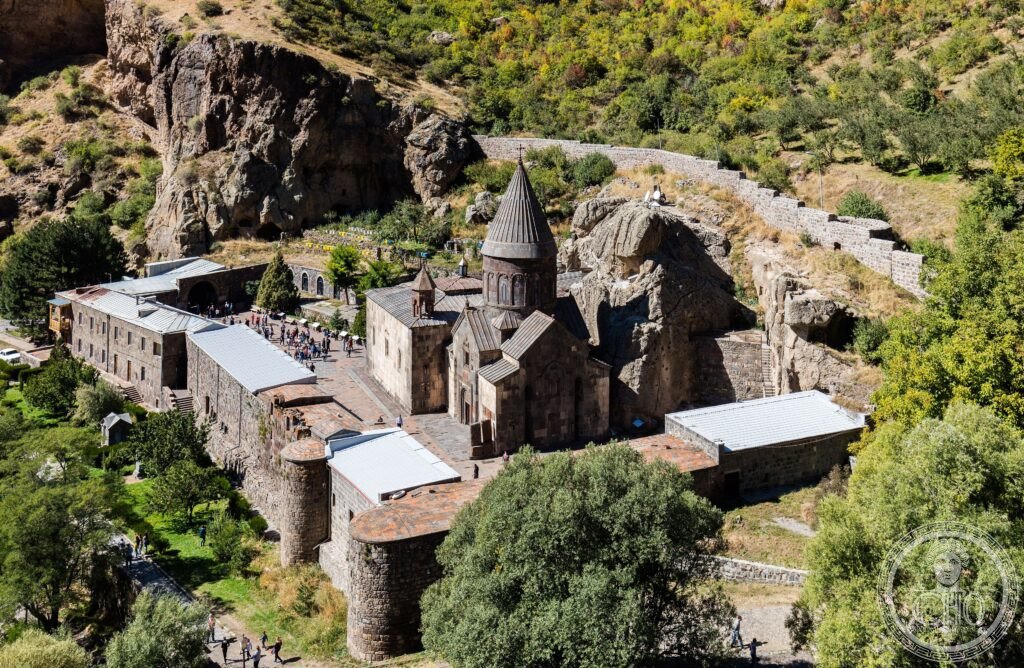
One of the great medieval monuments of the Christian East and the spiritual centrepiece of Armenian monastic architecture — the Monastery of Geghard (Geghardavank), 40 km east of Yerevan in the vertiginous Azat River gorge, is partly hewn from the living rock of the canyon wall and partly built as freestanding stone structures; its name — “Spear” in Armenian — recalls the Holy Lance that pierced Christ at the Crucifixion, which the Apostle Thaddaeus is said to have brought to Armenia in the 1st century AD and which was kept at Geghard for centuries before being transferred to the cathedral treasury at Vagharshapat (Etchmiadzin).
At a glance
Geghard is 40 km east of Yerevan (50 minutes by road) in the Azat River gorge (a dramatic limestone canyon carved by the Azat River through the Geghama Mountains; the gorge walls rise 100–200 metres above the river and are composed of dark basalt and tuff, giving the landscape a severe, almost theatrical quality). The monastery is still active in the Armenian Apostolic Church (services on Sundays and major feast days; pilgrims visit continuously); it is also the most visited historical site in Armenia after Etchmiadzin Cathedral. A visit to Geghard is almost always combined with the Garni Temple (9 km west of Geghard; the only surviving Greco-Roman colonnaded temple in Armenia and in the entire former Soviet Union, built approximately 77 AD by the Armenian king Tiridates I, reconstructed in the 1960s–1970s). The UNESCO inscription (2000) covers the monastery complex and the surrounding Azat River gorge landscape.
Key facts
- Foundation history and the Holy Lance: the site in the Azat gorge was a place of pre-Christian Armenian veneration (a sacred spring at the base of the cliff was already a cult site before the Christian era); the Apostle Thaddaeus (one of the twelve apostles, who according to Armenian tradition brought Christianity to Armenia in 40 AD) is said to have deposited the Holy Lance (the spear that a Roman soldier drove into Christ’s side at the Crucifixion) at this sacred spring; the monastery was founded in the 4th century AD as “Ayrivank” (Monastery of the Cave) by St Gregory the Illuminator (the bishop who converted King Tiridates III to Christianity in 301 AD, making Armenia the world’s first Christian state); the current monastery name “Geghardavank” (Monastery of the Spear/Lance) was adopted during the medieval period when the Holy Lance relic was actively displayed; the Holy Lance (Geghard) was transferred from the monastery to the cathedral treasury at Vagharshapat (Etchmiadzin) in the 13th century, where it remains today in the Etchmiadzin Treasury Museum
- The cave churches (the rock-hewn chambers, 1215–1283 AD): the most architecturally distinctive feature of Geghard and the reason for its UNESCO inscription — unlike virtually any other medieval Christian monastery in the world, Geghard includes churches and burial chambers carved directly into the rock face of the gorge; the main cave church is the Avazan (Holy Font) church, built 1283 AD by the Proshyan princes (the Proshyan/Liparit family were the most powerful Armenian noble family of the 13th century, based in the Garni/Geghard area); the Avazan church is entered through a rock-cut doorway in the cliff and contains a spring that still flows from the rock (the sacred spring of the pre-Christian cult site, now blessed as holy water); the walls and ceiling of the Avazan church are carved with intricate bas-reliefs (the chains and locks motif, symbolic of the chains that bound Christ in the Praetorium, is prominent on the left wall; the Proshyan family symbols — a chained lion and an eagle — are carved on the arch above the spring); above the Avazan church, cut into the rock at a higher level, is the tomb chamber of the Proshyan princes (the carved burial niches are visible in the rock wall); a second cave church (the Church of the Holy Mother of God, or Astvatsatsin) was also carved into the cliff in the 1280s, again by the Proshyan family
- The main (freestanding) church complex (1215–1225 AD): the primary freestanding structure at Geghard is the Katoghike (main cathedral), built 1215 AD; it follows the standard Armenian cruciform plan with a central dome on a circular drum (a conical stone roof, a distinctive feature of Armenian medieval church architecture) and four corner chapels; the interior is dark and intimate, lit by the narrow windows typical of Armenian medieval churches; attached to the west end of the Katoghike is the Gavit (narthex or vestibule, 1225 AD), a large square hall used for services, funerary rites, and general assembly; the Gavit’s ceiling is one of the most extraordinary works of medieval Armenian stonecarving — the central section is open (a “stalactite” vault using the technique of interlocking stone rings to form a complex geometric lattice) creating a pattern of interlocking geometric shapes that anticipates Gothic and Islamic muqarnas vaulting; the carved decorative programme of the Gavit includes Armenian khachkars (cross-stones, a distinctive form of Armenian decorative-religious stone carving in which a cross is surrounded by intricate interlaced geometric patterns carved in relief — the Geghard Gavit has some of the finest khachkars in Armenia)
- The gorge landscape and the Geghama Mountains: the Azat River gorge setting of Geghard is integral to the UNESCO inscription (the full name is “Monastery of Geghard and the Upper Azat Valley”) and adds a dimension of natural drama that many enclosed monastery sites lack — the monastery is built into the lower sections of cliffs that rise 100–200 metres above the river; the rock is dark basalt (volcanic, from the eruptions of the Geghama volcanic range that forms the eastern highlands of the Kotayk Province); the gorge is narrow and deep; the walk from the monastery down to the river involves descending through the gorge for 15–20 minutes to reach the Azat River itself (the river runs clear and fast through the basalt channel)
- Heritage: UNESCO World Heritage Site, Monastery of Geghard and the Upper Azat Valley, inscribed 2000; active Armenian Apostolic Church monastery
- GPS: 40.1531° N, 45.0947° E
History
The pre-Christian sacred spring at the Azat gorge site was converted into a Christian monastery in the 4th century AD, attributed to St Gregory the Illuminator; the original Ayrivank monastery was reportedly destroyed by Arab raids in the 9th century; the current monastery complex was built primarily in the 12th and 13th centuries: the main church (Katoghike, 1215 AD) and its Gavit (1225 AD) were built under the patronage of the Zakarian princes (Zakare and Ivane Zakarian, the dominant Armenian noble family of the early 13th century, who led the Armenian reconquest of large territories from the Seljuk Turks with Georgian support in the 1190s–1220s); the cave churches were carved in the 1280s under the Proshyan princes (who replaced the Zakarids as the dominant family in the Garni-Geghard area); the monastery was an important intellectual centre in the 13th century — the scriptorium of Geghard produced illuminated manuscripts, and the poet-musician Kostandin of Geghard (active 1250–1300 AD) wrote secular and religious songs at the monastery; the Mongol invasions (1236, then 1260–1290) disrupted Armenia severely but Geghard survived relatively intact under Proshyan patronage; the monastery was a pilgrimage centre throughout the medieval period (the Holy Lance, later joined by a fragment of the True Cross and an icon attributed to St Luke, made it one of the most venerated sites in Armenian Christianity); it is still active today.
What you see
Enter the monastery through the main outer gateway (a simple stone arch in the boundary wall); immediately ahead is the Gavit (narthex, 1225 AD) — enter and look up at the central ceiling vault, the finest example of Armenian medieval stone lacework; continue through the Gavit to the Katoghike main church (1215 AD, dark, intimate, with the original polychrome frescoes mostly gone but the carved stone decorative programme intact on the arches and capitals). Turn right (east) from the Gavit to find the entrance to the rock-cut churches: a door in the cliff face leads into the Avazan church (1283 AD), where the sacred spring flows from the rock beneath the carved Proshyan lion and eagle; above this, a narrow staircase leads to the upper cave chamber (the Proshyan tomb). The outer courtyard has several free-standing khachkars (cross-stones) and the monastery walls enclose the spring-fed stream. The walk from the monastery to the river and the gorge viewpoints takes 20 minutes and rewards with the full panoramic view of the monastery from below.
Practical information
- Admission: free (the monastery is an active Armenian Apostolic Church; visitors are welcome but should dress modestly — shoulders and knees covered; women may be asked to cover their head during services; photography of ongoing services should be avoided); a small donation to the monastery candle-sellers is customary; the on-site café and barbecue area near the entrance sells traditional Armenian khorovats (grilled meat), flatbread, and soft drinks
- Getting there: from Yerevan: by shared taxi/minibus from Yerevan’s Kilikia Bus Station to Garni (40 min, several per day; from Garni, a shared taxi to Geghard costs approximately 500 AMD, 10 min); by taxi from Yerevan approximately 5,000–7,000 AMD each way (45 min); by organised tour from Yerevan (the standard “Garni-Geghard” tour is the most popular day trip from Yerevan, operating from all major hotels, approximately €20–35 per person including transport, guide, and entrance to the Garni Temple)
- The Garni-Geghard circuit: Garni Temple (9 km west of Geghard, 30 km from Yerevan; the only Greco-Roman colonnaded temple in Armenia and the former Soviet Union, built c. 77 AD by King Tiridates I as a pagan temple and later converted to use as a royal bathhouse after the Christianisation of Armenia; reconstructed in the 1960s–1970s from excavated original stones using traditional Armenian masonry; stunning setting above the Azat gorge; allow 1h) → Geghard Monastery (allow 2h including the gorge walk) → optional: Symphony of Stones (Basalt Gorge, 2 km from Garni toward the gorge; a natural basalt column formation resembling a pipe organ, formed by the cooling of basalt lava; a 20-minute walk from the road)
Getting there
Yerevan Zvartnots Airport (EVN): 50 km west of Geghard (1h by car). Shared minibus from Yerevan Kilikia Bus Station to Garni, then shared taxi to Geghard. Organised tours from Yerevan from €20. GPS: 40.1531, 45.0947.
Nearby
- Garni Temple — 9 km west of Geghard (15 min by car); the only surviving Greco-Roman pagan temple in Armenia and in the former Soviet Union — built approximately 77 AD by King Tiridates I of Armenia (who received it as a gift from the Roman Emperor Nero in 66 AD, when Tiridates visited Rome to receive the Armenian crown from Nero’s hands in the most spectacular formal ceremony of the early Roman Empire; the temple was part of Tiridates’ programme of royal construction in the Hellenistic tradition); the temple is hexastyle (six columns on the short sides) of the Ionic order, built on a high podium with a monumental staircase; it was the mausoleum of the Arsacid royal family until Christianity replaced paganism in 301 AD, after which it was repurposed as a royal bathhouse; destroyed by an earthquake in 1679; reconstructed 1969–1975 using original stones (the reconstruction is largely accurate); the adjacent summer palace foundations, Roman-style bathhouse mosaics, and the dramatic gorge viewpoint above the Azat River make Garni a 1-hour visit in itself
- Khor Virap Monastery — 60 km south of Yerevan (45 min by car), on the Araxes River plain with Mount Ararat (5,137 metres, Turkey) dominating the horizon — the most visually dramatic monastery site in Armenia; Khor Virap (Armenian: “deep dungeon”) is the site where the future St Gregory the Illuminator was imprisoned for 13 years by King Tiridates III before his miraculous release (and the subsequent conversion of Tiridates and Armenia to Christianity, 301 AD); the view from Khor Virap across the flat Araxes plain to the volcanic cone of Mount Ararat (which has been in Turkish territory since the 1921 Treaty of Kars) is the iconic image of Armenia — the biblical mountain, unreachable by Armenians, looming 35 km away
- Monasteries of Haghpat and Sanahin — 150 km north of Yerevan (2h by car, in the Lori Province); UNESCO WHS 1996 — two 10th–13th century Armenian monastery complexes built by the Kiurikid dynasty in adjacent valleys in the Caucasus; Haghpat (959–1200 AD) has the most complete surviving Armenian medieval church ensemble (the main Surb Nshan church with its massive bell-tower, the Gavit, and the exquisite library building with its carved stone arches); Sanahin (966–1216 AD) has the oldest surviving Armenian church in the Lori region; both monasteries are on a plateau above the Debed River canyon (a dramatic landscape of forested valleys and volcanic cliffs); the nearby town of Alaverdi (20 km north of Sanahin) has the most spectacular Soviet-era industrial heritage in the Caucasus — a copper smelter and cable-car system that served the mine workers
Sources
- Wikipedia, Monastery of Geghard; Geghard; Proshyan family; Gregory the Illuminator, accessed June 2026
- UNESCO, Monastery of Geghard and the Upper Azat Valley, WHS reference 960, inscribed 2000
- Dickran Kouymjian, “Armenia from the Fall of the Cilician Kingdom (1375) to the Forced Emigration under Shah Abbas (1604)”, in The Armenian People from Ancient to Modern Times, vol. 1, Macmillan, 1997
- Patrick Donabédian and Jean-Michel Thierry, Armenian Art, Harry N. Abrams, 1989
Find it on the map
See this place and what’s around it →📷 Become a Cultural Heritage Online photographer
Share your photos of places: they stay published under your name as the author. The more they're seen, the more you get noticed — and soon a contest will reward the most appreciated photos.
Log in or sign up free to add a photo