
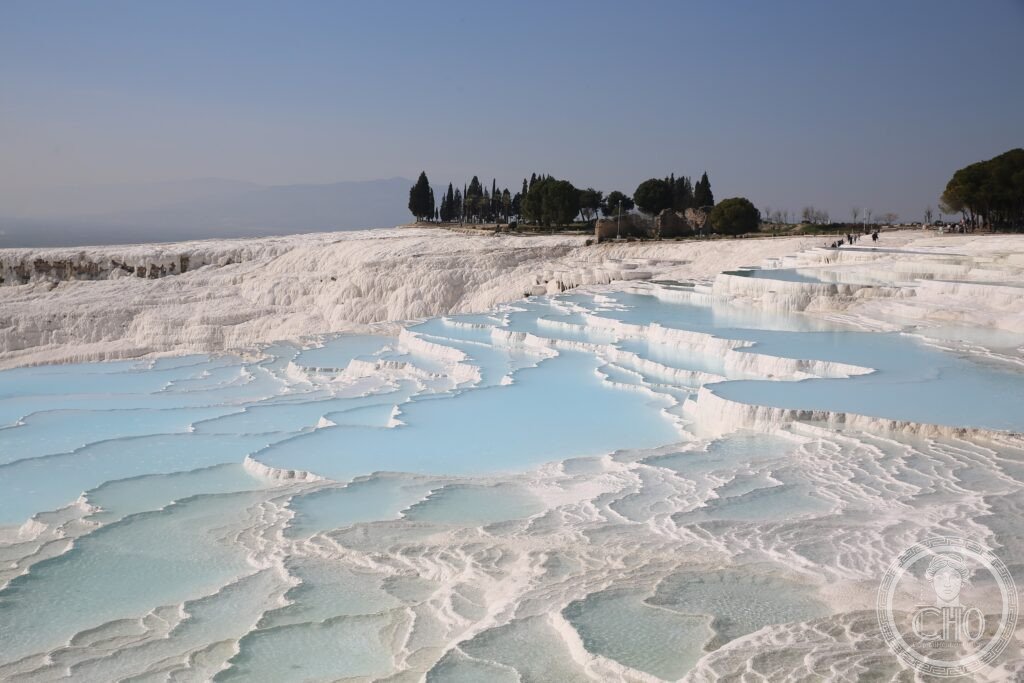
Turkey’s most visually extraordinary UNESCO site. The cotton-white travertine terraces of Pamukkale (Turkish: “cotton castle”) cascade 160 metres down a cliff above the Çürüksu Valley like a frozen waterfall of milk, their mineral-rich thermal pools reflecting turquoise against the blindingly white calcium carbonate. Above them on the plateau, the Greco-Roman city of Hierapolis (founded 190 BC by Eumenes II of Pergamon) adds a 1,190-metre colonnaded street, a 15,000-seat theatre, and the largest necropolis in Asia Minor to one of the few UNESCO Mixed (natural + cultural) World Heritage Sites in the world.
At a glance
Pamukkale (population of the administrative district approximately 100,000; the village adjacent to the site approximately 2,000) is in Denizli Province, 17 km from Denizli city, in western Anatolia. The UNESCO site (inscribed 1988 as a Mixed Cultural and Natural World Heritage Site, one of the few in the world to receive this dual classification) covers both the natural travertine terraces and the ancient city of Hierapolis on the plateau above. The thermal springs that create the terraces discharge approximately 250 litres of water per second at 35°C, depositing calcium carbonate (travertine) as the water cools and the CO₂ degasses. Over thousands of years this has built up the white cliff and its cascade of pools that is the most photographed natural formation in Turkey.
Key facts
- Travertine terraces (natural heritage): the pools and terraces are formed by the same process that forms stalactites in caves. Thermal spring water rich in calcium bicarbonate reaches the surface, loses CO₂ (which drives the carbonate reaction), and deposits calcium carbonate (travertine/calcite) as white crystalline limestone. The Pamukkale spring system has been depositing travertine for approximately 400,000 years. The terraces are approximately 2.7 km long and 160 metres tall. The water in the active pools is 35°C and can be walked through barefoot (footwear is banned on the terraces). The colour of the water ranges from milky white (in the higher pools where mineral concentration is highest and algae cannot survive) to turquoise-blue (in the lower, cooler pools where algae add a green tint). The terraces were seriously damaged in the 1980s–90s when hotels were built directly on the site and water diverted for hotel pools (most of the hotels were demolished after UNESCO listing, and the water flow is now carefully managed to maintain the active deposition zones).
- Hierapolis theatre (2nd century AD): the Roman theatre at Hierapolis is one of the best-preserved theatres in Asia Minor and is remarkable for the quality of its carved architectural decoration. The theatre was built in two phases (a first theatre in the 1st century AD; substantially rebuilt and enlarged under Septimius Severus, c. 200 AD) and seats approximately 15,000 spectators. The stage building (the scaenae frons) is richly decorated with two-storey orders of Corinthian columns and carved relief panels (many panels are now reassembled and displayed in the Hierapolis Museum). The theatre was still in use in the 4th century and may have been converted for gladiatorial games.
- Hierapolis colonnaded street (1st–4th century AD): the main street of Hierapolis (the plateia, the main east-west road, 1,190 metres long) is one of the longest surviving colonnaded streets of the ancient world. Flanked on both sides by the base courses of the column colonnade and the remains of tabernae (shops) and public buildings. The width of the street (approximately 14 metres) and the spacing of the columns (approximately 3.5 metres) is known from the surviving bases and fragments. The street was paved in marble.
- Plutonium (the “gate of hell”, 1st century BC–2nd century AD): a sacred cave at Hierapolis that emitted CO₂ gas toxic enough to kill animals. The Plutonium (dedicated to Pluto, god of the underworld) was a small cave-shrine associated with the oracle of the sanctuary of Apollo adjacent. Ancient writers (Strabo, c. 20 BC; Cassius Dio, c. 200 AD) described priests of Cybele leading bulls to the cave entrance and watching them fall dead, while the priests themselves entered and returned unharmed (their immunity was attributed to the goddess, though modern analysis suggests they simply crouched below the CO₂ layer, which is heavier than air and accumulates at floor level). The cave was sealed by Christians in late antiquity. It was rediscovered and excavated in 2013 and the CO₂ concentration was confirmed at lethal levels immediately at floor level.
- Hierapolis necropolis (1st–4th century AD): the largest necropolis in Asia Minor. Extending approximately 2 km north and south of the city, the necropolis contains approximately 1,200 tombs of a wide variety of types (tumuli, sarcophagi, house tombs, and temple tombs). The quality of inscription and carving on the sarcophagi (many now in the Hierapolis Museum, housed in the former Roman baths building at the centre of the site) documents the social history of Hierapolis in extraordinary detail. Several sarcophagi carry the occupation, family, and prohibitions against misuse (with fines specified) of the dead.
- Martyrium of St Philip the Apostle (5th century AD): the octagonal martyrium built at the site of the martyrdom of St Philip, one of the Twelve Apostles, who was martyred at Hierapolis in approximately 80 AD. The martyrium (a large octagonal structure approximately 20 metres in diameter, with eight radial chapels and a central space on an octagonal plan) is one of the earliest and most important surviving martyrium buildings in the Christian world. St Philip’s connection with Hierapolis is confirmed by Polycarp of Smyrna writing approximately 130 AD.
- Heritage: UNESCO Mixed World Heritage Site (cultural + natural), Hierapolis-Pamukkale, inscribed 1988.
- GPS: 37.9238° N, 29.1187° E.
History
Hierapolis (“holy city” in Greek) was founded approximately 190 BC by Eumenes II, King of Pergamon, on the plateau above the thermal springs (whose healing properties were already known). The city was ceded to Rome in 133 BC along with the rest of the Pergamene Kingdom. It became one of the most important Greco-Roman cities of Asia Minor, famous throughout the ancient Mediterranean for its thermal baths and as a pilgrimage destination for the oracles of Apollo and the extraordinary spectacle of the Plutonium. A significant Jewish community lived at Hierapolis (the city is mentioned in the Epistle to the Colossians) and the Apostle Philip is said to have preached and been martyred here. The city survived Byzantine rule but was severely damaged by the earthquake of 1354 AD and progressively abandoned. The site was excavated by Italian archaeologists beginning in 1957 (the Missione Archeologica Italiana di Hierapolis, still active) and the Hierapolis Archaeological Museum (in the converted Roman baths building) opened in 1984.
What you see
The site is best approached from below (the South Gate, 5 km south of the terraces) to walk UP the travertine slope on the prescribed path (other routes are closed to prevent damage). Remove shoes at the terraces (a requirement: the calcium deposits are damaged by footwear and the path is slippery). The active pools vary by season (the water flow management means some sections are draining while others fill; April–June and September–October typically offer the best combination of full pools and manageable crowds). The antique pool (Kleopatra’s Pool, in the centre of the Hierapolis site, 35°C water with submerged ancient columns — a swimming pool formed in a former Roman sacred pool) is worth the modest entrance fee as a direct sensory experience of the healing-water culture of ancient Hierapolis.
Above the terraces, the Hierapolis ruins spread across a large plateau (1–2 hours to walk the complete archaeological area). The priority sequence is: theatre (the most spectacular monument, 15 min walk north from the terraces entrance). Colonnaded street (running east from the theatre). Martyrium of St Philip (north end of the site, 10 min walk beyond the theatre). Hierapolis Museum (in the baths building at the south end of the site, with the best sarcophagi and theatre reliefs). The site is very large and exposed. Carry water and wear sun protection.
Practical information
- Admission: the Hierapolis-Pamukkale archaeological and natural site (covering the terraces, the archaeological remains, and the Hierapolis Museum) is a single ticketed area. Approximately 450 TRY in 2025 (approximately €13–15 at current exchange rates; prices are adjusted regularly). The Antique Pool (Kleopatra Havuzu) is separately ticketed at approximately 450 TRY additional. Museum card (Müze Kart) valid. The site is open year-round (7am–9pm in summer, shorter hours in winter).
- Getting there: Denizli-Çardak Airport (DNZ) is the nearest airport, 65 km east of Pamukkale (1h by bus or taxi; hourly bus service from Denizli bus terminal to Pamukkale village). Denizli is served by direct flights from Istanbul (Turkish Airlines, Pegasus, ~1h), Ankara, Antalya, and Izmir. By high-speed train from Istanbul to Denizli (approximately 3.5h on the Izmir HSR then Denizli regional train, fully operational since 2023). By car from Izmir 200 km east (2h 30 min). From Antalya 250 km north (3h on the D650 mountain road, scenic but slow). From Ephesus 200 km south-east (2h 30 min). From Konya 400 km south-west via the D300 (4h). Most visitors arrive from Selçuk/Ephesus or from the Aegean coast resorts on a day trip.
- Best time: April–June and September–October for the combination of warm weather, full terraces, and manageable crowds. July–August is extremely hot (35–40°C) and crowded. January–March can have snow on the plateau but the terraces are often quiet. The sunrise over the terraces (from the north end of the plateau) is spectacular if you can get there before the crowds (the site opens at 7am in summer).
Getting there
Denizli Airport (DNZ): 65 km (1h by bus). Bus from Denizli (hourly, 45 min). By car from Izmir (200 km, 2.5h). By car from Ephesus (200 km, 2.5h). GPS: 37.9238, 29.1187.
Nearby
- Ephesus (Efes). 200 km west of Pamukkale (2h 30 min by car). The most completely excavated Greco-Roman city in the Mediterranean (population approximately 250,000 at its peak in the 2nd century AD) and the site of the Temple of Artemis (one of the Seven Wonders of the Ancient World; only a single column survives). The Celsus Library (2nd century AD, the most photographed façade in Turkey outside Istanbul), the commercial agora, the marble-paved plateia, the theatre (capacity 25,000), the terrace houses (multi-storey private dwellings with floor mosaics, wall frescoes, and underfloor heating systems, still being excavated and partially covered by protective roofing — the single richest archaeological interior experience in Turkey, separately ticketed). UNESCO WHS 2015.
- Afrodisias. 100 km south-east of Pamukkale (1h 15 min by car). The best-preserved provincial Roman city in Asia Minor and one of the most important UNESCO archaeological sites in Turkey (WHS 2017). The city was built around the sanctuary of Aphrodite (the most important shrine of Aphrodite in Asia Minor) and grew from the 1st century BC to the 6th century AD as a centre of philosophy, sculpture (the Aphrodisian school of sculpture is named after the city’s sculptors, whose work is found in museums throughout the Roman Empire, identifiable by the distinctive marbled stone of the Aphrodisias quarry), and imperial favour. The stadium (270 x 59 metres, capacity 30,000, the longest and best-preserved ancient stadium in the world) is the most impressive monument at the site. The tetrapylon (a monumental gateway of four rows of columns, 2nd century AD, magnificently restored), the Sebasteion (a double portico of two three-storey colonnades with mythological and imperial relief panels — the single richest relief programme from any Roman city), and the theatre are all excellent. The Aphrodisias Museum (on-site) contains the finest collection of local sculpture including a head of Aphrodite and the detailed portrait reliefs of the Sebasteion.
- Laodicea on the Lycus. 6 km north of Denizli (20 min by car from Pamukkale). The ancient city of Laodicea (one of the Seven Churches of Revelation, addressed in Rev. 3:14–22 as the “lukewarm” church) is under active excavation and has produced one of the best-preserved double-columned nymphaeum (monumental fountain facade) in Asia Minor. The Syrian-type agora, two theatres, and a stadium are all visible. The excavations are ongoing and new discoveries made regularly (a 3rd-century AD Novaian church was discovered in 2022).
Sources
- Wikipedia, Pamukkale. Hierapolis, Phrygia. Plutonium (Hierapolis). Martyrium of Saint Philip, accessed June 2026.
- UNESCO, Hierapolis-Pamukkale, WHS reference 485, inscribed 1988.
- Francesco D’Andria, Hierapolis di Frigia: Guida Archeologica, Istanbul, 2003.
- Strabo, Geography, XIII.4.14 (on the Plutonium).
Find it on the map
See this place and what’s around it →📷 Become a Cultural Heritage Online photographer
Share your photos of places: they stay published under your name as the author. The more they're seen, the more you get noticed — and soon a contest will reward the most appreciated photos.
Log in or sign up free to add a photo