
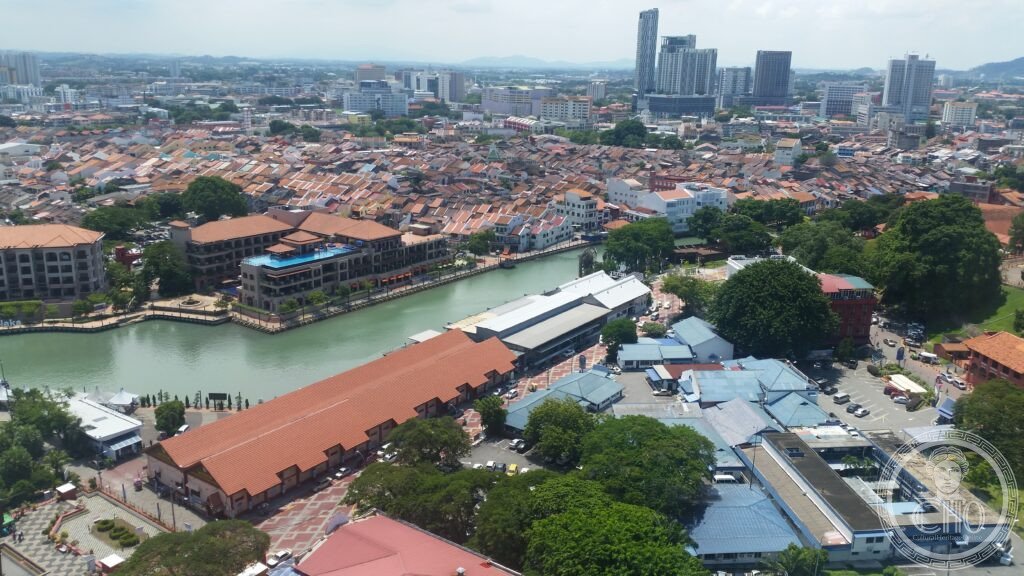
The city that taught the world to trade across the Indian Ocean. When the Malacca Sultanate was founded around 1400, Melaka became the first city in Southeast Asia to develop a permanent multilingual trading community (Gujarati, Tamil, Javanese, Chinese, Arab, and Malay merchants; a lingua franca trade language; a unified system of weights and measures) that served as the model for all subsequent colonial trading ports in the Indian Ocean world. The city passed through Portuguese, Dutch, and British control, each layer adding to the extraordinary architectural palimpsest of five centuries of international trade.
At a glance
Melaka (population approximately 500,000) is the capital of Melaka State, on the south-west coast of the Malay Peninsula, on the Strait of Malacca (the world’s busiest shipping lane), approximately 150 km south-east of Kuala Lumpur. The city was founded around 1400 by Parameswara, a Hindu prince from Palembang (Sumatra) who had fled the Majapahit Empire. Within a century it had grown to a population of approximately 100,000 and was described by Tomé Pires (the Portuguese apothecary who visited c. 1512) as the city “made for merchandise”. The most important trading port in the world east of the Arabian Sea. UNESCO inscribed Melaka jointly with George Town (Penang) in 2008 as “Melaka and George Town, Historic Cities of the Straits of Malacca.”.
Key facts
- A Famosa and St Paul’s Hill: the most visible remnant of Portuguese rule (1511–1641). The Portuguese Afonso de Albuquerque captured Melaka in July 1511 (the first Asian port to fall to a European power by direct military conquest) and immediately began constructing the fortress A Famosa (The Famous, 1511–12) on St Paul’s Hill. Only the Porta de Santiago (the surviving gatehouse, the oldest extant European architecture in Southeast Asia) remains standing, having been saved from demolition in 1807 by Sir Stamford Raffles, who was visiting as an East India Company officer and immediately ordered a halt to the British engineers who were destroying the walls. On the hilltop above the gatehouse, the Church of St Paul (1521, originally the Portuguese Duarte Coelho’s private chapel, later expanded by the Jesuits as St Paul’s Church) stands as a roofless ruin, its walls covered in Portuguese marble tomb slabs. Francis Xavier (the Jesuit missionary who founded the first Christian missions in Japan, India, and East Asia) was buried here for nine months (1552–53) before his body was transferred to Goa.
- The Dutch Square (Stadthuys): the most coherent Dutch colonial ensemble in Southeast Asia. The Dutch East India Company (VOC) captured Melaka from the Portuguese in 1641 after a five-month siege. The Dutch built the Stadthuys (City Hall, 1660 — the oldest surviving Dutch building in the East, painted the characteristic Dutch colonial red), the Christ Church (1753 — the oldest Protestant church still in regular use in Malaysia, painted the same characteristic red, its hand-made brick imported from Zeeland in the Netherlands), and the VOC administrative complex around the central town square. The entire Dutch Square ensemble is painted in the same deep terracotta red. The square (Dataran Pahlawan) is the most photographed heritage site in Malaysia.
- Jonker Street and Baba-Nyonya culture: the main heritage street of Chinatown and the centre of Baba-Nyonya (Peranakan Chinese) culture. The Baba-Nyonya are the descendants of Chinese immigrants (primarily Hokkien and Cantonese) who settled in Melaka from the 15th century onwards and over generations developed a distinctive hybrid culture combining Chinese, Malay, and later Dutch and British elements. The Baba-Nyonya language (Baba Malay, a Malay-based creole with Hokkien loanwords), cuisine (nasi lemak, laksa, and a series of unique dishes combining Chinese and Malay techniques), traditional dress (the kebaya blouse adapted from Malay/Indonesian clothing), and architecture (the Peranakan shophouse, with Chinese porcelain tile decoration and a distinctive narrow-front deep-plan layout) are the defining markers. The Baba Nyonya Heritage Museum (Jonker Street 48–50) is the best single museum of the culture in Malaysia.
- The Malacca Strait trade system: Melaka’s strategic importance derived from geography. The Strait of Malacca (800 km long, as narrow as 2.8 km at the Singapore Strait) is the only navigable passage between the Indian Ocean and the South China Sea. Approximately 25% of world trade passes through the Strait today. In the 15th century, all Chinese, Indian, and Arab trade between China and India passed through Melaka’s harbour. Tomé Pires estimated that 84 languages were spoken in Melaka at the time of the Portuguese conquest. The port system (with its Shahbandars — harbour-masters assigned to specific ethnic groups of merchants — its system of guaranteed safe passage, and its warehouses) was the model for all subsequent European colonial trading ports in Southeast Asia.
- Heritage: UNESCO World Heritage Site, Melaka and George Town, Historic Cities of the Straits of Malacca, inscribed 2008.
- GPS: 2.1937° N, 102.2526° E.
History
Parameswara founded Melaka around 1400 after fleeing Palembang with his followers. According to the Sejarah Melayu (Malay Annals, the primary historical source), he saw a mouse deer kick a hunting dog into the river while resting under a melaka tree and took the omen to found a city at that spot. The Malacca Sultanate grew rapidly from a fishing village to a major entrepôt by offering guaranteed security, standardised weights and measures, and a common trade language (Malay, which became the lingua franca of Southeast Asian trade, as Arabic was for the Islamic world and Greek was for the ancient Mediterranean). The Sultan converted to Islam around 1414, which attracted Arab and Indian Muslim merchants and gave Melaka a central role in the spread of Islam through maritime Southeast Asia.
The Portuguese conquest (1511) disrupted but did not destroy the trade networks. The Dutch conquest (1641) was more commercially systematic. British control (from 1795, permanent from 1824) integrated Melaka into the Straits Settlements together with Singapore (founded 1819 by Stamford Raffles) and Penang (founded 1786 by Francis Light). The 1957 independence of Malaya and the 1963 formation of Malaysia transformed Melaka from a colonial port to a heritage tourism destination.
What you see
The heritage zone of Melaka is compact (most of the key sites are within a 1 km radius of the Dutch Square) and walkable. The circuit from the Dutch Square: Stadthuys (City Hall) and Christ Church (the red Dutch ensemble). Porta de Santiago gate (bottom of St Paul’s Hill). St Paul’s Church ruin (top of the hill, 10 min walk, best city view). Malacca Sultanate Palace Museum (Istana Kesultanan Melaka, a replica of the 15th-century palace, interesting museum of Melaka Sultanate history). Jonker Street (Jalan Hang Jebat — walking street on Saturdays and Sundays, antique shops and Peranakan food stalls). Baba Nyonya Heritage Museum. Kampung Morten (a surviving Malay village of traditional houses, 10 min walk north of Jonker Street).
The Malacca River cruise (30 min boat tour, departs from the Quayside Hotel jetty) is the most pleasant way to see the painted mural wall-art along the river banks (approximately 50 large murals by local and international street artists were commissioned for the riverbanks in 2012 and are the most visited public art in Malaysia) and to understand the historical geography of the town from the water.
Practical information
- Admission: Dutch Square and surroundings free. Porta de Santiago and St Paul’s Church ruin free. Malacca Sultanate Palace Museum approximately MYR 5 (about €1). Baba Nyonya Heritage Museum approximately MYR 16 (about €3.30). Stadthuys (History and Ethnography Museum complex) approximately MYR 5. River cruise approximately MYR 25 per person. Tun Mutahir Maritime Museum (housed in a full-size replica Portuguese caravel, excellent displays on Strait of Malacca trade history) approximately MYR 5.
- Getting there: Melaka does not have its own commercial airport. Nearest airport is Kuala Lumpur International Airport (KLIA, 90 km north). From KLIA to Melaka by express bus: Transnasional or Aeroline (approximately 2 hours, MYR 28). From Kuala Lumpur KL Sentral station: Aeroline bus (2h, MYR 35) or Transnasional bus from TBS Bus Terminal (1.5h, approximately MYR 20). By taxi or Grab from KL: approximately 2 hours without traffic. There is no direct rail connection to Melaka from KL.
- Best visit time: December–February (the north-east monsoon brings rain to the east coast of Malaysia but leaves Melaka relatively dry). Saturday evening in Jonker Street (the walking street, food hawkers, Peranakan cuisine) is the best single evening. The Jonker Street Night Market starts at 6 pm.
Getting there
No direct airport. Nearest is Kuala Lumpur KLIA (90 km). Express bus from KL Sentral (1.5–2h). No rail connection. GPS: 2.1937, 102.2526.
Nearby
- George Town, Penang. 350 km north of Melaka (jointly inscribed in the same UNESCO World Heritage site). Accessible by bus to Butterworth + ferry, or by plane (Penang Airport from Subang or KLIA). The richest surviving concentration of Peranakan heritage architecture in Malaysia, with the Clan Jetties, the Blue Mansion (Cheong Fatt Tze Mansion, 1880s, 38-room Hakka Chinese villa), and the Komtar colonial core. The street food of George Town (the hawker centre culture of char kway teow, laksa, and nasi kandar) is consistently rated the best in Malaysia.
- Port Dickson (PD). 60 km north of Melaka on the Strait coast. The most popular beach resort for Kuala Lumpur residents (day-trip and weekend destination). The beaches are not the cleanest in Malaysia (the Strait of Malacca receives heavy ship traffic) but the Fort Tanjung Tuan (the oldest surviving Portuguese fort in Malaysia, 1520) at Cape Rachado (5 km south of Port Dickson) and the Cape Rachado Forest Reserve (an important migratory bird stopover site) are worth the detour.
- Kuala Lumpur (KLCC, Batu Caves, etc.). 90–120 km north of Melaka (1.5–2h). The Batu Caves (7 km north of KL city centre). A series of limestone cave temples of the Thaipusam festival (a Hindu festival of remarkable physical devotion in which participants carry kavadis with metal skewers through their cheeks and tongues in procession to the cave shrine) and a UNESCO Geopark candidate. The KL city centre (the Petronas Twin Towers, the National Museum, the Islamic Arts Museum of Malaysia) extends the heritage itinerary northward from Melaka.
Sources
- Wikipedia, Malacca City. Malacca Sultanate. Baba Nyonya, accessed June 2026.
- UNESCO, Melaka and George Town, Historic Cities of the Straits of Malacca, WHS reference 1223, inscribed 2008.
- Tomé Pires, Suma Oriental, c. 1515 (trans. Armando Cortesão, Hakluyt Society, 1944).
- Barbara Watson Andaya and Leonard Andaya, A History of Malaysia, 2nd ed., University of Hawaiʻi Press, 2001.
Find it on the map
See this place and what’s around it →📷 Become a Cultural Heritage Online photographer
Share your photos of places: they stay published under your name as the author. The more they're seen, the more you get noticed — and soon a contest will reward the most appreciated photos.
Log in or sign up free to add a photo