
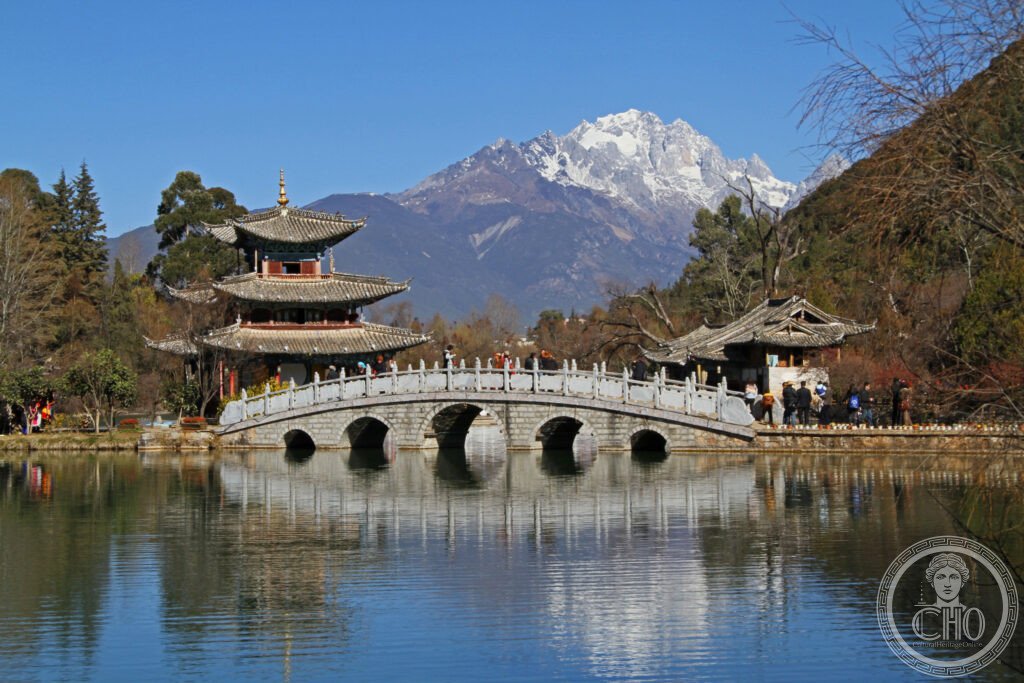
The most complete surviving urban settlement of the Naxi minority people, and the only ancient Chinese city built without city walls — the Naxi built Lijiang in the foothills of the Jade Dragon Snow Mountain in the 13th century as a trading post on the Ancient Tea Horse Road between Yunnan and Tibet, letting the three spring-fed branches of the Yuhe River run through the city as an integrated water-supply, fire-prevention, and street-cleaning system that still flows through every neighbourhood today.
At a glance
Lijiang (population of the city approximately 230,000; the old town district, Dayan, population approximately 30,000) is a prefecture-level city in north-western Yunnan Province, south-west China, at an altitude of approximately 2,400 m, 520 km north-west of Kunming. The old town (Dayan) was established as a trading post by the Naxi people (a minority ethnic group of approximately 320,000, whose traditional territory covers north-western Yunnan and the Hengduan Mountains) during the Song dynasty (960–1279) and developed into a major town during the Yuan and Ming dynasties. The Naxi Dayan old town, the Baisha Ancient Town, and the Shuhe Ancient Town constitute the UNESCO World Heritage inscription of the Old Town of Lijiang, inscribed in 1997.
Key facts
- The canal system: the most sophisticated integrated urban water-management system in traditional Chinese urbanism — the Naxi founders of Lijiang diverted the three branches of the Yuhe River to run through the town in an interconnected grid of approximately 350 km of channels, canals, and sluices that deliver fresh mountain water to every part of the old town; the channels run down every street, along every alley, and through the courtyards of private houses; at fixed intervals in the network, sluices can divert the full flow to flush any section of the system; the Naxi tradition holds that the main channel above the Three Wells Square (where three wells are fed by the same source at different heights — the top level for drinking water, the middle for washing food, and the bottom for laundry) must be respected by anyone drawing water; the system continues to function without mechanical assistance and provides the water supply for approximately 6,000 residents of the heritage zone
- Naxi Dongba culture: the indigenous cultural tradition of the Naxi people, centred on the Dongba (priests/shamans) who are the custodians of the only living pictographic writing system in the world; the Dongba script (approximately 1,400 pictograms) is used to write the Dongba sutras (religious texts) that the Dongba priests recite at rituals — weddings, funerals, exorcisms, and harvest ceremonies; approximately 20,000 Dongba manuscripts survive in libraries and museums worldwide (the largest collections in the Library of Congress, Washington DC, and the Naxi Dongba Culture Research Institute in Lijiang); fewer than 100 practising Dongba priests remain; the Dongba Research Institute in Lijiang is open to visitors
- The Ancient Tea Horse Road (Chama Gudao): the network of trade routes connecting Yunnan and Sichuan with Tibet, Burma, and India that were in active use from the 7th century until the 1950s; Lijiang was the principal staging post on the Yunnan–Tibet route, where caravans of horses and mules exchanged the tea of Yunnan (pressed into fermented tea cakes for the journey — pu’er tea) for the horses of Tibet (superior mountain horses valued by the Chinese military); the muleteers who operated the caravans were predominantly Naxi; the warehouses, inns (lüdian), and trade wells of the tea horse caravan era survive in the street grid of the old town; the Ancient Tea Horse Road Lijiang Cultural Museum is at the Northern Square end of the old town
- Mu Family Mansion (Mu Fu): the historical residence of the Naxi hereditary chiefs (the Mu family, who were the local rulers of Lijiang under the Yuan, Ming, and Qing dynasties for approximately 470 years from 1271 to 1723); the mansion complex (covering approximately 3 ha) was destroyed during the 1996 Lijiang earthquake and entirely reconstructed; it is the largest historical architectural complex in the old town and gives a sense of the scale and sophistication of the Naxi ruling culture; the garden (modelled on the imperial gardens of Beijing, but with Naxi pictographic inscriptions throughout) is one of the best-preserved examples of Ming-dynasty garden design in Yunnan
- The 1996 Lijiang earthquake: a Mw 7.0 earthquake struck Lijiang on 3 February 1996, killing 309 people and injuring approximately 17,000; the earthquake destroyed much of the modern parts of the city but — paradoxically — caused relatively little damage to the historic old town (whose traditional timber-framed buildings, constructed with the earthquake-resilient cantilever beam technique inherited from Song-dynasty engineering, absorbed the ground movement better than modern reinforced concrete construction); the earthquake and the subsequent UNESCO inscription (February 1997, just one year after the earthquake) triggered a massive tourism development that has transformed Lijiang into one of China’s top domestic tourism destinations
- Heritage: UNESCO World Heritage Site, Old Town of Lijiang, inscribed 1997
- GPS: 26.8720° N, 100.2290° E
History
The Naxi people migrated from the Tibetan Plateau to the Lijiang valley in the 10th century; the Song dynasty (960–1279) recognised the Mu family as local chieftains (tusi — a system of indirect rule through recognised indigenous leaders) in exchange for tax payments and military support; the town developed as a trading hub at the intersection of the Yunnan–Tibet road and the east–west routes connecting the interior of Yunnan with Burma; the Mu family patrons commissioned Buddhist temples and Taoist shrines and maintained a cultural tradition that synthesised Naxi, Han Chinese, Tibetan, and Yi influences; the most important architectural ensemble of the pre-modern period (the Mu Family Mansion, rebuilt after 1996) gives a sense of the scale of the Mu family’s cultural ambitions.
The old town survived the Cultural Revolution (1966–76) relatively intact because it was classified as a “minority area” and therefore not subject to the same degree of Red Guard destruction as Han Chinese heritage; the 1996 earthquake (and the UNESCO inscription that followed) transformed Lijiang into a major tourism destination; the pressure of approximately 30 million visitors annually (the figure varies significantly by source and year, but Lijiang is consistently one of the most visited heritage cities in China) has produced both the restoration of the historic fabric and the near-total displacement of original Naxi residents, replaced by Han Chinese tourism entrepreneurs; this tension between heritage preservation and authentic community survival is the central management challenge for the site.
What you see
The Dayan old town is best explored on foot from the Sifang (Four Directions) Square — the central market square of the old town where Naxi women perform the traditional Guozhuang circle dance in the evenings; from here the canal-lined lanes radiate outward through the neighbourhood of densely packed two-storey Naxi timber-frame courtyard houses (the standard building type: an outer gate, a paved courtyard, two-storey gallery surrounding the courtyard, with the family living quarters on the upper floor and storage/workshops below). The Black Dragon Pool park (30 minutes walk north of Sifang Square, or 10 minutes by taxi) gives the classic view of Jade Dragon Snow Mountain reflected in the pool with the Deyue Pavilion in the foreground — the most photographed image in Yunnan.
Jade Dragon Snow Mountain (Yulong Xueshan, 5,596 m, the southernmost snowfield in the Northern Hemisphere) is visible from much of the old town on clear days; access to the mountain’s Glacier Park (by cable car, with a high-altitude plateau at 4,506 m) requires a separate day trip (approximately 25 km from the old town; entrance plus cable car approximately CNY 500). The Shuhe Ancient Town (10 km north of Dayan, accessible by taxi or bicycle) is the quieter and more authentic alternative to the heavily commercialised Dayan, with better preserved traditional domestic architecture and fewer souvenir shops.
Practical information
- Admission: old town streets free (no gate fee); the Lijiang old town “maintenance fee” of CNY 80 (about €10) is charged at some access points but enforcement has been sporadic; Mu Family Mansion approximately CNY 60 (about €7.50); Black Dragon Pool Park approximately CNY 80; Dongba Cultural Research Institute approximately CNY 30; Jade Dragon Snow Mountain Glacier Park: approximately CNY 230 cable car + CNY 130 plateau cable car (separate ticket)
- Getting there: Lijiang Sanyi Airport (LJG) — direct domestic flights from Kunming (1h, multiple daily), Chengdu (1.5h), Beijing (3h), Shanghai (3.5h), Guangzhou (2.5h); the airport is 25 km from the old town; taxi approximately CNY 60–80 (40 min); by high-speed train from Kunming (2h, CNY 130) — the Lijiang Railway Station is 4 km from the old town; both the domestic tourism market and the limited international arrivals (international flights operate seasonally from Bangkok and Kuala Lumpur) make Lijiang one of the most accessible heritage sites in south-west China
- Tiger Leaping Gorge day trip: one of the deepest gorges in the world (approximately 60 km north-east of Lijiang, 2h by bus); the Jinsha River (the upper reach of the Yangtze) drops approximately 200 m through the gorge in a series of rapids between the Jade Dragon Snow Mountain and the Haba Snow Mountain; the Upper Trail hiking route (1–2 days, hiking infrastructure well maintained) is one of the most spectacular mountain hikes in China; accessible by direct bus from Lijiang’s bus station
Getting there
Lijiang Airport (LJG): 25 km from old town. Flights from Kunming (1h), Chengdu (1.5h). High-speed train from Kunming (2h). GPS: 26.872, 100.229.
Nearby
- Shangri-La (Zhongdian / Gyalthang) — 200 km north of Lijiang (3–4 hours by bus via the Tiger Leaping Gorge road); the Tibetan prefecture-level city of Deqin, known internationally as “Shangri-La” since the Chinese government renamed it in 2001 (after James Hilton’s 1937 novel of the hidden Himalayan utopia), contains the Songzanlin Monastery (1679, the largest Tibetan Buddhist monastery in Yunnan, often called the “little Potala”) and the Dukezong Ancient Town (partially destroyed by fire in 2014); the surrounding Pudacuo National Park (one of the first Chinese national parks conforming to IUCN standards) has pristine Himalayan meadows and high-altitude lakes
- Dali Ancient Town — 180 km south of Lijiang (2.5h by bus or high-speed rail); the capital of the historical Kingdom of Dali (937–1253) and the ancestral homeland of the Bai minority people; the Three Pagodas of Chongsheng Temple (10th–11th century, the most photographed monument in Yunnan) and the Cangshan mountain range rising above Erhai Lake are the defining sights; the Dali old town is less overcrowded than Lijiang and maintains a more authentic mixed Han–Bai character; the Bai architecture (whitewashed walls with elaborate painted decorative borders) is the most distinctive regional building style in Yunnan
- Lugu Lake (Yunnan–Sichuan border) — 200 km north-east of Lijiang (3–4 hours by bus); a pristine high-altitude lake (2,685 m) on the Yunnan–Sichuan border, the territory of the Mosuo people, who maintain a traditional matrilineal society (the “Kingdom of Women”) with a distinctive marriage practice (the “walking marriage” — men and women maintain separate households, with men visiting women at night and returning to their maternal household in the morning) that has been the subject of both anthropological study and Chinese popular fascination; the lake and the surrounding Mosuo villages are a UNESCO Intangible Cultural Heritage candidate
Sources
- Wikipedia, Lijiang; Naxi people; Dongba (religion), accessed June 2026
- UNESCO, Old Town of Lijiang, WHS reference 811, inscribed 1997
- Chuan-kang Shih, Quest for Harmony: The Moso Traditions of Sexual Union and Family Life, Stanford University Press, 2010
- Joseph Rock, The Ancient Na-khi Kingdom of Southwest China, Harvard-Yenching Institute, 1947
Find it on the map
See this place and what’s around it →📷 Become a Cultural Heritage Online photographer
Share your photos of places: they stay published under your name as the author. The more they're seen, the more you get noticed — and soon a contest will reward the most appreciated photos.
Log in or sign up free to add a photo