

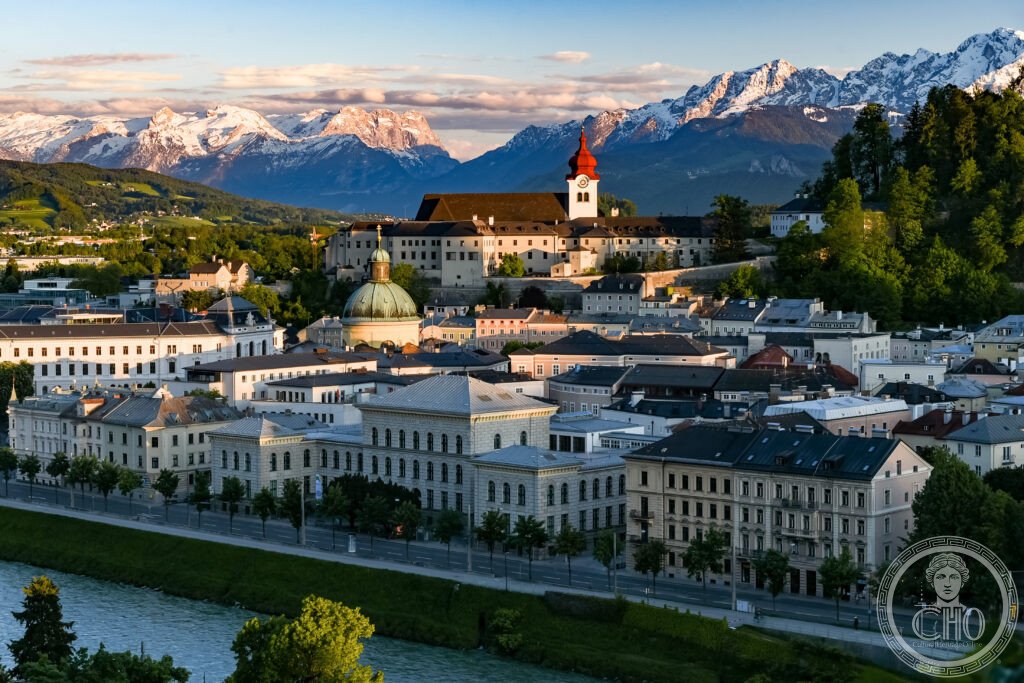
The most complete Baroque city north of the Alps. The Archbishop-Princes of Salzburg rebuilt their city in Italian Baroque between 1587 and 1753, employing the architects Vincenzo Scamozzi, Santino Solari, Johann Bernhard Fischer von Erlach, and Johann Lukas von Hildebrandt to create a series of cathedral squares, palace gardens, and palace ensembles against the backdrop of the Hohensalzburg fortress and the Alpine scenery. Birthplace of Wolfgang Amadeus Mozart in 1756, and site of the Salzburg Festival (founded 1920). The world’s most prestigious classical music and opera festival.
At a glance
Salzburg (population approximately 155,000) is the capital of Salzburg State (Bundesland Salzburg), western Austria, on the Salzach River at the foot of the Bavarian Alps, 130 km south-east of Munich and 300 km west of Vienna. The city was founded as a Roman settlement (Iuvavum), developed as an episcopal see from the 8th century under Saint Rupert (died 710 AD), and became the seat of an Archbishopric and, from 1278, a Prince-Archbishopric. A sovereign ecclesiastical state (the Duchy of Salzburg) whose Archbishop-Princes wielded both religious and temporal authority until the Napoleonic annexation of 1803. UNESCO inscribed the Historic Centre of Salzburg in 1996.
Key facts
- The Salzburger Dom (Cathedral, 1628): the centrepiece of the Baroque city. A five-domed Italianate cathedral designed by Santino Solari and consecrated in 1628, the first Italian-style Baroque cathedral north of the Alps. The façade (completed 1655) with its two towers, three portals (Faith, Hope, Charity), and the statue of the patron saints Rupert and Virgilius flanking the entrance was modelled on Roman Baroque churches. The interior (87 metres long, 79 metres wide, 79 metres at the dome) can hold 10,000 people. The three bells of the cathedral (named after three saints) are rung in a specific sequence whose sound identifies Salzburg above any other. Mozart was baptised at the Romanesque font here in January 1756.
- The Hohensalzburg Fortress: the largest intact medieval castle in the German-speaking world. Built in 1077 by Archbishop Gebhard and continuously expanded over six centuries. The fortress sits on the Festungsberg (542 m) above the old city, with views over the Salzach valley and the Alpine panorama. The interior (open daily; accessible by Festungsbahn funicular from the old city) includes the Romanesque state rooms of the Archbishop-Princes, the Golden Room (with its late Gothic carved majolica oven), the Torture Tower, and the Rainer Museum. The fortress was never successfully besieged.
- The Getreidegasse and Mozart’s Birthplace: the main shopping street of the old city. A narrow medieval lane of continuous 3–4 storey buildings whose wrought-iron guild signs (each shopfront has a unique 3D iron sign above the door, a Salzburg tradition dating from the period when most of the population was illiterate) make it the most photographed street in the city. The house where Wolfgang Amadeus Mozart was born on 27 January 1756 (Getreidegasse 9, now the Mozart Geburtshaus museum — the most visited museum in Salzburg) is the centrepiece. The Mozarteum University of Music (founded 1841, now one of the world’s leading conservatories) and the Mozart Wohnhaus (the family residence on Makartplatz) complete the Mozart geography of the city.
- The Salzburg Festival (Salzburger Festspiele): founded in 1920 by Hugo von Hofmannsthal, Max Reinhardt, and Richard Strauss as a reaction against the commercialisation of opera. The festival has been held annually ever since (August, approximately 6 weeks) and is consistently rated the world’s most prestigious classical music and opera festival. The opening performance is always Hugo von Hofmannsthal’s Jedermann (Everyman), performed on a stage set up in front of the Salzburger Dom (since 1920). The Große Festspielhaus (1960, largest opera stage in the world, seating 2,170) and the Felsenreitschule (an open-air theatre cut into the cliff face of the Mönchsberg, with views of the open sky through the arches above the stage) are the two main performance venues. Tickets are expensive and must be booked months in advance.
- Fischer von Erlach and Baroque architecture: the architect Johann Bernhard Fischer von Erlach (1656–1723, born in Graz) developed his distinctive Austrian Baroque style in Salzburg before moving to Vienna. His Salzburg works include the Kollegienkirche (University Church, 1707 — the finest example of his mature style, with its extraordinary concave façade and interior that anticipates Borromini), the Dreifaltigkeitskirche (Trinity Church), and the Ursulinenkirche. The ensemble of Fischer von Erlach’s Salzburg buildings is the most important concentration of Austrian Baroque architecture in the country.
- Heritage: UNESCO World Heritage Site, Historic Centre of the City of Salzburg, inscribed 1996.
- GPS: 47.7982° N, 13.0454° E.
History
The Roman town of Iuvavum (founded c. 14 BC) occupied the Salzburg site for four centuries. After the Roman withdrawal it was abandoned until Saint Rupert of Worms arrived around 696 AD, founded the monastery of Saint Peter, and established the Archbishopric of Salzburg as the centre for the Christianisation of Bavaria. The Archbishops accumulated political power over the surrounding territory from the 11th century. The discovery of extensive salt deposits in the Salzkammergut (the salt chambers, the source of the city’s name: Salz = salt, Burg = fortress) and the salt trade along the Salzach River made the Archbishop-Princes wealthy. The Baroque transformation of the city began with Archbishop Wolf Dietrich von Raitenau (ruled 1587–1612, who had the old cathedral demolished to build a grander replacement, and commissioned Vincenzo Scamozzi to design the new city plan) and continued through the 17th and 18th centuries. The most important Archbishop for building was Paris Lodron (ruled 1619–53, under whom the current Cathedral was consecrated and the university founded).
The principality was secularised in 1803 and passed through Bavarian and French control before becoming part of the Austrian Empire in 1816. Mozart’s residence in Salzburg (he lived here until his permanent move to Vienna in 1781) and the founding of the Salzburg Festival (1920) established the city’s cultural identity as the “City of Mozart” that defines its tourism economy today. Approximately 9 million visitors annually (making it, per capita, one of the most visited cities in Europe).
What you see
The historic centre is divided by the Salzach River into the Old City (Altstadt, on the left/west bank — the episcopal and commercial quarter with the Cathedral, the Residenzplatz, the Getreidegasse, and the Mönchsberg hill) and the New City (Neustadt, on the right/east bank — the residential and park quarter with the Mirabell Palace and its gardens, the Markartplatz, and the Mozart Wohnhaus). The left bank is dominated vertically by the Hohensalzburg fortress and the silhouette of the Cathedral. The Residenzplatz (the main square in front of the Archbishop’s Residenz and the Cathedral) is the spatial and ceremonial centre of the Baroque city. The Mönchsberg cliff face gives the best view down onto the Cathedral square from above (accessible on foot from the old city or by the Museum der Moderne lift).
The Mirabellgarten (on the right bank). A formal Baroque garden (1690, rebuilt 1730) with geometrically clipped hedges, fountains, and marble statues. Was used as the garden setting for the “Do Re Mi” scene in the film The Sound of Music (1965). The film (which was filmed in and around Salzburg) has become the primary driver of international tourism to the city, with organised Sound of Music tours running daily.
Practical information
- Admission: Hohensalzburg by funicular approximately €15 (includes funicular return + access to state rooms). Mozart Geburtshaus (Getreidegasse 9) approximately €12. Mozart Wohnhaus (Makartplatz 8) approximately €11. Combination ticket for both Mozart museums approximately €18. Salzburg Card (24h/48h/72h; approximately €30/39/44) covers all public transport and most museum entrances. Highly recommended for a 2-day visit.
- Getting there: Salzburg Airport W. A. Mozart (SZG) receives direct flights from London (Ryanair, British Airways, easyJet), Amsterdam, Frankfurt, Zurich, Barcelona, and dozens of European cities. From the airport to the old city centre by bus (30 min, airport bus S-Bus) or taxi (20 min, approximately €25). By train from Vienna (2.5h, Austrian Federal Railways ÖBB, frequent connections), Munich (1.5h, DB), and Zurich (3.5h). Salzburg Hauptbahnhof is 20 min walk from the old city centre.
- Day trip to Hallstatt: the UNESCO World Heritage Hallstatt-Dachstein-Salzkammergut cultural landscape (85 km south-east of Salzburg, 1.5 hours by train and ferry or 1h by car) combines the most photographed village in Austria (Hallstatt, on the shore of the Hallstätter See lake, with its 16th-century salt mine and the Bronze Age necropolis that gave the Hallstatt culture its name) with the alpine scenery of the Dachstein massif. The most crowded single tourist site in Austria.
Getting there
Salzburg Airport (SZG): direct flights from London, Amsterdam, Frankfurt. Train: 2.5h from Vienna, 1.5h from Munich. Station 20 min walk from old city. GPS: 47.7982, 13.0454.
Nearby
- Hellbrunn Palace and Trick Fountains. 5 km south of Salzburg. The summer palace of Archbishop Markus Sittikus (1612–19), built 1613–15 as a pleasure palace and notable above all for its Wasserspiele (water games). An elaborate system of concealed water jets, mechanical automata powered by water pressure, and hydraulic grottos designed to soak unsuspecting guests at the Archbishop’s bidding. The guided tour of the Wasserspiele (open May–October) is the most unusual heritage experience in the Salzburg area. The small zoo (Hellbrunn Zoo) and the stone theatre (Steintheater, built 1614 — the oldest permanent German-language outdoor theatre in the world) are in the adjacent park.
- Hallstatt. 85 km south-east. The most photographed village in Austria, set on a narrow strip of land between the Hallstätter See and the steep Dachstein cliffs. The prehistoric salt mine (the oldest salt mine in the world, continuously worked since approximately 1200 BC — the Bronze Age miners’ tools and clothing are preserved in the mine’s saline atmosphere). The bone house (Beinhaus) in the Catholic church (a charnel house with decorated skulls). The mountain station gondola with views over the lake to the Hallstätter Gletscher (Hallstatt Glacier, rapidly receding). UNESCO WHS 1997.
- Berchtesgaden and Königssee. 30 km south-east of Salzburg (across the Austrian-German border in Bavaria). The Königssee. A glacially-carved lake so steep-sided that electric boats are the only vessels permitted (to avoid pollution and engine noise bouncing off the cliff walls). Ends at the isolated pilgrimage church of St. Bartholomä at its southern end (accessible only by boat). The Kehlsteinhaus (“Eagle’s Nest”). Hitler’s high-altitude meeting room (1938). Stands on the Kehlstein mountain (1,834 m) above Berchtesgaden. The Bavarian National Park (the only national park in Germany with a true Alpine character) covers the massif.
Sources
- Wikipedia, Salzburg. Salzburger Dom. Hohensalzburg Castle, accessed June 2026.
- UNESCO, Historic Centre of the City of Salzburg, WHS reference 784, inscribed 1996.
- Hans Sedlmayr, Fischer von Erlach, Verlag Herold, 1956.
- Michaela Binder and others, The Archaeology of Salzburg, Österreichisches Archäologisches Institut, 2020.
Find it on the map
See this place and what’s around it →
📷 Become a Cultural Heritage Online photographer
Share your photos of places: they stay published under your name as the author. The more they're seen, the more you get noticed — and soon a contest will reward the most appreciated photos.
Log in or sign up free to add a photo