

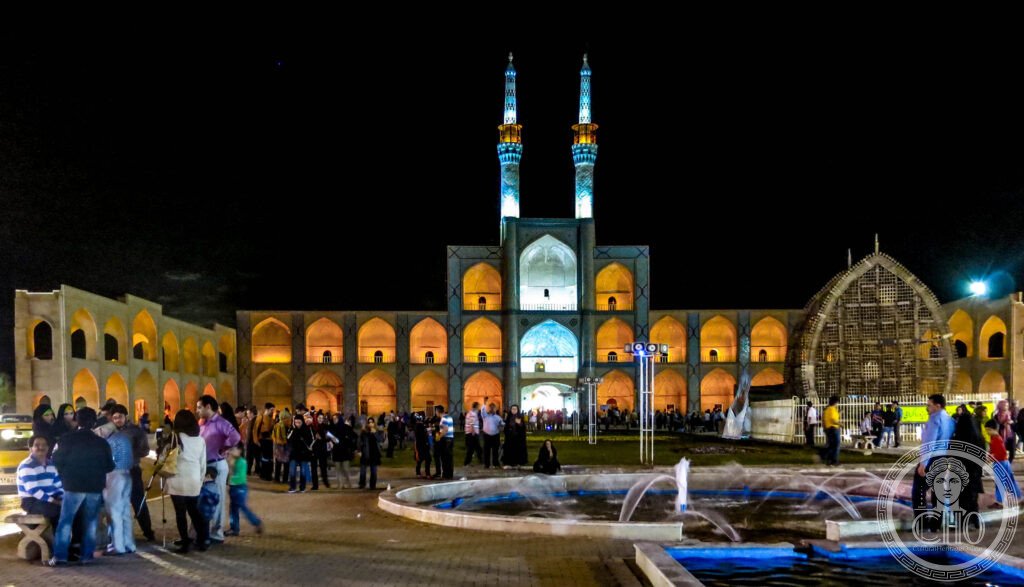
The oldest living city in the world built entirely in mudbrick and terracotta clay. A desert city in central Iran whose organic urban fabric of narrow alleys, domed houses, underground cisterns (ab-ambars), and wind-catching towers (badgirs) has been continuously adapted to the extreme desert environment for 2,500 years, and whose Zoroastrian community (among the oldest continuously living religious communities in the world) has maintained the sacred fire of one of its fire temples without interruption for over 1,500 years.
At a glance
Yazd (Persian: یزد) is a city of approximately 700,000 inhabitants in the Yazd Province of central Iran, in the semi-arid region between the Dasht-e Kavir (Salt Desert) and the Dasht-e Lut (Desert of Emptiness). The historic city centre is built almost entirely in adobe mudbrick, with a colour palette of ochre, terracotta, and pale gold that is determined entirely by the local clay. The organic urban plan (no straight streets, dead-end alleys leading to private courtyards) reflects centuries of incremental adaptation to the desert climate. Yazd is one of the oldest continuously inhabited cities in the world (settled from at least 3000 BC) and is the centre of the Zoroastrian community in Iran. The majority religion of pre-Islamic Persia. UNESCO inscribed the historic city of Yazd in 2017.
Key facts
- Badgirs (Windcatcher Towers): Yazd has the highest density of windcatcher (Persian: بادگیر, bādgīr, “wind-catcher”) towers of any city in the world. The towers rise above the rooftops and catch the prevailing desert wind, channelling it downward through the house interior to cool the living spaces by several degrees below the outside temperature. The towers are orientated toward the prevailing winds (typically south-west in Yazd). The taller the tower, the higher the wind it catches (up to 15–20 metres). The Dowlat Abad Garden badgir (33 metres) is the tallest functioning windcatcher in the world.
- Qanats (Underground water channels): Yazd’s water supply (for much of its history) came from qanats. Gently sloping underground channels that tap aquifers in the mountains 30–50 km away and bring water to the city by gravity. The qanat system is an ancient Iranian technology (dating from at least 3000 years ago) that enabled desert cities to exist without surface rivers. Yazd had over 1,000 km of active qanat channels in the 19th century. Qanats are UNESCO Intangible Cultural Heritage. The underground cisterns (ab-ambars, domed cisterns with stepped access) stored qanat water. The Yazd qanats are still partially functioning.
- Zoroastrianism and the Fire Temples: Yazd is the most important centre of Zoroastrianism in Iran. The Zoroastrian community (approximately 10,000 people, 1–2% of the city’s population) has maintained the Atash Bahram of Yazd (the Yazd Fire Temple) since at least 470 AD, when the sacred fire was brought there from the Sassanid imperial fire. The fire has been burning continuously for approximately 1,550 years (it was moved multiple times between temples, but the same fire; the current fire temple was built in 1934). Non-Zoroastrians may view the fire through a glass panel in the temple’s inner room. The Tower of Silence (Dakhma, 3 km south of the city) is the Zoroastrian sky-burial site. Circular platforms where the dead were exposed to vultures (a practice that has ended in Iran).
- Jameh Mosque (1324–1365): the Friday Mosque of Yazd, built in the 14th century under the Muzaffarid dynasty. The portal (iwan). At 48 metres tall, the highest mosque portal in Iran. Is faced with Timurid-period tilework in geometric patterns of turquoise, cobalt, and white. The pair of minarets above the portal are the tallest in Iran (52 metres). The interior (prayer hall, courtyard, and winter prayer hall) is the finest medieval architecture in Yazd.
- Amir Chakhmaq Complex (15th century): the most photogenic urban ensemble in Yazd. A large three-storey façade of arched niches (the tekieh, a space for Muharram mourning processions) facing a rectangular pool in the city centre. The symmetrical facade is the most frequently reproduced image of Yazd. The complex includes a mosque and a bazaar. The full effect of the façade is best seen at dusk, when the niches are lit and the reflection appears in the pool.
- Heritage: UNESCO World Heritage Site, Historic City of Yazd, inscribed 2017.
- GPS: 31.8974° N, 54.3569° E.
History
Yazd is one of the oldest continuously inhabited places on the Iranian plateau. Evidence of settlement dates from at least 3000 BC. Under the Achaemenid Persian Empire (c. 550–330 BC), the area was settled as a garrison and trade centre. The name “Yazd” is a shortened form of “Yazdegerd,” a Persian royal name, suggesting a connection to the Sasanian period. The city was the capital of the semi-independent Kakuyid dynasty (1041–1119) and then a centre of the Muzaffarid dynasty (1314–1393), under whom the Jameh Mosque and several other major monuments were built. The Timurid period (15th century) added the tile work on the Jameh Mosque portal.
Yazd’s relative isolation in the central Iranian desert protected it from the most destructive Mongol raids of the 13th century (Genghis Khan’s armies destroyed most Iranian cities; Yazd was apparently spared by paying tribute) and from the Ottoman-Safavid border conflicts of the 16th–17th centuries. The city developed a prosperous silk-weaving industry (Yazdi silk, particularly the termeh — a complex multi-coloured woven fabric — remains a Yazd specialty) and a culture of religious tolerance that allowed the Zoroastrian community to maintain its practices even under Islamic rule. The current generation of Yazd’s Zoroastrian community is among the best-educated in Iran, with a long tradition of literacy and scholarship dating from the Avesta (the Zoroastrian sacred text) which they preserved in writing when much of Persian literary culture was destroyed by the Arab conquests.
What you see
The historic city is a labyrinth of narrow mudbrick alleys (some barely wide enough for two people to pass) that open unexpectedly into courtyard houses, caravanserai gates, or mosque complexes. The Amir Chakhmaq Complex is the natural starting point (the central public space of the city). From there, the Jameh Mosque (15 minutes north on foot, through the bazaar), the Ab-Anbar of Haj Khalifeh (a 19th-century double-windcatcher cistern whose interior domed space can be entered for the view of the underground cistern), and the Zoroastrian Quarter (the Jewish and Zoroastrian neighbourhoods of the old city, where the oldest fabric survives) compose a full half-day walk.
The Dowlat Abad Garden (a 18th-century formal garden with the world’s tallest functioning windcatcher, 33 metres; built by the Zand dynasty governor of Yazd in 1750) is 20 minutes walk north of the Amir Chakhmaq. The garden is a UNESCO-listed Persian garden and one of nine Persian gardens inscribed collectively as a UNESCO WHS (2011). The Zoroastrian Fire Temple (5 minutes drive from the historic centre) and the Tower of Silence (3 km south, accessible by taxi) complete the Zoroastrian heritage itinerary. Both are fully open to visitors of all backgrounds.
Practical information
- Getting there: Yazd Airport (AZD) has flights from Tehran (1 hour, Iran Air and Mahan Air) and Mashhad. By train from Tehran (7 hours, Iran Railways, scenic route through the central plateau). By bus from Tehran (8–9 hours) or Isfahan (4 hours). Yazd is on the primary Iran tourist circuit Tehran–Isfahan–Yazd–Shiraz (–Persepolis) and most organised tours include it. Travel to Iran requires a visa (most nationalities can obtain on arrival at Tehran airport; citizens of the US, UK, and Canada cannot obtain visa on arrival as of 2024).
- Best time: October–April (temperatures 12–22°C). The summer heat (June–September, 35–45°C) makes walking in the mudbrick alleys physically demanding, though the windcatcher-cooled interiors of traditional guesthouses maintain a temperature 10–15°C below outside. The Persian New Year (Nowruz, March 20–21) is the busiest period with Iranian domestic tourists.
- Accommodation: Yazd has an excellent range of traditional guesthouses (converted caravanserais and courtyard houses) in the historic city. Staying within the old city walls is strongly recommended. Several of the finest examples of Yazdi domestic architecture are now guesthouses with functioning windcatcher cooling.
Getting there
Yazd Airport (AZD) with flights from Tehran (1h). Train from Tehran (7h). On the Iran tourist circuit Tehran–Isfahan–Yazd–Shiraz. GPS: 31.8974, 54.3569.
Nearby
- Isfahan (Naqsh-e Jahan Square). 270 km north-west of Yazd (4 hours by bus). The Royal Square (Naqsh-e Jahan, 512 × 160 metres) is the second-largest urban square in the world (after Tiananmen) and the finest ensemble of Safavid architecture. The Imam Mosque (1611–29, the blue-tiled masterpiece of Shah Abbas), the Ali Qapu Palace, the Sheikh Lotfollah Mosque (no minaret, for the private use of the Shah’s women), and the Qeysarie Bazaar gate. UNESCO WHS (Meidan Emam, Isfahan) inscribed 1979.
- Persepolis and Shiraz. 380 km south of Yazd (6 hours by bus). Persepolis (the ceremonial capital of the Achaemenid Persian Empire, built by Darius I c. 515 BC and destroyed by Alexander the Great in 330 BC) is the most important pre-Islamic archaeological site in Iran. Shiraz (Hafez’s city, the garden city of Persian poetry) has the Nasir al-Mulk Mosque (the “Pink Mosque”, the most photogenic interior in Iran) and the tomb of Hafez. UNESCO WHS (Persepolis) inscribed 1979.
- Meybod. 45 km north-west of Yazd. A smaller mudbrick desert city with the Narin Qal’a (the most complete mudbrick citadel in Iran, 3,000 years old), the Rabat ice house (a conical mudbrick structure in which natural ice was preserved through the summer using the same physics as the windcatcher towers), and the pigeon tower (an ornate mudbrick dovecote holding 4,000 pigeons, whose droppings were used as fertiliser). An excellent daytrip from Yazd.
Sources
- Wikipedia, Yazd. Zoroastrianism. Badgir, accessed June 2026.
- UNESCO, Historic City of Yazd, WHS reference 1544, inscribed 2017.
- Mary Boyce, Zoroastrians: Their Religious Beliefs and Practices, Routledge, 1979.
- Donald Wilber, The Architecture of Islamic Iran: The Il-Khanid Period, Princeton University Press, 1955.
Find it on the map
See this place and what’s around it →📷 Become a Cultural Heritage Online photographer
Share your photos of places: they stay published under your name as the author. The more they're seen, the more you get noticed — and soon a contest will reward the most appreciated photos.
Log in or sign up free to add a photo