
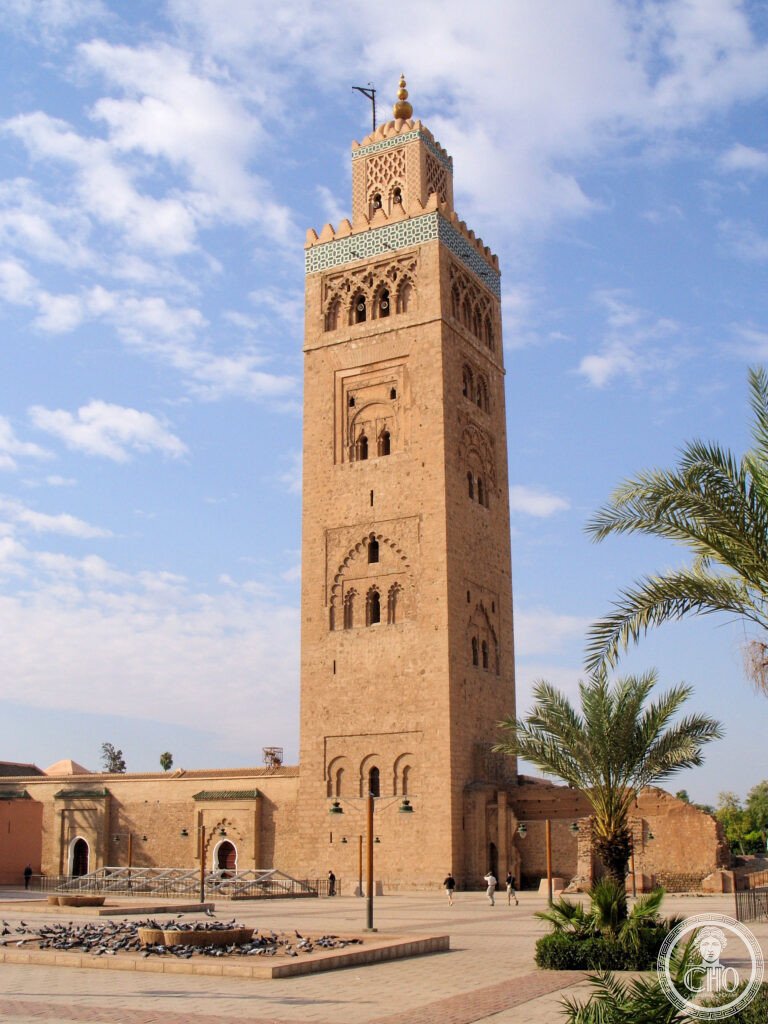
Medina of Marrakesh
The “Red City” of southern Morocco — the former imperial capital of the Almoravid and Almohad dynasties, where the Koutoubia Mosque minaret (1158 AD) set the template for the great minarets of Seville and Rabat, the Ben Youssef Madrasa is the most elaborate Moorish interior on African soil, and the Djemaa el-Fna square — the last great square in the world still functioning as a medieval public theatre of story-tellers, acrobats, snake charmers, and musicians — was inscribed separately by UNESCO as Intangible Cultural Heritage in 2001.
At a glance
Marrakesh (Arabic: مراكش; French: Marrakech) is a city of approximately 900,000 inhabitants in south-central Morocco, at the foot of the High Atlas Mountains. It was founded in 1070 AD as the capital of the Almoravid dynasty, which unified the Maghreb and Al-Andalus (Islamic Spain) under a single kingdom; the name “Marrakesh” gives the country of Morocco its name in most European languages. The medina (old walled city) covers approximately 6 km² and contains the Djemaa el-Fna square, the souks (markets), the Koutoubia Mosque, the Ben Youssef Madrasa, the Saadian Tombs, the Bahia Palace, and the museums within the former palaces. The medina is a UNESCO World Heritage Site inscribed in 1985; the Djemaa el-Fna square was added to the UNESCO List of Intangible Cultural Heritage in 2001.
Key facts
- Koutoubia Mosque and Minaret (1150–1158 AD): the largest mosque in Marrakesh and the archetype of Moroccan-Andalusian religious architecture; the 70-metre minaret (actually twin minarets — the visible one replaced an earlier minaret on the same site when the mosque was rebuilt slightly to correct the qibla direction) set the proportional system (1:5 base-to-height ratio) and decorative programme (four-screen shaft with each face differently decorated in carved stone tracery, a band of ceramic tile below the parapet, and a lantern with a copper ball finial) copied by the Giralda of Seville (1196) and the Hassan Tower of Rabat (1196, unfinished); the mosque interior is not open to non-Muslims
- The Djemaa el-Fna (11th century–present): the central square of Marrakesh, immediately adjacent to the souks; in the morning: orange juice stalls, dentists with their extracted-tooth collections, and the first food vendors; in the afternoon: storytellers (halqa circles), water sellers in traditional costume, snake charmers, and acrobats; in the evening: the food stalls fill the square with smoke and the competing calls of 100 vendors; the “street theatre” nature of the square — each entertainer performing in a circle of spectators who move from circle to circle — is a social form specific to Morocco and almost unchanged from medieval descriptions of the square
- Ben Youssef Madrasa (1564–1565): the largest Islamic seminary in Morocco, built under the Saadian Sultan Abdullah al-Ghalib on the site of a 14th-century Marinid madrasa; the central courtyard (marble floor, marble fountain, Moroccan cedar-wood upper gallery, lower walls of zellige tilework, middle register of carved stucco) is the most elaborate Moorish interior in Africa; the 130 student cells on the upper floors open to the courtyard gallery; the madrasa was a functioning seminary until 1960 and is now a museum
- Saadian Tombs (1578–1603): the mausoleum of the Saadian dynasty, walled off by the Alawite Sultan Moulay Ismail in 1672 (who wanted to erase the memory of his rivals) and rediscovered from aerial photographs in 1917; the Hall of the Twelve Columns (the main royal burial chamber, with 12 Italian Carrara marble columns supporting a cedar-wood muqarnas vault) contains the tombs of Ahmad al-Mansur (the most powerful Saadian ruler, who defeated Portugal at the Battle of the Three Kings in 1578) and his family; the zellige, stucco, and carved cedar work is outstanding
- The High Atlas backdrop: Marrakesh is at the foot of the High Atlas Mountains, visible from the city on clear days (often blocked by haze in summer); the ski resort of Oukaimeden (2,600 m) is 74 km south of Marrakesh; the Toubkal National Park (centred on Jbel Toubkal, 4,167 m, the highest peak in North Africa) is accessible as a two-day trekking circuit from the village of Imlil (80 km from Marrakesh)
- Heritage: UNESCO World Heritage Site, Medina of Marrakesh, inscribed 1985; Djemaa el-Fna inscribed on the UNESCO Intangible Cultural Heritage list, 2001
- GPS: 31.6295° N, 7.9811° W
History
Marrakesh was founded in 1070 by Yusuf ibn Tashfin, the Almoravid commander (later sultan) from the Western Sahara, as the capital of his expanding kingdom. The Almoravids (Berber dynasty from Mauritania) unified Morocco and extended their empire to Al-Andalus (Islamic Spain), making Marrakesh the capital of a kingdom stretching from the Senegal River to the Tagus; Seville, Córdoba, and Granada were all under Almoravid suzerainty. The Koutoubia Mosque was built in two phases (1147 and 1158) under the succeeding Almohad dynasty, which overthrew the Almoravids in 1147.
Marrakesh was the capital of the Almohad Caliphate (which ruled from Marrakesh to Tripolitania and controlled all of the western Mediterranean) at its peak in the 12th century. The Almohad philosopher and physician Ibn Rushd (Averroës, 1126–1198) — whose commentaries on Aristotle transformed European medieval philosophy — worked at the Almohad court in Marrakesh. After the Almohad collapse, the city passed through the Marinid, Wattasid, and Saadian dynasties; the Saadians (1549–1659) made Marrakesh the capital again, built the Ben Youssef Madrasa and the Saadian Tombs, and conducted the Morocco-Songhai War (1591) that destroyed the Mali Empire’s successor state and redirected the trans-Saharan gold trade to Morocco.
The French Protectorate (1912–1956) was headquartered in Rabat rather than Marrakesh, which preserved the city’s medieval character; the French urban planners built a Ville Nouvelle (new town) adjacent to the medina, leaving the medina largely untouched. The post-independence tourism development of Marrakesh (from the 1960s, when the city became fashionable with the Rolling Stones and Yves Saint Laurent, who built his Majorelle Garden there) has transformed the medina into the most visited city in Morocco — approximately 4 million tourists annually — and put severe pressure on the riyad housing market and the traditional craft production of the souks.
What you see
The medina is anchored by the Djemaa el-Fna and entered via the ring of souks north of it: the Souk Semmarine (silk textiles), the Souk El Attarine (spices and perfumes), the Souk Haddadine (metalworkers), and the Souk des Teinturiers (wool dyers). The Koutoubia Mosque is visible from most of the medina as a vertical reference point (the minaret can be seen from the central souks); the Ben Youssef Madrasa is north of the central souk cluster (15-minute walk from the Djemaa).
The Bahia Palace (1894–1900, a 8-hectare complex of 160 rooms built by Grand Vizier Si Moussa and his son Ba Ahmed) and the Dar Si Said Museum (silk-road decorative arts, in a riyad near the Djemaa) represent the decorative arts of the 19th-century Moroccan court at their most opulent: tiled floors extending to the courtyard, painted cedar ceilings, carved stucco arches, and tile-panel walls in the hammam (bath) rooms. The Majorelle Garden (owned by the Yves Saint Laurent Foundation since 1980, restored in the 1990s) is the most famous garden in Morocco — a modernist riyad with cobalt-blue water tanks, cactus and bamboo planting, and a Berber museum in the original Majorelle villa.
Practical information
- Getting there: Marrakesh Menara Airport (RAK) is 6 km south-west of the medina; among the busiest airports in Morocco, with direct flights from London (Heathrow and Gatwick), Paris CDG, Brussels, Amsterdam, Madrid, and most European cities; low-cost carriers (easyJet, Ryanair, Transavia) make Marrakesh one of the most accessible Moroccan cities from Europe; bus 19 from the airport to Djemaa el-Fna (~20 minutes, 30 MAD); taxi (~80 MAD, negotiate firmly)
- Navigation: the medina is large and the street signage is sparse; GPS works but many lanes are too narrow to appear on maps; the Djemaa el-Fna is the universal reference point (always find your way back to it); a guide for the souks north of the Djemaa is recommended for first-time visitors (2–3 hours, 300–500 MAD); the main tourist monuments (Ben Youssef, Saadian Tombs, Bahia Palace, Dar Si Said) are individually accessible without a guide
- Best time: October–April (temperatures 18–25°C); May–September is very hot (35–40°C) but all the tourist facilities and the Djemaa el-Fna operate normally; Ramadan is an interesting time (the square is quiet during the day and intensely alive at night after the iftar); December and January can be cold at night (<10°C) but the Atlas Mountains have snow and are beautiful
Getting there
Marrakesh Menara Airport (RAK) has direct flights from most European cities. Bus 19 from airport to Djemaa el-Fna (30 MAD). Oncf train from Casablanca (3h, Marrakesh station is in the Ville Nouvelle, 10 minutes taxi to the medina). GPS: 31.6295, -7.9811.
Nearby
- Ourika Valley and Jbel Toubkal — the Ourika Valley (the first valley of the High Atlas, 30 km south of Marrakesh) has Berber villages, waterfalls, and argan-oil cooperatives; the Toubkal National Park (centred on Jbel Toubkal, 4,167 m, the highest peak in North Africa) is a classic 2-day trek via Imlil (80 km from Marrakesh); Toubkal requires no technical climbing skills in summer but crampons in winter; the views from the summit (the Atlas range, the Anti-Atlas, and the Sahara on a clear day) are extraordinary
- Aït-Ben-Haddou — the best-preserved ksar (fortified mudbrick village) in Morocco, 200 km south-east of Marrakesh via the Tizi n’Tichka pass (2,260 m, often closed in winter); the ksar has been used as a film location by Ridley Scott (Gladiator), David Lean (Lawrence of Arabia), and many others; UNESCO WHS 1987; the combination of the High Atlas road (some of the finest mountain scenery in North Africa) and the ksar makes this the best day-trip from Marrakesh
- Essaouira — the blue-and-white coastal medina (170 km west, on the Atlantic coast), a former Portuguese fort (16th century) turned Moroccan city that is now famous for its wind (the strongest surf wind in the western Mediterranean, making it the world’s most consistent windsurfing location), its gnawa music, and its woodworking craft (the local thuya-wood marquetry); UNESCO WHS (Medina of Essaouira, formerly Mogador), inscribed 2001
Sources
- Wikipedia, Marrakesh; Koutoubia Mosque; Ben Youssef Madrasa, accessed June 2026
- UNESCO, Medina of Marrakesh, WHS reference 331, inscribed 1985
- Jonathan Bloom and Sheila Blair, Grove Encyclopedia of Islamic Art and Architecture, Oxford University Press, 2009
- Barnaby Rogerson, Morocco, Cadogan Guides, 2000
Find it on the map
See this place and what’s around it →📷 Diventa un fotografo di Cultural Heritage Online
Condividi le tue foto dei luoghi: restano pubblicate con la tua firma come autore. Più vengono viste, più ti fai conoscere — e presto un concorso premierà le foto più apprezzate.
Accedi o registrati gratis per aggiungere una foto