
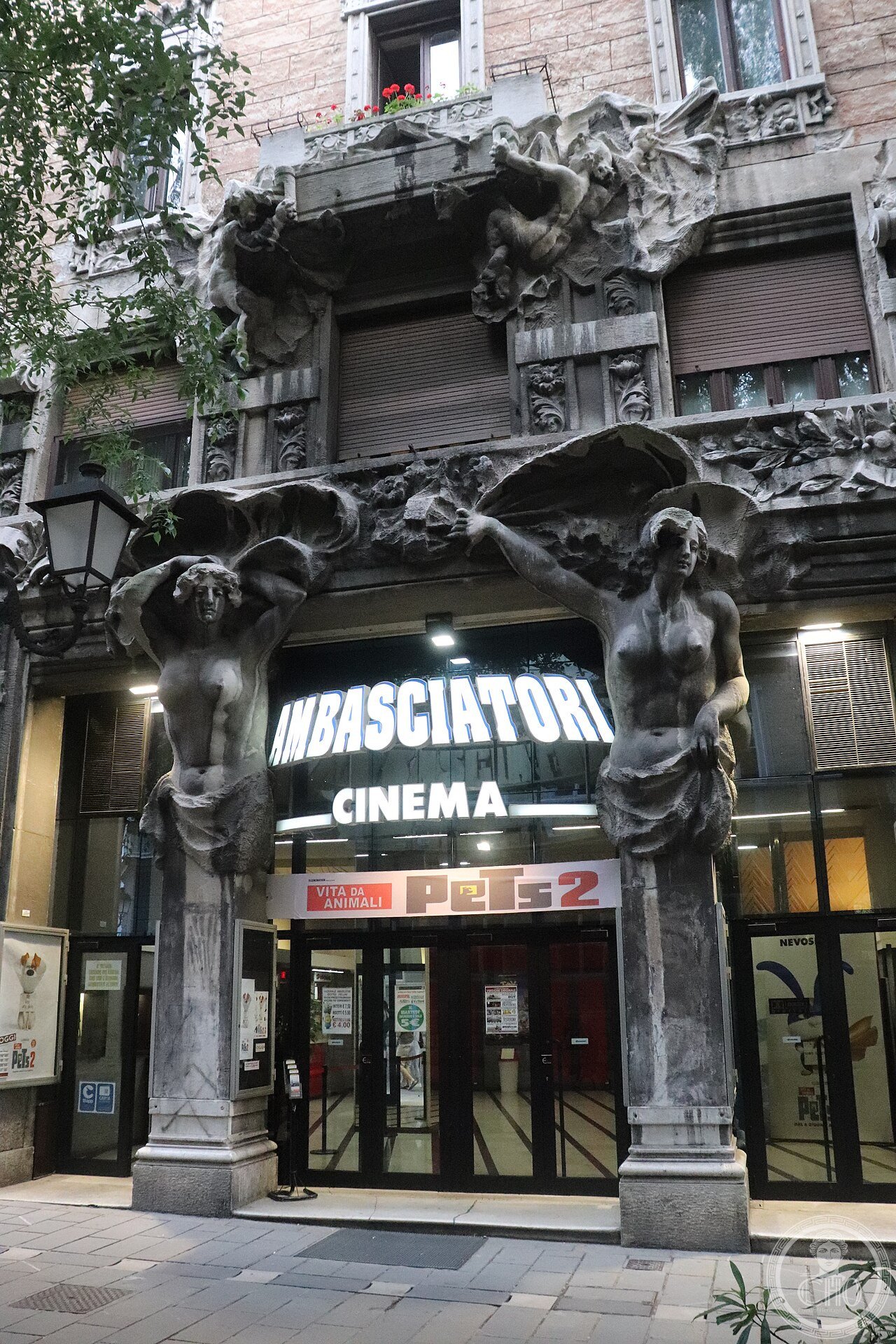

The only Trieste palazzo signed by an Italian Liberty master from the Castiglioni generation: Giuseppe Sommaruga adapted his Milanese Sezessionstil vocabulary to the Mitteleuropean register Fabiani had set down at Casa Bartoli two years earlier.
At a glance
Palazzo Viviani-Giberti stands at Viale XX Settembre 35 and opened on Christmas Day 1907. Giuseppe Sommaruga, the Milanese architect of Palazzo Castiglioni, is the manifesto of Italian Sommaruga-school Liberty in Corso Venezia; Viviani-Giberti is the only Trieste palazzo signed by an architect of that Italian Liberty generation. The building was conceived as an amateur dramatic theatre with two galleries, a stalls area and a large stage — a complete theatre-residence-commercial block in one elevation.
Key facts
- Architect: Giuseppe Sommaruga (Milan)
- Completed: Christmas Day 1907
- Address: Viale XX Settembre 35, 34125 Trieste
- Style: Liberty (Italian Sommaruga school)
- Sculptor: Romeo Rathmann (entrance statues)
- Original use: Amateur dramatic theatre with residential and commercial levels
- Converted: 1951 — Cinema Eden (now Cinema Ambasciatori)
- GPS: 45.6521, 13.7821
History
Sommaruga came north from Milan to Trieste to build Viviani-Giberti, and adapted his Liberty grammar to the Mitteleuropean register that Fabiani and Depaoli had already established in the city. Romeo Rathmann — the same sculptor who worked on Casa Terni-Smolars and Casa Polacco for Depaoli — supplied the impressive female statues that flank the entrance pilasters. The building’s second life began in 1951 when fire-safety adaptations and conversion to the Cinema Eden stripped much of the interior decoration. It now operates as Cinema Ambasciatori. The exterior is intact.
What you see
The pilasters and stone architraves carry floral patterns characteristic of Sommaruga’s Milan vocabulary, but the scale and proportions answer the Trieste street rather than Corso Venezia. Read the façade as Sommaruga writing in a Mitteleuropean dialect. This is what Sommaruga’s Castiglioni manifesto looked like when it crossed the Adriatic and tried to argue with Vienna instead of Milan. Stand across Viale XX Settembre at the south end of the avenue and compare the line of the building with what you saw at Casa Bartoli.
Practical information
- Access: Cinema Ambasciatori — exterior free; interior access during cinema screenings
- Programme: Check local listings for film times
- Time needed: 10 minutes for exterior
Getting there
Viale XX Settembre is the main avenue connecting the Borgo Teresiano grid to the seafront. From the Sinagoga di Trieste (Via San Francesco), walk south 5 minutes to reach the palazzo at n. 35.
Nearby
- Sinagoga di Trieste (Berlam, 1912) — 200 m north, Via San Francesco 19
- Hotel Savoia Excelsior Palace (Fiedler, 1911) — 700 m south-west, Riva del Mandracchio 4
- Piazza Unità d’Italia — 600 m south-west, Trieste’s main civic square
Sources
- Beniculturali.comune.trieste.it: Palazzo Viviani-Giberti — Sommaruga 1906–07, Rathmann statues, Christmas Day 1907 inauguration
- Wikimedia Commons: Photo, Andrzej Otrębski, CC BY-SA 4.0
Find it on the map
See this place and what’s around it →Record researched and written by Carla Szathvary for Cultural Heritage Online, 2026.
📷 Become a Cultural Heritage Online photographer
Share your photos of places: they stay published under your name as the author. The more they're seen, the more you get noticed — and soon a contest will reward the most appreciated photos.
Log in or sign up free to add a photoIs this page about you?
This page is read by travellers and heritage enthusiasts who find it on Google. Tell us how you are connected to this place and we will take it from there.