
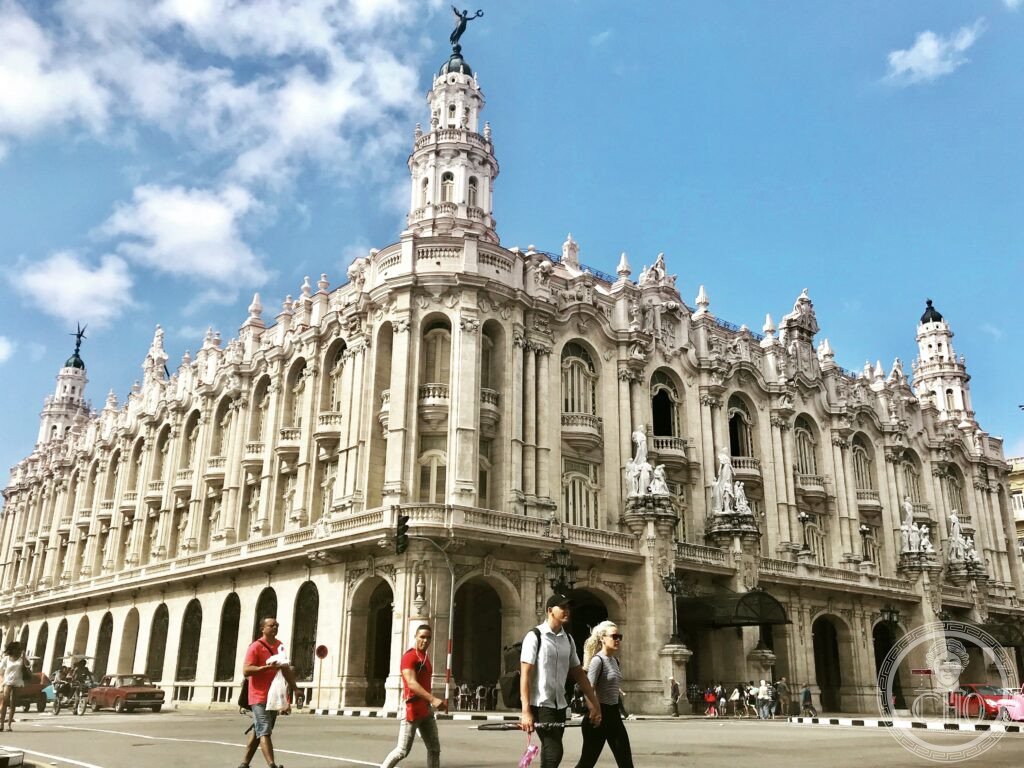
The Galician immigrants of Havana commissioned Paul Belau to give their community the most extravagant building on the Paseo del Prado — a Cuban Baroque palace of art that opened in 1915 and has been the home of the Cuban National Ballet since 1950. Since 2015 it carries the name of Alicia Alonso, the ballet legend who founded the company.
At a glance
The Gran Teatro de La Habana Alicia Alonso stands on Havana’s Paseo del Prado at the edge of the Parque Central, the grandest pedestrian boulevard of Cuba’s capital. Designed by the Belgian architect Paul Belau and built by Purdy and Henderson Engineers, it opened in 1915 on the site of the former Teatro Tacón (Havana’s nineteenth-century principal theatre). Its construction was paid for by the Galician immigrant community of Havana through their mutual aid society, the Centro Gallego — which gave the building its first name, Palacio del Centro Gallego. Since 1950 it has been the home of the National Ballet of Cuba, founded that year by Alicia Alonso; since 2015 it carries her name. The García Lorca auditorium seats 1,500.
Key facts
- Architect: Paul Belau (Belgian)
- Builder: Purdy and Henderson Engineers
- Opened: 1915
- Style: Cuban Baroque Revival / Eclectic
- Capacity: 1,500 (García Lorca Auditorium)
- Location: Paseo del Prado, Parque Central, Havana, Cuba
- GPS: 23.1369, −82.3594 — Google Maps
- Tenants: Cuban National Ballet (1950–present); International Ballet Festival of Havana (1960–present)
- Name history: Palacio del Centro Gallego (1915) → Gran Teatro Centro Gallego (1902–1961) → Gran Teatro de La Habana (1985–2015) → Gran Teatro de La Habana Alicia Alonso (2015–present)
History
The story of the Gran Teatro begins with the Galician immigration to Cuba in the nineteenth and early twentieth centuries. Galicia — the Atlantic region of northwest Spain — sent hundreds of thousands of emigrants to Cuba, where they formed one of the most organised immigrant communities on the island. Their mutual aid society, the Centro Gallego, was founded in 1879 and by the early twentieth century had accumulated enough resources and cultural ambition to commission a building that would serve the community’s social, educational, and cultural needs while also presenting to Havana the spectacle of Galician collective achievement.
The commission went to the Belgian architect Paul Belau, who designed a building in a freely interpreted Cuban Baroque Revival style — elaborating the Baroque tendencies already present in Havana’s colonial architecture with the ornamental density of the Belle Époque. The building replaced the Teatro Tacón, which had been the city’s principal theatre since 1838; Belau’s structure incorporated the Tacón within its larger programme, giving the new Palacio del Centro Gallego a theatre at its core while wrapping it in ballrooms, meeting rooms, and the administrative spaces of the Centro. The building opened in 1915.
The political changes of the early 1960s nationalised the building and transferred it to the state. In 1950, Alicia Alonso (1920–2019) — the Cuban ballerina who had trained in New York and performed internationally before returning to Cuba — founded the National Ballet of Cuba and established it in the Gran Teatro. She directed the company for nearly seven decades; in 2015, on her 95th birthday, the Cuban government renamed the building in her honour. Alonso died in 2019 but the company and the festival she created continue.
What you see
The exterior of the Gran Teatro is among the most exuberant in the Caribbean: a free composition in carved stone in which Baroque arches, columned loggia, corner towers with pavilion roofs, and an ornamental programme of angels, cartouches, and figural sculpture accumulate over four storeys to create a façade of deliberately theatrical excess. The scale of the building and the density of its ornament have no equivalent in Havana; even from Parque Central, the building dominates its setting.
The interior García Lorca auditorium — the principal performance space — has an intimate horseshoe plan with four tiers of boxes, red velvet seating, and an elaborate painted ceiling. The foyer sequence and staircase carry through the ornamental programme of the exterior in plasterwork, mosaic, and gilded detail. The building was restored in 2004 and again in 2015 in preparation for the renaming ceremony.
Practical information
- Home of the Cuban National Ballet; performances of ballet and opera throughout the season.
- Tickets for performances at the box office on Paseo del Prado; advance booking recommended.
- The International Ballet Festival of Havana (biennial) is the major annual event, attracting companies from across the world.
- The exterior is freely visible from Parque Central and Paseo del Prado at all hours.
- Guided tours of the interior may be arranged through the theatre administration.
Getting there
The Gran Teatro is on Paseo del Prado at the western edge of Parque Central, in the heart of Havana’s old city. From José Martí International Airport (HAV, 20 km south), taxi takes 30–40 minutes to the Parque Central area. The Capitol building (Capitolio Nacional), the Museum of Fine Arts, and the Hotel Nacional are all within 15 minutes’ walk.
Nearby
- Capitolio Nacional de Cuba — 300 m south, Neoclassical capitol building (1929)
- Parque Central — directly in front, the main park of historic Havana with the Martí statue
- Hotel Inglaterra — 100 m south, Havana’s oldest hotel (1875), Moorish Revival
- Habana Vieja (Old Havana) — UNESCO World Heritage Site, 10-minute walk east
Sources
- Wikipedia (EN): Gran Teatro de La Habana — architect Paul Belau (Belgian); Purdy and Henderson Engineers; 1914–1915; site of former Teatro Tacón; Galician community commission (Centro Gallego); 1,500 seats (García Lorca Aud.); National Ballet of Cuba 1950–present; GPS 23.1369/−82.3594; renamed 2015 for Alicia Alonso
- Wikipedia (EN): Alicia Alonso — founder of Cuban National Ballet (1920–2019); biography; International Ballet Festival of Havana (1960)
- Wikipedia (EN): Centro Gallego de La Habana — Galician immigrant mutual aid society history
Find it on the map
See this place and what’s around it →📷 Become a Cultural Heritage Online photographer
Share your photos of places: they stay published under your name as the author. The more they're seen, the more you get noticed — and soon a contest will reward the most appreciated photos.
Log in or sign up free to add a photoDo you manage this place?
This page is read by travellers and heritage enthusiasts who find it on Google. Keep it accurate — and make it work for you. Free for non-profit heritage institutions.