
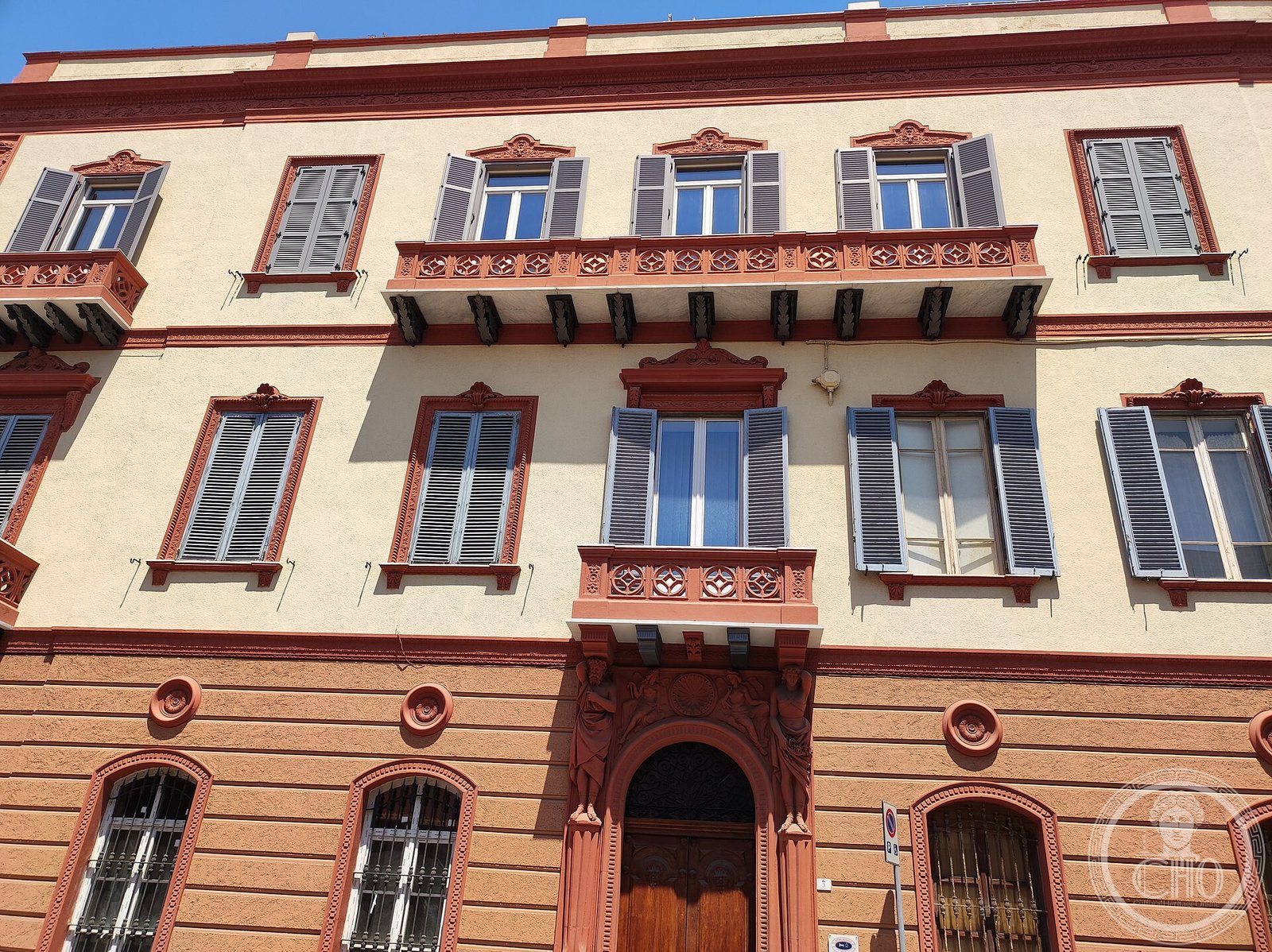

Riccardo Simonetti’s 1914 palazzo on Via Trento marks the moment Cagliari’s architecture crossed from nineteenth-century eclecticism into Liberty — botanical window frames and projecting carved cornices rising from a solid rusticated base in the Stampace quarter.
At a glance
Palazzo Merello stands on Via Trento in Cagliari’s historic Stampace quarter, with a secondary facade facing the street that now bears the family name. Designed in 1912 and completed around 1914 by architect Riccardo Simonetti, the building is considered a mature expression of early Sardinian Liberty: a style that had reached the island later than mainland Italy but produced work of real quality before the First World War. The Merello family, originally from Liguria and established in Cagliari through mining, chemical industry and grain commerce, commissioned the palazzo as an emblem of their economic and social position. Unlike much of Stampace, the building survived the 1943 Allied air raids intact. It is now listed as a protected cultural heritage site.
Key facts
- Architect: Riccardo Simonetti
- Designed: 1912; completed c. 1914
- Style: Sardinian Liberty (transition from late eclecticism to Art Nouveau)
- Patron: the Merello family (mining, chemistry, grain commerce; originally from Liguria)
- Address: Via Trento, Stampace, Cagliari (secondary facade: Via Luigi Merello)
- Status: protected cultural heritage site
- GPS: approx. 39.2185° N, 9.1080° E — Google Maps (coordinates approximate — verify on site)
History
The Merello family arrived in Sardinia from Liguria and built a commercial empire spanning mining, chemical production and grain trade. By the early twentieth century they were among Cagliari’s most prominent bourgeois families, and the commission to Riccardo Simonetti in 1912 was a statement of that standing. Simonetti designed a building that sat at the junction of two architectural moments: the rusticated base and restrained massing of the outgoing eclectic tradition, and the plant-derived ornamental language of the incoming Liberty movement.
The palazzo was complete by around 1914, as the decorative style it embodied was already beginning to give way to early Rationalism on mainland Italy. In Sardinia, Liberty continued longer, partly because of the island’s geographic remove and partly because local patrons were just then reaching the prosperity to commission ambitious residential architecture. The Merello palazzo survived the 1943 Allied bombardments that left much of Stampace in ruins — a fact that makes it one of the most intact examples of the city’s pre-war residential Liberty stock. It is now under heritage protection.
What you see
The rusticated stone base anchors the building solidly to Via Trento before the upper floors open into the Liberty vocabulary. Botanical and floral motifs wrap the window frames; the carved brackets that support the projecting cornice are the facade’s most sculptural element, each one carrying a different organic form. Stone balustrades run across the balcony fronts, giving the upper floors a horizontal rhythm that contrasts with the vertical botanical energy of the window surrounds.
Inside, Simonetti continued the decorative programme through painted ceilings and carefully selected materials intended to project bourgeois prestige. The building is residential and not open to the public, but the main facade on Via Trento and the secondary elevation reward a slow circuit of the block.
Practical information
- Access: exterior only; residential building, no public interior access
- Best time to visit: morning, when eastern light catches the carved cornice brackets
- Time needed: 10 minutes to walk both facades
Getting there
Palazzo Merello stands in the Stampace quarter, roughly 15 minutes on foot northwest from the Palazzo Civico on Via Roma. From Piazza Yenne, take Via Azuni or Via Manno toward Stampace. CTM buses serving Viale Trento stop near the building. Street parking is available on the surrounding streets.
Nearby
- Palazzo Civico di Cagliari — Liberty-Gothic-Catalan city hall on Via Roma, 15 minutes east
- Chiesa di Sant’Anna — eighteenth-century baroque church in Stampace, nearby
- Bastione di Saint Remy — panoramic bastion above the old city, 20 minutes on foot
Sources
- Wikipedia IT: Palazzo Merello
- Comune di Cagliari: comune.cagliari.it
- Sardegna Cultura: sardegnacultura.it
Find it on the map
See this place and what’s around it →Record researched and written by Carla Szathvary for Cultural Heritage Online, 2026.
📷 Become a Cultural Heritage Online photographer
Share your photos of places: they stay published under your name as the author. The more they're seen, the more you get noticed — and soon a contest will reward the most appreciated photos.
Log in or sign up free to add a photoIs this page about you?
This page is read by travellers and heritage enthusiasts who find it on Google. Tell us how you are connected to this place and we will take it from there.