
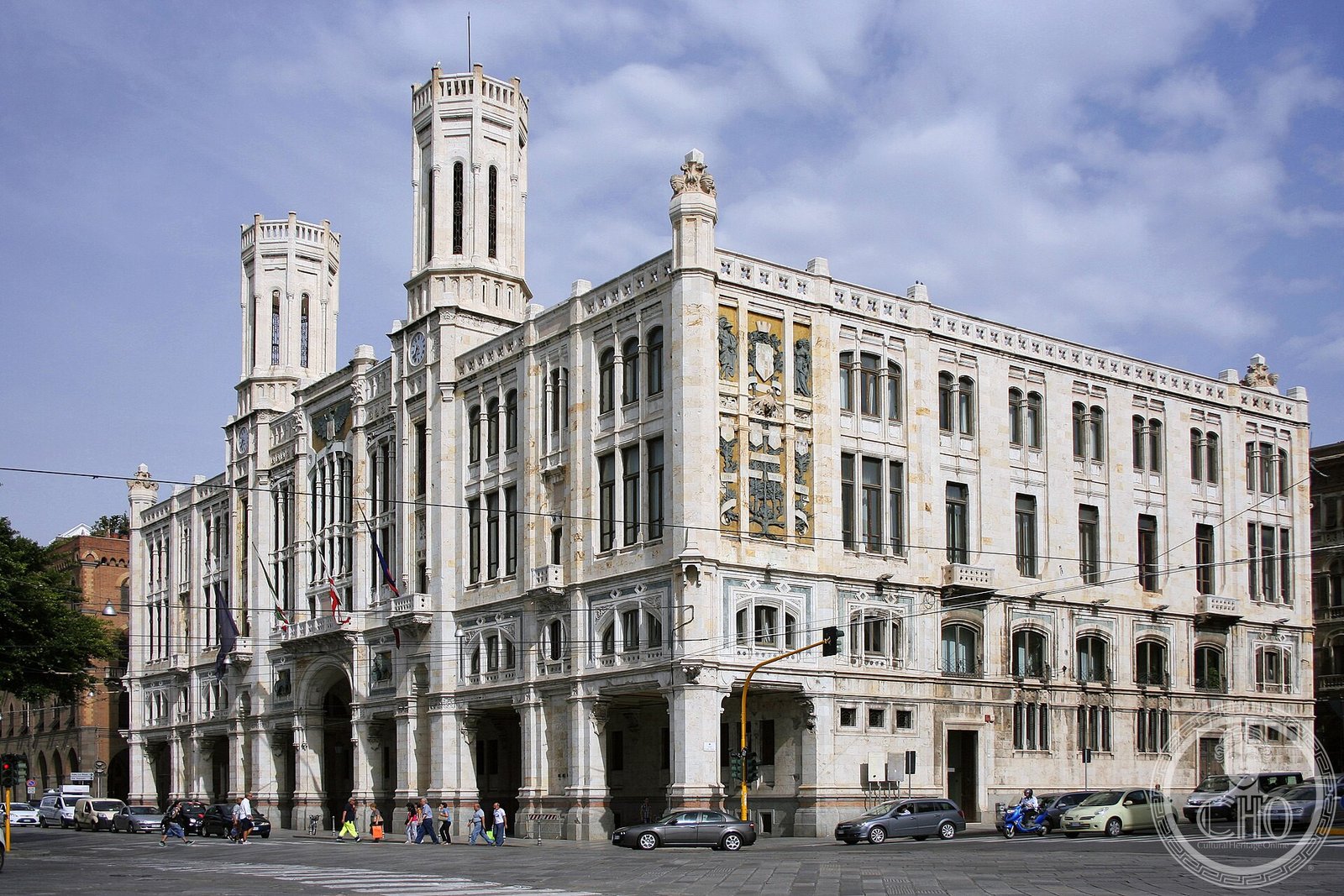

Cagliari’s city hall rises on Via Roma in pale limestone, fusing Liberty ornament with pointed Gothic-Catalan arches — one of southern Italy’s most distinctive civic buildings of the early twentieth century.
At a glance
Known informally as Palazzo Bacaredda, after the mayor who championed its construction, the Palazzo Civico occupies the corner of Via Roma and Largo Carlo Felice in the Stampace quarter. Annibale Rigotti, a Turin architect with a firm command of Liberty idiom, designed the facade and its carved ornament; Crescentino Caselli oversaw the structural work. The building took eight years to complete and was not inaugurated until 1914. Heavily damaged during the Allied bombing of 1943, it was restored and returned to use by 1953, and it remains the seat of Cagliari’s municipal government today.
Key facts
- Design competition: 1896
- Facade awarded to Rigotti: 1902
- Construction: 1899–1907
- Inauguration: 1914
- Architects: Annibale Rigotti (facade & decoration); Crescentino Caselli (structural supervision)
- Style: Liberty with Gothic-Catalan elements
- Address: Via Roma, angolo Largo Carlo Felice, Quartiere Stampace, Cagliari
- GPS: 39.2153° N, 9.1103° E — Google Maps
History
The municipality of Cagliari launched an architectural competition for a new seat of civic government in 1896. The brief called for a monumental building that would signal the city’s ambitions on its most prominent waterfront avenue, Via Roma. The competition attracted proposals from architects working across the Italian peninsula.
By 1902 the jury had assigned the facade design and decorative programme to Annibale Rigotti, a Turin-trained architect who brought the Liberty vocabulary then flourishing in northern Italy into dialogue with Sardinia’s own medieval heritage. Construction had already begun in 1899 under the structural supervision of Crescentino Caselli; the building was substantially complete by 1907, though formal inauguration was delayed until 1914. The mayor of the period, Ottone Bacaredda, gave the building its popular name.
Allied air raids in 1943 badly damaged the structure. A sustained programme of repair and restoration ran from 1946 to 1953, returning the building to civic use. The restored Palazzo Civico has served as Cagliari’s city hall ever since.
What you see
The pale limestone facade stretches along Via Roma in a sequence of pointed arches — Gothic in silhouette but dressed with the flowing plant motifs and carved female masks of Italian Liberty. The roofline rises into slender pinnacles that catch the Sardinian light and throw thin shadows across the upper loggia. Rigotti borrowed the pointed arcade from Catalonia’s medieval civic tradition, then grafted onto it the sinuous ornamental language of early twentieth-century European modernism.
At street level the entrance portico draws pedestrians in from the main promenade. Carved floral panels frame each storey; the sculptural detail grows denser toward the corner tower, which anchors the junction of Via Roma and Largo Carlo Felice. Inside, the council chamber and ceremonial halls retain original decorative work, though public access to the interior is limited to official functions and periodic open days.
Practical information
- Exterior: visible at any time from Via Roma and Largo Carlo Felice
- Interior access: limited — check the Comune di Cagliari website for open-day events
- Best time to visit: morning or late afternoon, when low light catches the carved limestone detail
- Time needed: 10–15 minutes for the exterior; allow longer on an open day
Getting there
The Palazzo Civico stands on Via Roma, Cagliari’s main seafront avenue. The nearest public transport hub is Piazza Matteotti (CTM bus terminal), a two-minute walk east. From Cagliari Centrale railway station, cross Piazza Matteotti and walk west along Via Roma for roughly 300 metres. Parking is available along the Lungomare Cristoforo Colombo and in the Via Roma underground garage.
Nearby
- Bastione di Saint Remy — panoramic bastion above the old quarter, 10 minutes on foot
- Castello district — medieval walled citadel visible from Via Roma
- Via Roma colonnade — the arcaded waterfront promenade flanking the building to the south
- Palazzo Valdès — another Liberty-era palazzo in the Villanova quarter, 15 minutes on foot
Sources
- Wikipedia IT: Palazzo Civico (Cagliari)
- Comune di Cagliari: comune.cagliari.it
- Sardegna Turismo: sardegnaturismo.it
- Candidooperti: scheda storica Palazzo Civico
Find it on the map
See this place and what’s around it →Record researched and written by Carla Szathvary for Cultural Heritage Online, 2026.
📷 Become a Cultural Heritage Online photographer
Share your photos of places: they stay published under your name as the author. The more they're seen, the more you get noticed — and soon a contest will reward the most appreciated photos.
Log in or sign up free to add a photoIs this page about you?
This page is read by travellers and heritage enthusiasts who find it on Google. Tell us how you are connected to this place and we will take it from there.