
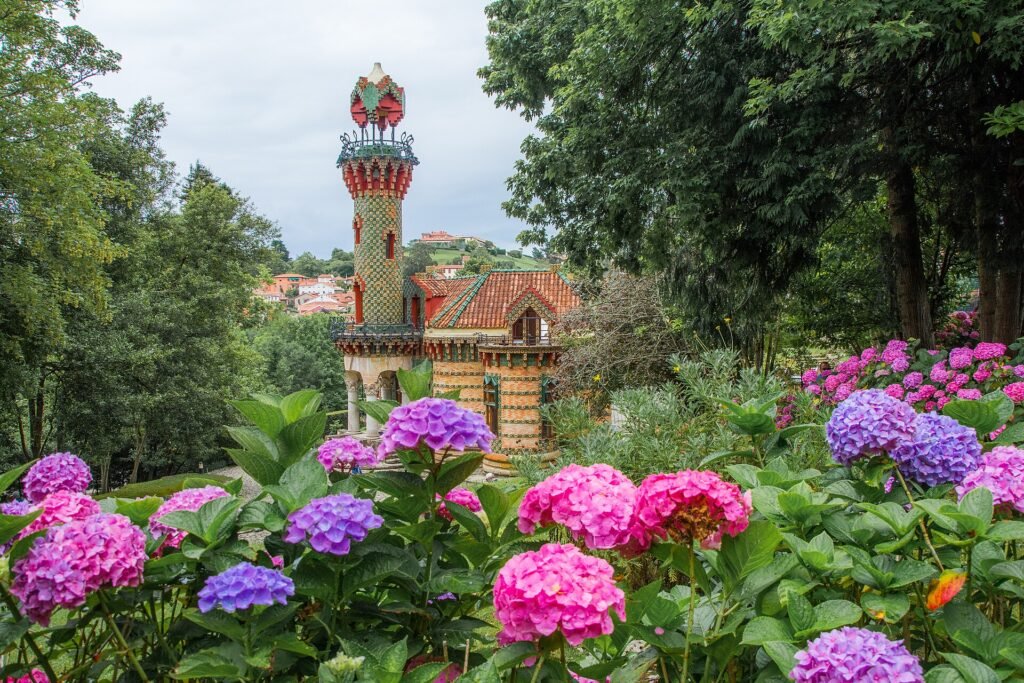
A summer villa of striped brick and sunflower tiles, one of the few buildings Gaudí ever raised outside Catalonia.
At a glance
El Capricho, formally the Villa Quijano, stands on a wooded slope below the cemetery of Comillas on the Cantabrian coast. Antoni Gaudí designed it between 1883 and 1885 for Máximo Díaz de Quijano, an indiano who had made his fortune in the Americas. Gaudí never came to the site; the work was supervised on the ground by his colleague Cristóbal Cascante. It is one of only a handful of buildings the architect raised outside Catalonia, and the most playful of his early works, a fantasy of brick, iron and glazed ceramic still drenched in the Orientalist taste of the 1880s.
Key facts
- Location: Barrio de Sobrellano, Comillas, Cantabria
- Architect: Antoni Gaudí (site supervision by Cristóbal Cascante)
- Built: 1883–1885
- Style: Orientalist early Gaudí, a forerunner of Modernisme
- Today: a museum (since 2009), open to visitors
History
Máximo Díaz de Quijano wanted a summer house near the palace his relatives were raising at Comillas, and he gave the commission to the young Gaudí, then barely past his studies. The architect answered with a small villa that owes nothing to the grand stone of northern Spain. He clad it in red brick and ran bands of ceramic tiles around the whole building, each tile stamped with a sunflower and a green leaf.
Quijano died in 1885, a year before the house was finished, and never lived in the building made for his pleasure. The villa passed through private hands and, after the Civil War, slid towards ruin, even though it had been declared a cultural monument in 1969. In 1992 a Japanese group bought and restored it, and in 2009 El Capricho opened as a museum devoted to Gaudí and to the house itself.
For all its early date, the villa already shows the obsessions of the mature Gaudí: nature turned into ornament, colour used without restraint, and a structure shaped around the path of the sun.
What you see
The eye goes first to the tower. A slim cylinder sheathed in sunflower tiles rises over the entrance porch like a minaret, carried on four stone columns, a deliberate echo of Persian and Mughal models. Below it the long brick body of the house is striped horizontally with the same flowered ceramic, so the whole villa seems wrapped in ribbon.
Look closer and the details turn musical. The iron railings of the balconies were designed so that raising or lowering the counterweighted sashes rings small pipes. Sunflowers, the flower that turns to follow the light, set the theme; the rooms behind were arranged to catch the southern sun. It is a house built as a private joke about warmth, made by a Catalan for a man who wanted the Mediterranean on the Atlantic coast.
Practical information
- Open: daily as a museum (Museo El Capricho de Gaudí); hours vary by season
- Cost: admission charge
- Best for: the sunflower-tiled tower and the ironwork balconies
- Time needed: 45–60 minutes
Getting there
Comillas lies on the Cantabrian coast about 50 km west of Santander; El Capricho is a short signposted walk from the village centre, beside the Sobrellano palace and chapel.
Nearby
- Palacio de Sobrellano — the neo-Gothic palace of the Marquis of Comillas, just above El Capricho
- Universidad Pontificia de Comillas — the great seminary on the hill, with Modernista detailing by Domènech i Montaner
Sources
- Museo El Capricho de Gaudí (elcaprichodegaudi.com) — history and visits
- Turismo de Cantabria / Ayuntamiento de Comillas — El Capricho
- Wikimedia Commons — image source and licence
Find it on the map
See this place and what’s around it →Record researched and written by Luigi De Marchi for Cultural Heritage Online, 2026.
📷 Become a Cultural Heritage Online photographer
Share your photos of places: they stay published under your name as the author. The more they're seen, the more you get noticed — and soon a contest will reward the most appreciated photos.
Log in or sign up free to add a photoIs this page about you?
This page is read by travellers and heritage enthusiasts who find it on Google. Tell us how you are connected to this place and we will take it from there.