
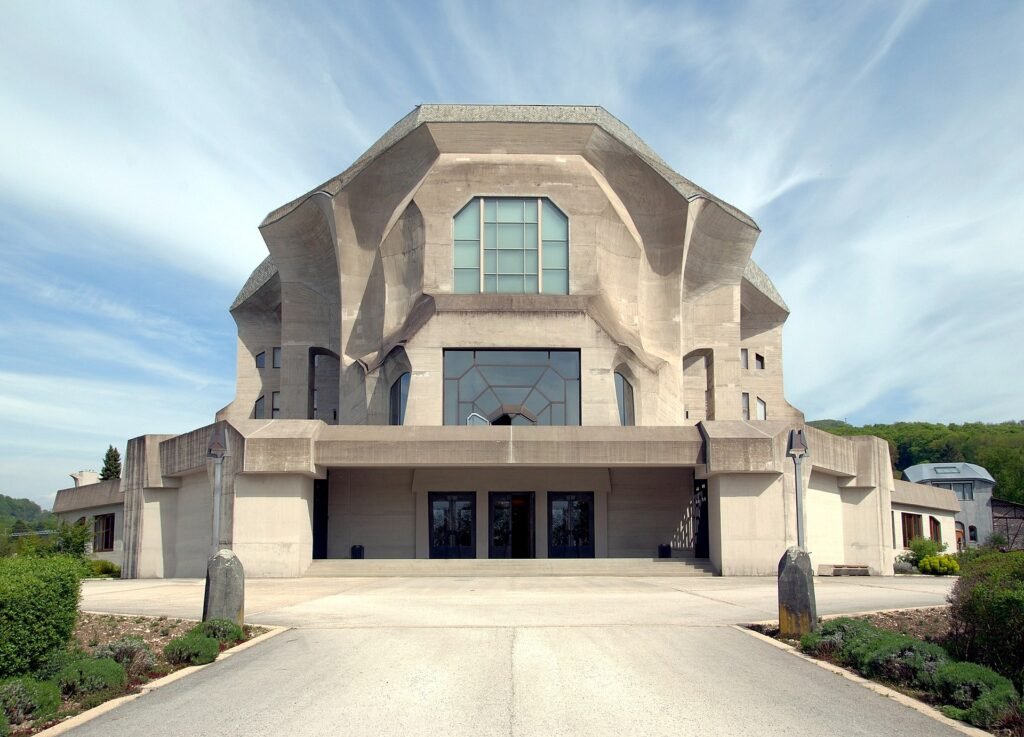
A building cast like a sculpture: Steiner shaped poured concrete into curves no straightedge could draw.
At a glance
On a hill at Dornach near Basel stands the Goetheanum, the world centre of the anthroposophical movement founded by Rudolf Steiner. The present building, of 1925 to 1928, is moulded from poured concrete into great curved forms, a landmark of Expressionist architecture. It holds a large auditorium and is named after the poet Goethe.
Key facts
- Location: Dornach, near Basel, Switzerland
- Designer: Rudolf Steiner
- Built: 1925–1928 (second Goetheanum)
- Style: Expressionism, in poured concrete
- Function: cultural centre and theatre of anthroposophy
History
Steiner’s first Goetheanum, an extraordinary double-domed building of wood, was destroyed by fire on New Year’s Eve 1922. He resolved to rebuild in a material that could not burn.
For the second building he turned to reinforced concrete, modelling it by hand into sweeping, organic shapes. He died in 1925, before it was finished; the work was completed to his designs by 1928. It remains the seat of the movement and a place of performance and study.
What you see
There are almost no right angles. Walls bulge and fold; windows are cut as irregular openings; the great west front leans and curves like something grown rather than built. Inside, a large hall stages plays and the movement art of eurythmy. Few buildings push concrete this far toward sculpture.
Practical information
- Open: daily; guided tours and performances scheduled
- Cost: grounds free; tours and events ticketed
- Best for: the sculptural concrete forms and the great hall
- Time needed: 45–90 minutes
Getting there
Dornach is a short train ride south of Basel; the Goetheanum is signposted from Dornach station and reached by a walk uphill or a local bus.
Nearby
- Basel — the museum city on the Rhine, just to the north
- Dornach — the village and the anthroposophical campus around the building
Sources
- Encyclopædia Britannica / Wikipedia — Goetheanum
- Goetheanum — official site (anthroposophical society)
- Wikimedia Commons — image source and licence
Find it on the map
See this place and what’s around it →Historical events at this place (1)
📷 Become a Cultural Heritage Online photographer
Share your photos of places: they stay published under your name as the author. The more they're seen, the more you get noticed — and soon a contest will reward the most appreciated photos.
Log in or sign up free to add a photoIs this page about you?
This page is read by travellers and heritage enthusiasts who find it on Google. Tell us how you are connected to this place and we will take it from there.