
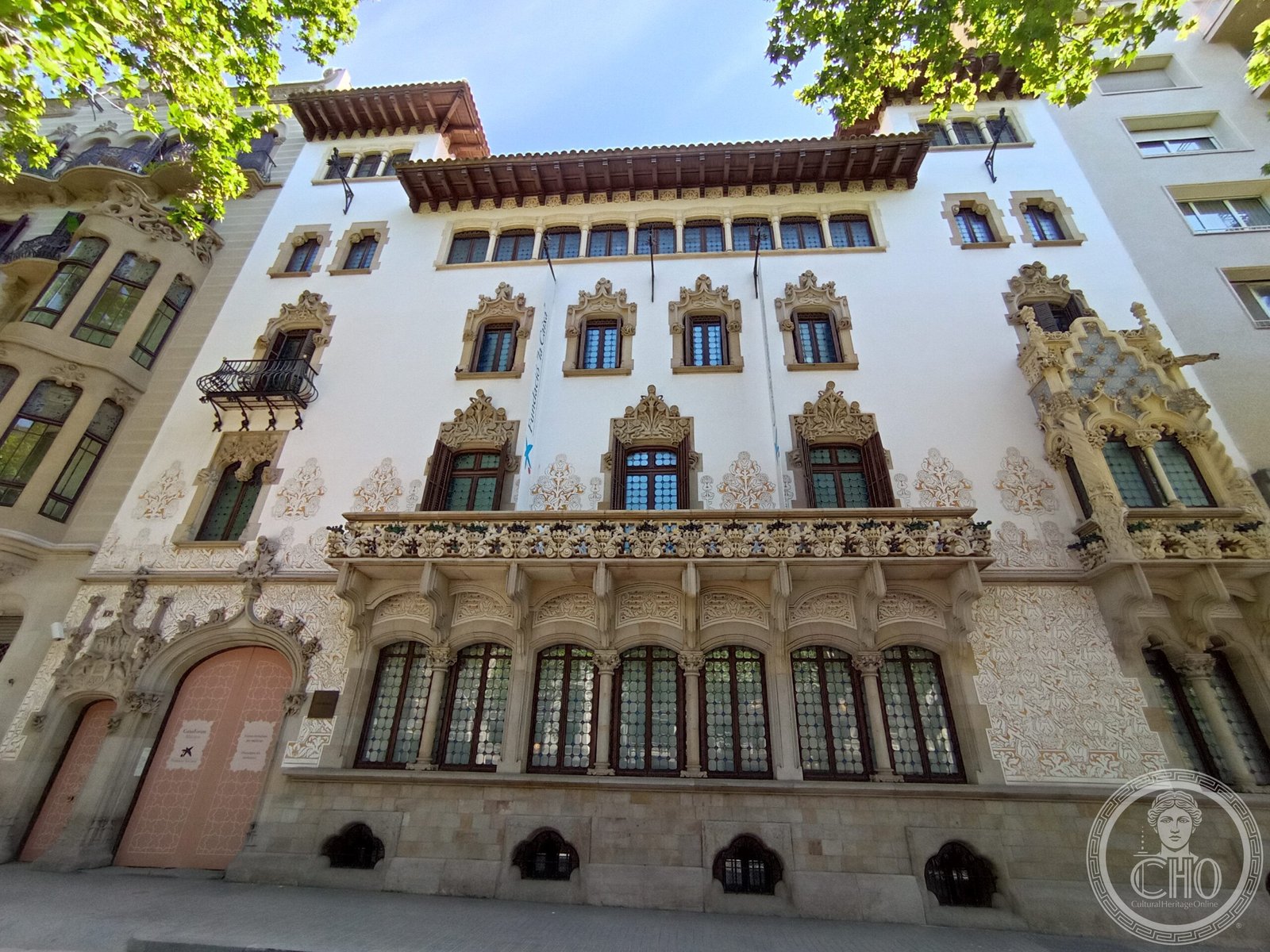
A white palace scratched all over with ornament — carved, it is said, with everything from a workman’s tools to a cyclist.
At a glance
The Palau Macaya rises on the Passeig de Sant Joan in Barcelona, designed by Josep Puig i Cadafalch and built between 1898 and 1901, soon after his neighbouring Casa Amatller. Behind a white facade covered in delicate sgraffito and crowned with Gothic-revival sculpture, it gathered the leading decorative artists of the Modernista movement. Declared a national monument in 1976, it became the first home of the cultural centre of the La Caixa foundation, and today it operates as the CaixaForum Macaya, a venue for talks and exhibitions.
Key facts
- Architect: Josep Puig i Cadafalch
- Built: 1898–1901
- Client: Romà Macaya i Gibert
- Artists: sgraffito by Joan Paradís; sculpture by Eusebi Arnau and Alfons Juyol
- Address: Passeig de Sant Joan 108
- Now: CaixaForum Macaya cultural centre
History
In 1899 the businessman Romà Macaya i Gibert commissioned Puig i Cadafalch to build a palace on the Passeig de Sant Joan. Completed in 1901, just after Casa Amatller, it earned a mention in the city’s annual competition for artistic buildings.
The work drew on the crafts the Modernista movement championed: sgraffito by Joan Paradís, tile designs by Antoni Maria Gallissà, ironwork by Manuel Ballarín and sculpture by Eusebi Arnau and Alfons Juyol.
The palace later passed to the La Caixa foundation, served for decades as an institute and then a cultural centre, and reopened in 2012 as the CaixaForum Macaya.
What you see
The facade is pale and luminous, its plaster incised with fine white-on-white sgraffito patterns that spread like lacework across the wall. A deep carved doorway and Gothic-inspired window galleries break the surface, with sculpture by Eusebi Arnau adding figures and detail.
Within is a typical Modernista courtyard with a grand staircase, ceramic and ironwork throughout. The building’s mix of medieval reference and modern craft is pure Puig i Cadafalch, the same hand seen at Casa Amatller a few streets away.
Practical information
- As CaixaForum Macaya, the building hosts free talks and exhibitions; check the current programme.
- The courtyard and staircase are usually accessible during opening hours.
- Time needed: 30–60 minutes.
Getting there
The palace is on the Passeig de Sant Joan at the corner of Carrer de Provença, a short walk from the Verdaguer metro station.
Nearby
- The Sagrada Família, a short walk east.
- Casa Amatller and the Block of Discord, by the same architect.
- The gardens of the Passeig de Sant Joan.
Sources
- Wikipedia (CA), “Palau Macaya”.
- Catalan cultural heritage inventory; CaixaForum Macaya.
Find it on the map
See this place and what’s around it →Record researched and written by Luigi De Marchi for Cultural Heritage Online, 2026.

📷 Become a Cultural Heritage Online photographer
Share your photos of places: they stay published under your name as the author. The more they're seen, the more you get noticed — and soon a contest will reward the most appreciated photos.
Log in or sign up free to add a photoIs this page about you?
This page is read by travellers and heritage enthusiasts who find it on Google. Tell us how you are connected to this place and we will take it from there.