
The quietest building Gaudí ever made — and the only one his own city ever gave a prize.
At a glance
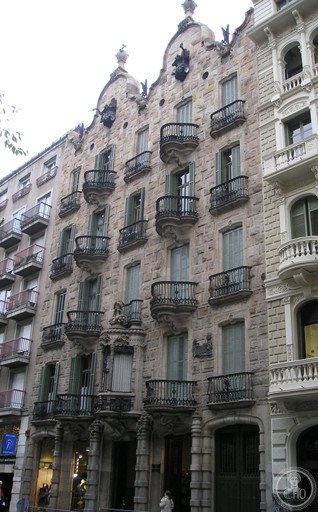
Casa Calvet, at Carrer de Casp 48 in the Eixample, was designed by Antoni Gaudí for a textile manufacturer and built between 1898 and 1900. It served as both business premises, in the basement and on the ground floor, and family home above. Scholars agree it is the most conventional of Gaudí’s works: squeezed between older buildings on an elegant street, it keeps a symmetry and rhythm rare in his architecture. Yet the curving double gable, the dramatic entrance oriel and a host of witty details mark it unmistakably as his. In 1900 it won Barcelona’s first annual award for the best building of the year.
Key facts
- Architect: Antoni Gaudí
- Built: 1898–1900
- Use: textile business below, residence above
- Address: Carrer de Casp 48, Eixample
- Award: Barcelona’s building of the year, 1900
- Character: Gaudí’s most restrained, symmetrical work
History
The house was commissioned by the heirs of Pere Màrtir Calvet, a textile manufacturer, for a plot in one of the most fashionable parts of the new Eixample district. Gaudí had to fit his building between existing structures and to respect a refined, bourgeois setting.
That discipline shaped the result. Between 1898 and 1900 he produced a building far calmer than his later, sculptural work, and the Barcelona city council rewarded it as the best new building of 1900 — the only such official honour Gaudí received in his lifetime.
The house remains in use, with offices and apartments, and a restaurant has occupied part of the ground floor.
What you see
The stone facade is symmetrical and orderly, with bulging balconies alternating with shallower ones and a projecting oriel over the entrance, almost baroque in its drama. Above, twin curved gables crown the front. Columns flanking the door are shaped like stacked bobbins, a nod to the family’s textile trade, and carved mushrooms over the oriel recall the owner’s love of mycology.
Three sculpted heads at the top portray Saint Peter Martyr, the family’s name-saint, together with the patron saints linked to the owner’s home town, while the wrought-iron and stone gallery at street level weaves in a cypress, an olive tree, horns of plenty and the Catalan coat of arms.
Practical information
- The house is private; the facade is the main thing to see, and is always visible from the street.
- The ground floor has at times held a restaurant — check current use for any interior access.
- Time needed: a short stop on an Eixample Modernisme walk.
Getting there
Carrer de Casp 48 is in the Eixample, a short walk from Plaça de Catalunya and the Passeig de Gràcia; the nearest metro stations are Urquinaona and Catalunya.
Nearby
- The Block of Discord on the Passeig de Gràcia (Batlló, Amatller, Lleó Morera).
- The Palau de la Música Catalana.
- Casa Milà (La Pedrera), further up the Passeig de Gràcia.
Sources
- Wikipedia (EN), “Casa Calvet”.
- Catalan cultural heritage inventory.
Find it on the map
See this place and what’s around it →Record researched and written by Luigi De Marchi for Cultural Heritage Online, 2026.

📷 Become a Cultural Heritage Online photographer
Share your photos of places: they stay published under your name as the author. The more they're seen, the more you get noticed — and soon a contest will reward the most appreciated photos.
Log in or sign up free to add a photoIs this page about you?
This page is read by travellers and heritage enthusiasts who find it on Google. Tell us how you are connected to this place and we will take it from there.