

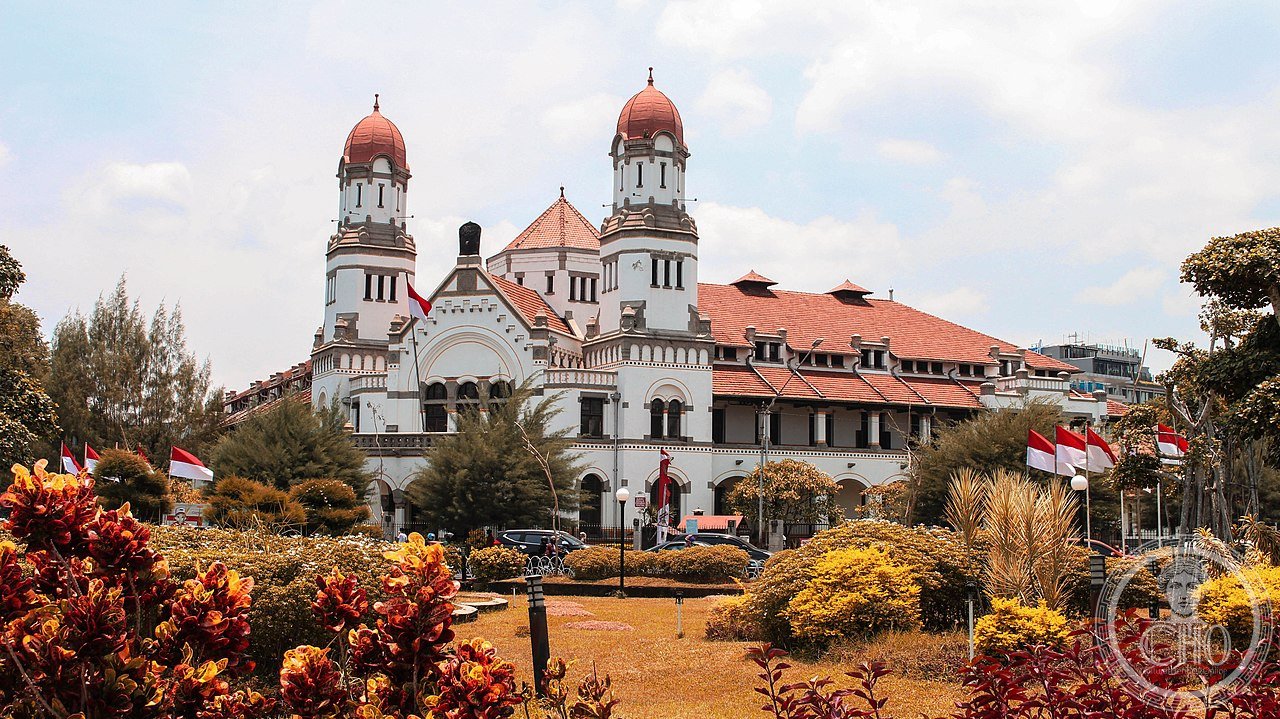
Semarang’s iconic colonial landmark, whose name means “Thousand Doors” in Javanese, is the grandest railway headquarters ever built in the Dutch East Indies and one of Java’s most haunting heritage sites.
At a glance
- Type
- Colonial administrative building / heritage museum
- Period
- 1904-1919
- Style
- Dutch Colonial, Art Nouveau
- Location
- Jl. Pemuda, Semarang, Central Java, Indonesia
- Coordinates
- -7.0071, 110.4099
- Architect
- Henri Maclaine Pont (Amsterdam)
Overview
Lawang Sewu, literally “Thousand Doors” in Javanese, is the most celebrated colonial building in Java outside Jakarta. Commissioned by the Dutch East Indies Railway Company (NISM) and designed by Amsterdam-based architect Henri Maclaine Pont, the complex was built in stages between 1904 and 1919 to serve as the company’s central headquarters. The name refers to the building’s extraordinary fenestration: thousands of tall glass-and-steel doors and windows that flood every corridor with light and maximize cross-ventilation in the tropical heat. Three interconnected buildings surround a landscaped tropical garden, forming a composition of classical Dutch brick, Renaissance pilasters, ornamental keystones, and copper-capped corner towers.
History
When the Netherlands East Indies Railway Company (NISM) outgrew its original offices in the late nineteenth century, it commissioned a monumental new headquarters to reflect its commercial dominance. Construction began in 1904 and the complex was completed in 1919. During the Japanese occupation of 1942-1945 the building was requisitioned as a military detention center; its basement waterworks were converted into cells and became the site of documented torture and mass executions. After Indonesian independence the building served as the regional headquarters of the national railway operator. A major restoration program completed in 2011 stabilized the fabric and converted the complex into a public heritage museum.
Architecture and Design
The main building is organized on a symmetrical T-plan anchored by two square corner towers whose copper cupolas have oxidized to a distinctive verdigris. The facade is built in red Dutch brick with white limestone dressings; Art Nouveau influence appears in the sinuous ironwork of the door frames, floral stained-glass transoms, and rhythmic arched window heads. Maclaine Pont integrated passive cooling into every decision: double-skin walls, an extensive covered colonnade, and the celebrated system of full-height pivoting glass doors that channel prevailing sea breezes through the building’s deep plan. The basement level retains its original hydraulic engineering infrastructure, now interpreted as part of the museum’s dark-history galleries.
Cultural significance
Lawang Sewu occupies an outsized place in Indonesian popular culture as the country’s most famous haunted building. The combination of colonial grandeur, wartime atrocity, and decades of abandonment has generated an enormous body of urban legend, horror fiction, and reality-television ghost hunting. For architectural historians the building is equally significant as one of the most technically accomplished examples of colonial tropical design in Southeast Asia. It was officially declared a national cultural heritage site (Cagar Budaya) in 2010.
Visiting today
Lawang Sewu is open daily; admission is charged. The museum circuit includes the main building interiors, a ground-floor exhibition on NISM railway history, and guided access to the basement detention cells. Night tours are offered on weekends. Photography is permitted throughout. Allow two hours for a thorough visit.
Getting there
The building stands at the eastern end of Jalan Pemuda in central Semarang, directly opposite the Tugu Muda independence monument. It is a ten-minute walk from Semarang Tawang railway station and is served by Trans Semarang BRT corridor 1 (stop: Balai Kota). From Ahmad Yani International Airport the journey by taxi or ride-hail takes approximately 25 minutes.
Sources and resources
Find it on the map
See this place and what’s around it →Record researched and written by Luigi De Marchi for Cultural Heritage Online, 2026.
📷 Become a Cultural Heritage Online photographer
Share your photos of places: they stay published under your name as the author. The more they're seen, the more you get noticed — and soon a contest will reward the most appreciated photos.
Log in or sign up free to add a photoIs this page about you?
This page is read by travellers and heritage enthusiasts who find it on Google. Tell us how you are connected to this place and we will take it from there.