
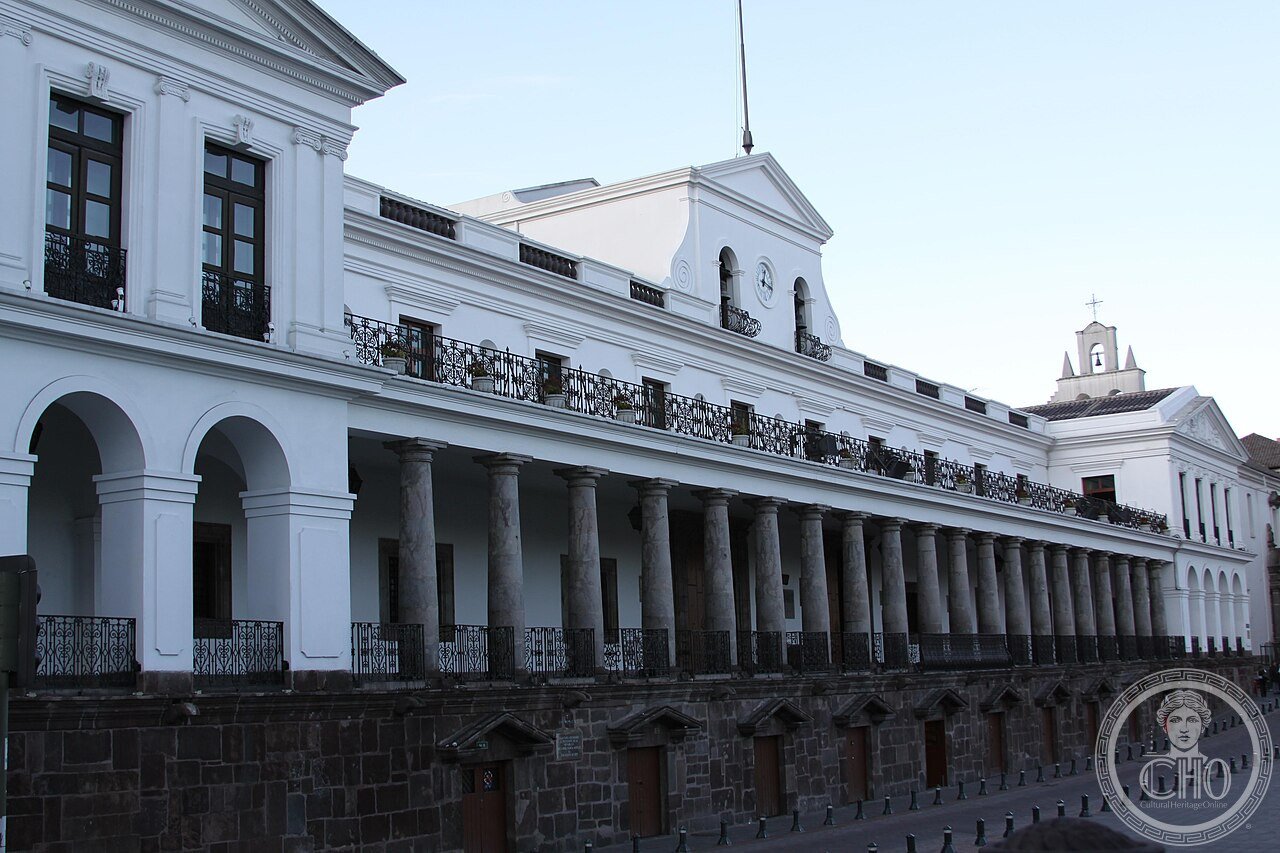
The presidential palace of Ecuador occupies the western flank of Quito’s Plaza Grande in one of the best-preserved colonial city centers on earth, a site of continuous political power since 1563 and the backdrop to some of the most dramatic moments in South American history.
At a glance
- Type
- Presidential palace
- Period
- Original 1563; current Neoclassical facade c. 1830
- Style
- Neoclassical / Spanish Colonial
- Location
- Plaza de la Independencia (Plaza Grande), Quito, Ecuador
- Coordinates
- -0.2202, -78.5126
- Architect
- Various; rebuilt post-independence
Overview
The Palacio Presidencial de Carondelet is the official seat of the President of Ecuador, occupying the entire western side of the Plaza de la Independencia in the UNESCO World Heritage historic center of Quito. The site has been the center of government in this part of South America for nearly five centuries, first as the seat of the Spanish colonial audiencia from 1563 and then as the executive residence of the independent republic from 1830. Its pale stone colonnaded facade, guarded by the presidential honor guard in blue-and-gold ceremonial dress, is one of the most recognizable images in Ecuadorian public life. The ceremonial changing of the guard draws visitors daily.
History
Quito was founded by Francisco de Orellana in 1534 on the site of a destroyed Inca city, and a casa de gobierno was established on the plaza by 1563. The building took its current name from Baron Louis Hector de Carondelet, President of the Real Audiencia de Quito from 1799 to 1807. Ecuador declared independence in 1822 as part of Simon Bolivar’s Gran Colombia, and became a fully independent republic in 1830. The current Neoclassical facade was completed around that time, refashioning the colonial structure into a symbol of republican authority. The palace survived the 1987 earthquake that damaged much of Quito’s historic center. In 2007 President Rafael Correa opened the palace to free public tours on weekdays, a policy maintained by subsequent administrations.
Architecture and Design
The palace presents a horizontal two-story facade of dressed pale stone running the full width of the Plaza Grande’s western side. A deep colonnaded portico at ground level provides shade and frames the main entrance bays, while the upper story is articulated with tall rectangular windows and a continuous balcony from which the president addresses crowds on national occasions. The interior is organized around a central courtyard with arcade galleries on all four sides. State rooms on the upper floor include the Salon Amarillo (Yellow Salon) with murals depicting key scenes of Ecuadorian independence, a formal dining room, and the presidential office overlooking the plaza. The building’s restrained Neoclassical vocabulary was common across newly independent South American republics seeking to project modern republican dignity.
Cultural significance
The Palacio de Carondelet stands at the geographic and symbolic center of a World Heritage site of exceptional integrity. Quito’s historic center was one of the two sites (alongside Krakow) to receive the very first UNESCO World Heritage designations in 1978, recognized for its extraordinary density of intact colonial baroque architecture including the Cathedral, the Iglesia de La Compania de Jesus (considered the finest baroque facade in the Americas), and dozens of monasteries and palaces. The Palacio anchors the Plaza Grande, which functions as a living civic space where political rallies, cultural events, and everyday public life coexist with monumental heritage. The building embodies five centuries of continuous governmental authority in the Andes.
Visiting today
Free guided tours of the interior are available Monday to Friday; visitors queue at the main entrance on the Plaza Grande. Tours cover the state rooms, the presidential murals, and the courtyard. The ceremonial changing of the presidential guard takes place on the plaza on Monday mornings. The plaza itself is accessible at all hours and surrounded by the Cathedral, the Archbishop’s Palace, and the Municipal Palace. The entire historic center is compact and best explored on foot from the plaza. Altitude note: Quito sits at 2,850 meters; visitors arriving from sea level should allow a day to acclimatize before extended walking.
Getting there
The historic center is approximately 8 km from Quito’s Mariscal Sucre International Airport. Taxis and Uber operate directly to the Plaza Grande (30-45 minutes depending on traffic). The Trole bus rapid transit line stops at La Marin, a 10-minute walk from the plaza. From the Mariscal (new town / tourist district) take a taxi or the Ecovia trolley line southbound. The historic center is best explored on foot; the Plaza Grande is the natural starting point for the Cathedral, La Compania, and San Francisco church.
Sources and resources
Find it on the map
See this place and what’s around it →Record researched and written by Luigi De Marchi for Cultural Heritage Online, 2026.
📷 Become a Cultural Heritage Online photographer
Share your photos of places: they stay published under your name as the author. The more they're seen, the more you get noticed — and soon a contest will reward the most appreciated photos.
Log in or sign up free to add a photoIs this page about you?
This page is read by travellers and heritage enthusiasts who find it on Google. Tell us how you are connected to this place and we will take it from there.