
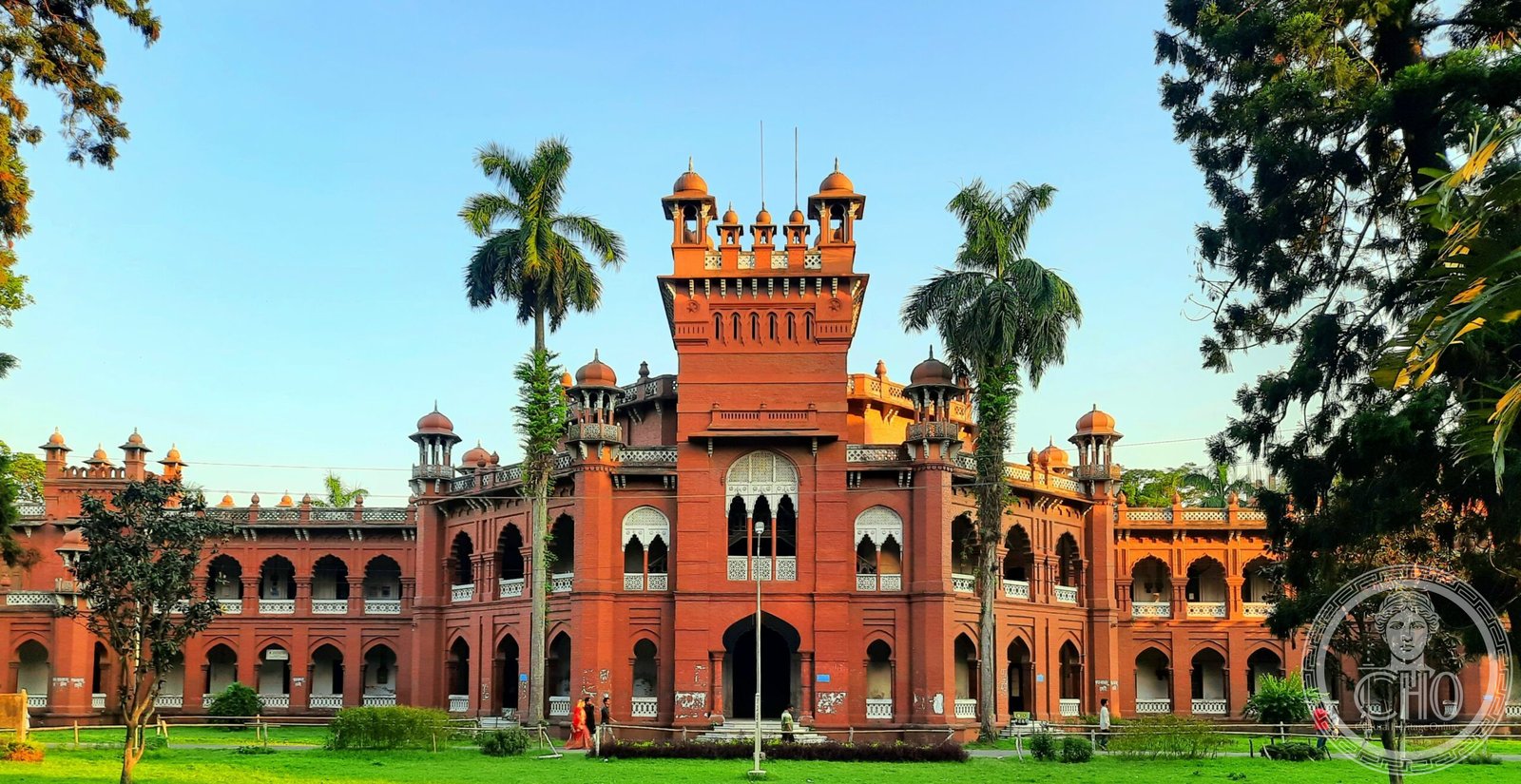
Dhaka’s most beautiful colonial building — a pink-and-white Mughal Revival masterpiece that witnessed the Language Movement of 1952, which gave the world International Mother Language Day.
At a glance
- Type
- University science faculty building
- Period
- 1904-1905
- Style
- British Raj / Mughal Revival
- Location
- University of Dhaka campus, Dhaka, Bangladesh
- Coordinates
- 23.7269, 90.3963
- Architect
- R. Rennick (British colonial engineer)
Overview
Curzon Hall is the most celebrated heritage building in Dhaka — a confident fusion of British Victorian planning and Mughal ornamentation built in 1904 to receive Lord Curzon, Viceroy of India, on his official visit to Bengal. Its pink brick walls, white stucco arches, ogee Mughal domes, and richly detailed terracotta ornamentation represent a high point of the colonial hybrid style known as Indo-Saracenic or Mughal Revival. The building now serves as the Faculty of Science of the University of Dhaka, one of the most important institutions in Bangladesh, and is designated a protected heritage structure by the government.
History
Construction began in 1904 and was completed in 1905, timed to coincide with the Partition of Bengal that created the new province of Eastern Bengal and Assam with Dhaka as its capital. The building was named after Lord Curzon, the Viceroy responsible for the partition. When Dhaka University was founded in 1921, Curzon Hall became the centrepiece of its science faculty. On February 21, 1952, students gathering on the steps of Curzon Hall were among those who marched to the Legislative Assembly to protest the Pakistani government’s imposition of Urdu as the sole state language, suppressing Bengali. Police fired on the crowd; several students were killed. This Language Movement is now commemorated annually as Shaheed Dibosh (Martyrs’ Day) and, since 2000, as UNESCO International Mother Language Day — one of the most significant outcomes of any student protest in history.
Architecture and Design
The building exemplifies the Indo-Saracenic synthesis that British colonial architects developed in the late nineteenth and early twentieth centuries: a Western structural system dressed in subcontinental ornamental vocabulary. The principal facade features a deep veranda of pointed Mughal arches supported on slender columns, with ogee cusping. Above, three domed chattris punctuate the roofline. The walls are Dhaka’s characteristic pink brick trimmed in white limestone plaster. Terracotta panels in floral and geometric patterns fill the spandrels. The interior retains its original high-ceilinged halls and wide corridors designed for cross-ventilation in Bengal’s subtropical climate. The building is set within a landscaped campus of wide lawns and rain trees that enhances its monumental presence.
Cultural significance
Curzon Hall carries two overlapping historical meanings. As architecture it is the finest surviving example of the Mughal Revival style in Bangladesh — a reminder of the aspirations of British Bengal’s capital city in the brief Edwardian moment before partition politics reshaped South Asia. As a site of memory it is inseparable from February 21, 1952, when the steps of the building became a gathering point for the Language Movement protesters. The martyrdom of those students eventually produced both Bangladesh’s independence (1971) and one of UNESCO’s most universally recognised commemorative days. The building thus stands at the intersection of architectural heritage and foundational national memory.
Visiting today
Curzon Hall is an active university building and can be viewed from the campus grounds at any time during university hours. The exterior and courtyard gardens are accessible to visitors; interior rooms may require escort by a university contact. The campus itself — with its century-old rain trees and colonial-era buildings — is pleasant to walk in the cooler morning hours. February 21 sees commemorative events at and near Curzon Hall, with the Shaheed Minar (Language Movement Martyr’s Memorial, five minutes on foot) as the primary ceremony venue.
Getting there
The University of Dhaka campus is in the Shahbag area of central Dhaka, directly adjacent to the Shahbag intersection — one of the city’s major transit nodes. CNG auto-rickshaws and ride-share apps (Pathao, Shohoz, Uber) are the easiest way to arrive; specify “Curzon Hall” or “Dhaka University Shahbag gate.” The nearest Dhaka Metro Rail (MRT Line 6) station is Shahbag, a short walk from the campus gate. From Hazrat Shahjalal International Airport the journey takes 45-75 minutes depending on traffic.
Sources and resources
Find it on the map
See this place and what’s around it →📷 Become a Cultural Heritage Online photographer
Share your photos of places: they stay published under your name as the author. The more they're seen, the more you get noticed — and soon a contest will reward the most appreciated photos.
Log in or sign up free to add a photoIs this page about you?
This page is read by travellers and heritage enthusiasts who find it on Google. Tell us how you are connected to this place and we will take it from there.