
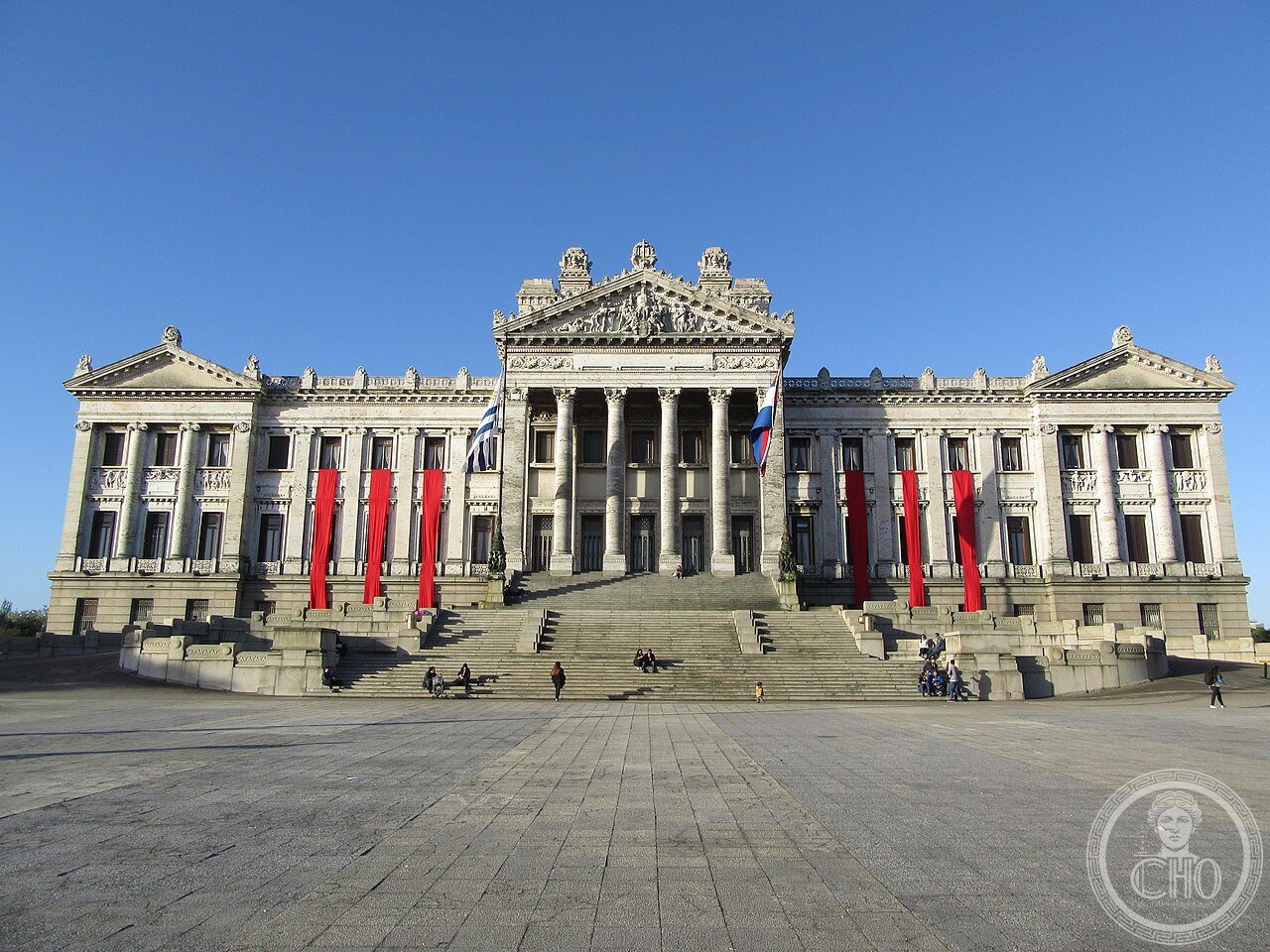
A marble palace built over 20 years with 11 varieties of Uruguayan marble, the Legislative Palace in Montevideo is one of the most magnificent Beaux-Arts civic buildings in the Americas.
At a glance
- Type
- Legislative Palace
- Period
- 1904-1925
- Style
- Neoclassical / Beaux-Arts
- Location
- Avenida de las Leyes, Montevideo, Uruguay
- Coordinates
- -34.9069, -56.1879
- Architect
- Gaetano Moretti, Victor Rabu
Overview
The Palacio Legislativo in Montevideo is Uruguay’s parliament building and one of the great Beaux-Arts civic monuments of the Americas. Built between 1904 and 1925, the palace consumed 11 varieties of Uruguayan marble quarried from 11 different provinces and was designed by Italian architect Gaetano Moretti, who won an international competition with a scheme inspired by the Paris Opera, the Italian Parliament, and the civic buildings of Vienna’s Ringstrasse. Its central dome rises 76 metres, making it the third tallest dome in Latin America. The palace stands as the physical embodiment of Uruguay’s Golden Era – the period from 1900 to 1930 when Uruguay was internationally known as the Switzerland of South America and pioneered social reforms that the rest of the world would only adopt decades later.
History
Uruguay at the turn of the twentieth century was a model progressive state. Under President Jose Batlle y Ordonez, the country introduced universal male suffrage, the eight-hour workday, free secular education, divorce rights for women, and separation of church and state – reforms decades ahead of most of Europe and North America. The decision to build a new parliament building commensurate with Uruguay’s self-image was taken in 1902. An international architectural competition was held and won by Italian architect Gaetano Moretti, working with local architect Victor Rabu. Construction began in 1904 and took 21 years, partly due to the extraordinary ambition of the marble programme: every interior surface is clad in one of 11 different Uruguayan marbles, each from a different department of the country, symbolizing national unity. The building was inaugurated on 25 August 1925, on the 100th anniversary of Uruguay’s first constitutional assembly.
Architecture and Design
Moretti’s design draws equally on French Beaux-Arts and Italian Neoclassical traditions. The main facade presents 46 marble columns across a broad colonnaded portico. Above the entrance, allegorical sculptural groups represent Justice, Freedom, and the Arts. The central dome – faced in Uruguayan marble and topped by a bronze lantern – dominates Montevideo’s flat skyline from a great distance. Inside, the grand staircase hall rises through multiple levels under coffered marble vaults, flanked by bronze railings and monumental sculptures. The Senate chamber beneath the dome is considered the architectural masterpiece of the interior: an oval room with tiered galleries, marble columns, and a painted ceiling depicting the heroes of Uruguayan independence. The 11 marbles range in colour from white and cream through grey, red, green, and black, creating a polychromatic effect unique in the Americas.
Cultural significance
The Palacio Legislativo is the physical symbol of Uruguayan democracy and the progressive ideals of the Batllista era. Uruguay was the first country in the Americas to legalize divorce (1907), the first to introduce an eight-hour workday (1915), and one of the first in the world to establish a welfare state. The palace built to house this democracy is proportionally grandiose – a deliberate statement that a small South American republic could build monuments equal to the great capitals of Europe. The building has been the site of every major event in Uruguayan political history since 1925, from constitutional crises to the restoration of democracy after the 1973-1985 military dictatorship. It is also one of the finest intact examples of early twentieth-century Beaux-Arts civic architecture anywhere in the Southern Hemisphere.
Visiting today
The Palacio Legislativo is open to visitors and free guided tours run daily, conducted by staff from the parliament’s public relations department. Tours cover the main hall, Senate chamber, and key ceremonial rooms and take approximately one hour. Photography is permitted throughout. The palace is in the Aguada neighbourhood of central Montevideo, about 1.5 kilometres from the Old City (Ciudad Vieja). The building can be visited on Mondays through Saturdays; hours vary by session calendar and are posted on the parliament website (parlamento.gub.uy).
Getting there
The Palacio Legislativo is easily reached from central Montevideo. Bus lines 103, 121, 142, 174, and 180 stop on Avenida del Libertador near the palace. The closest point of the Old City (Ciudad Vieja) is about 20 minutes on foot along Avenida 18 de Julio. Taxis and ride-share services operate throughout the city. From Carrasco International Airport, the journey by taxi or bus to central Montevideo takes approximately 30-45 minutes.
Sources and resources
Find it on the map
See this place and what’s around it →📷 Become a Cultural Heritage Online photographer
Share your photos of places: they stay published under your name as the author. The more they're seen, the more you get noticed — and soon a contest will reward the most appreciated photos.
Log in or sign up free to add a photoDo you manage this place?
This page is read by travellers and heritage enthusiasts who find it on Google. Keep it accurate — and make it work for you. Free for non-profit heritage institutions.