

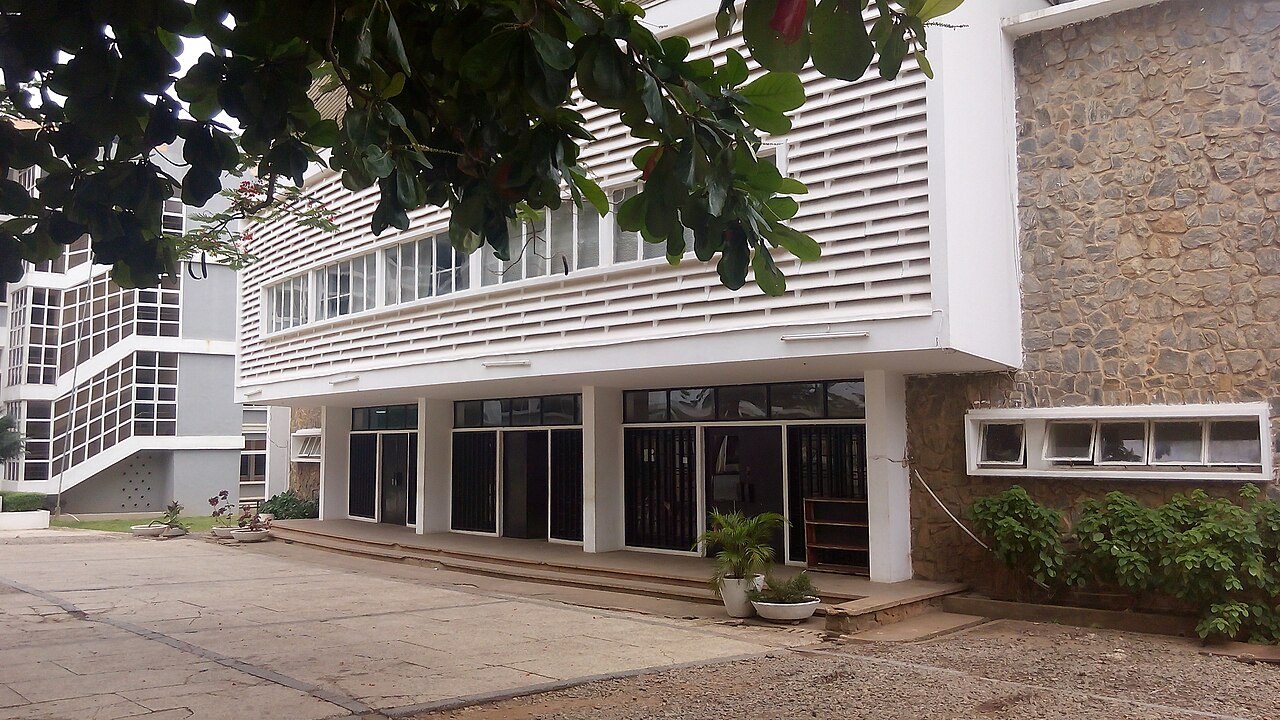
Africa’s first university south of the Sahara, whose 1948 campus by Maxwell Fry and Jane Drew pioneered tropical modernism and set the template for institutional architecture across the continent.
At a glance
- Type
- University campus (heritage buildings)
- Period
- Founded 1948; Great Hall 1955
- Style
- Tropical Modernism / British Colonial Modernism
- Location
- University Road, Ibadan, Oyo State, Nigeria
- Coordinates
- 7.3970, 3.9014
- Architect
- Maxwell Fry and Jane Drew (London)
Overview
The University of Ibadan, founded in 1948 as University College Ibadan (a college of the University of London), holds the distinction of being the first university established south of the Sahara Desert. Its campus is architecturally exceptional: designed by the British husband-and-wife team Maxwell Fry and Jane Drew, who had collaborated with Le Corbusier on the design of Chandigarh, India, the buildings are a masterwork of tropical modernism — a discipline that fused European Modernist principles with serious engagement with the demands of the West African climate. The campus now serves more than 30,000 students, and its 1950s buildings retain heritage-listed status.
History
The university was established by the British colonial government as University College Ibadan in 1948, initially operating under the academic umbrella of the University of London. The choice of Ibadan — then one of the largest cities in West Africa — reflected its position as the capital of the Western Region and a centre of Yoruba cultural life. The institution gained full university status in 1962, one year after Nigerian independence. Throughout the 1950s and 1960s it attracted faculty from across the world and became one of Africa’s foremost centres of scholarship in medicine, agriculture, and the humanities. Nobel laureate Wole Soyinka is among its most celebrated alumni.
Architecture and Design
Maxwell Fry and Jane Drew designed the campus as a laboratory for tropical architecture. The solution they devised responded systematically to the West African climate: long, thin building plans oriented to catch prevailing south-westerly breezes; floors elevated on pilotis to allow air circulation beneath; deep overhanging eaves and brise-soleil screens that shade glazed walls from direct sun; and covered walkways connecting buildings to protect pedestrians from both rain and intense heat. The Great Hall (1955) is the campus masterpiece: its monumental concrete sunscreen facade — a grid of angled fins that filter light while permitting ventilation — became one of the defining images of post-war African civic architecture. Fry and Drew subsequently wrote the influential book “Tropical Architecture in the Humid Zone” (1956), codifying the principles they had developed at Ibadan.
Cultural significance
The University of Ibadan campus occupies a unique place in the cultural history of both Nigeria and Africa. As the continent’s first sub-Saharan university, it became the training ground for the generation of intellectuals, doctors, lawyers, and civil servants who led African nations to independence and shaped the post-colonial era. Architecturally, the Fry and Drew buildings directly influenced the design of universities, hospitals, and government buildings across Anglophone West Africa and beyond, making the campus a founding document of African Modernism. The university’s cultural life — its theatre, its literary journals, its Yoruba studies programmes — helped establish Ibadan as one of Africa’s great intellectual cities in the 1950s and 1960s.
Visiting today
The University of Ibadan campus is accessible to visitors; the grounds are open and the main architectural landmarks — the Great Hall, the Senate Building, and the covered walkways — can be seen on a self-guided walk. The university library holds significant collections of Nigerian literature and colonial-era documents. The UI Zoo, located within the campus, is one of Nigeria’s oldest and is open to the public. The campus is best experienced in the cooler morning hours.
Getting there
The University of Ibadan is located on University Road in the northern part of Ibadan, approximately eight kilometres from the city centre. From Lagos (about 130 km south-west), buses and shared taxis depart regularly from Mile 2 and Ojota motor parks; journey time is two to three hours depending on traffic. Within Ibadan, commercial motorcycles and minibuses serve University Road. Ride-hailing apps including Bolt operate in Ibadan. The nearest international airport is Murtala Muhammed International Airport, Lagos.
Sources and resources
Find it on the map
See this place and what’s around it →Record researched and written by Luigi De Marchi for Cultural Heritage Online, 2026.
📷 Become a Cultural Heritage Online photographer
Share your photos of places: they stay published under your name as the author. The more they're seen, the more you get noticed — and soon a contest will reward the most appreciated photos.
Log in or sign up free to add a photo