
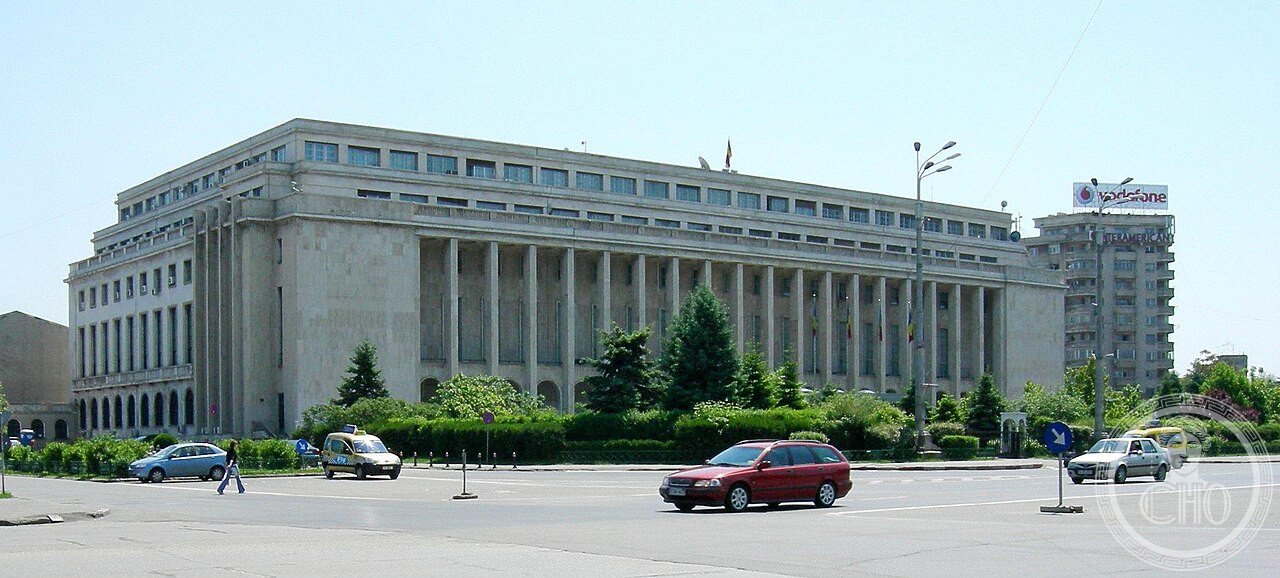
Romania’s seat of government since 1944, the Victoria Palace witnessed the final hours of communist rule when Nicolae Ceausescu’s helicopter fled from a nearby rooftop on December 22, 1989.
At a glance
- Type
- Government palace
- Period
- 1938-1944
- Style
- Neoclassical with Romanian national motifs
- Location
- Piata Victoriei, Bucharest, Romania
- Coordinates
- 44.4529 N, 26.0873 E
- Architect
- Duiliu Marcu
Overview
The Palatul Victoriei (Palace of Victoria) is the official seat of the Romanian Government and the office of the Prime Minister. Located on Piata Victoriei (Victory Square) in central Bucharest, the palace is one of the most significant public buildings in Romania, combining monumental neoclassical architecture with Romanian decorative traditions. The building takes its name from Victory Square, which itself commemorates the victorious conclusion of World War I and Romania’s unification in 1918. Today the palace serves as the operational heart of Romanian executive governance and is a landmark address of the Romanian state.
History
Construction began in 1938 under the reign of King Carol II, commissioned as a grand statement of the Romanian state during the interwar period. Architect Duiliu Marcu, the leading Romanian public architect of the era, designed the building in the dominant monumental neoclassical style of 1930s European state architecture, blending it with Romanian folk decorative motifs. The palace was completed in 1944 during World War II. After Romania joined the Eastern Bloc, the building became the headquarters of the Council of Ministers. Piata Victoriei gained worldwide attention on December 22, 1989, the pivotal day of the Romanian Revolution: the crowd in the square watched as Nicolae Ceausescu’s helicopter lifted off from the rooftop of the nearby Central Committee building, ending 45 years of communist rule. Ion Iliescu announced the formation of the first post-communist Romanian government from this palace in December 1989.
Architecture and Design
Duiliu Marcu designed the Victoria Palace as a monumental neoclassical composition anchored at Piata Victoriei. The facade presents a measured rhythm of pilasters and arched windows across a symmetrical volume, projecting institutional gravity appropriate to its role as the seat of government. Romanian national decorative motifs are integrated into the ornamental program, reflecting the cultural-nationalist priorities of the Carol II era. Marcu was responsible for most of Bucharest’s major interwar state buildings, including the Faculty of Law and the Romanian Academy, giving the city a coherent monumental character across its civic center. The palace’s proportions and restrained classicism distinguish it from the more theatrical Soviet-influenced architecture that was later imposed on Bucharest, making it one of the most refined examples of Romanian interwar state architecture still in active government use.
Cultural significance
The Victoria Palace is inseparable from Romania’s modern political history. As the seat of government through monarchy, communist dictatorship, and post-communist democracy, the building has been the physical address of Romanian executive power across three radically different political orders. Its significance crystallized in December 1989 when it became the symbol of transition: the square outside was the site of the largest popular demonstrations of the Romanian Revolution, and the palace itself became the operational base of the National Salvation Front in the hours after Ceausescu’s fall. For Romanians, the address Piata Victoriei carries the emotional weight of national liberation. The building also represents the career of Duiliu Marcu, considered the master of Romanian interwar public architecture, and exemplifies the cultural ambitions of Greater Romania during its most prosperous and architecturally productive decade.
Visiting today
The Palatul Victoriei is an active government building and is not open to the public for general visits. The exterior and the surrounding Piata Victoriei are freely accessible and offer excellent views of the palace facade. The square itself is a major public space in Bucharest and has been the site of significant political demonstrations, including the large anti-corruption protests of 2017-2018, making it a living civic landmark. Nearby attractions include the Natural History Museum (Grigore Antipa Museum) and the National Museum of the Romanian Peasant, both on the Sos. Kiseleff promenade that begins at Piata Victoriei.
Getting there
Piata Victoriei is one of the best-connected points in Bucharest. Metro: Piata Victoriei station serves lines M1 and M3, providing direct connections to the city center, Henri Coanda International Airport (via the express shuttle from Gara de Nord), and all major districts. Tram and bus: multiple surface lines converge on the square. By car, Piata Victoriei sits at the junction of Calea Victoriei and Soseaua Kiseleff, two of Bucharest’s main arteries. From Henri Coanda Airport: approximately 20 minutes by metro.
Sources and resources
Find it on the map
See this place and what’s around it →📷 Become a Cultural Heritage Online photographer
Share your photos of places: they stay published under your name as the author. The more they're seen, the more you get noticed — and soon a contest will reward the most appreciated photos.
Log in or sign up free to add a photoIs this page about you?
This page is read by travellers and heritage enthusiasts who find it on Google. Tell us how you are connected to this place and we will take it from there.