

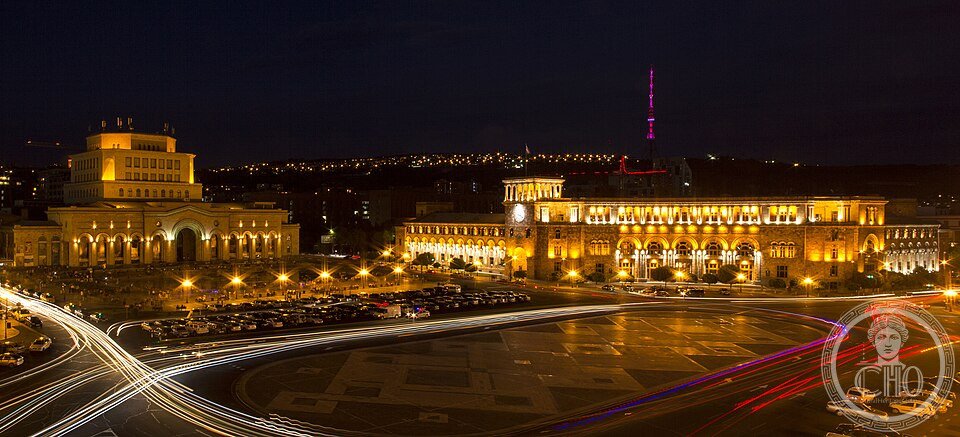
Republic Square is the monumental civic heart of Yerevan and one of the most coherent ensembles of 20th-century public architecture in the former Soviet Union. A unified composition in local pink, yellow, and grey tufa stone, its arc of colonnaded government buildings wraps around a central fountain plaza with a formal symmetry that feels distinctly Armenian rather than generically Soviet. Alexander Tamanian’s 1924 masterplan for the Armenian Soviet capital deliberately drew on ancient Urartian and medieval Armenian architectural forms rather than importing generic Soviet classicism, creating a civic space with genuine national character. The square’s Dancing Fountains, the Government of Armenia, and the National History Museum make it both the political and symbolic centre of the country.
At a glance
- Type
- Public Square / Civic Ensemble
- Period
- 1924-1958 (masterplan 1924; major buildings 1930s-1950s)
- Style
- Soviet Classical / Armenian Romantic Revival
- Location
- Republic Square, Yerevan, Armenia
- Coordinates
- 40.1776, 44.5126
- Architect(s)
- Alexander Tamanian (masterplan); subsequent buildings by various Soviet architects
Overview
Republic Square (Hanrapetutyan Hraparak) occupies the geographic and symbolic centre of Yerevan. The square is defined by a curved arc of monumental buildings in pink, yellow, and grey tufa stone quarried from the volcanic rock that underlies the Armenian plateau. The ensemble includes the Government of Armenia (the dominant northern building), the National History Museum of Armenia, the National Gallery of Armenia, the Central Post Office, and what is now the Marriott Armenia Hotel (formerly the Intourist). A central fountain plaza features the famous Dancing Fountains, which perform nightly to music ranging from Armenian folk songs to classical and operatic repertoire. The square functions simultaneously as a state ceremonial space, a public gathering point, and a tourist destination, and is the starting point for most walks through Yerevan’s historic centre.
History
Armenia was incorporated into the Soviet Union in 1920 following the brief First Republic (1918-1920). The new Soviet Armenian government immediately commissioned Alexander Tamanian, a major figure in Russian and Armenian architecture, to produce a masterplan for Yerevan, which was then a small provincial town of around 30,000 people. Tamanian’s 1924 plan was revolutionary: it envisioned a modern capital built from native tufa stone in forms that referenced pre-Christian Urartian and medieval Armenian architecture, creating a distinctly Armenian metropolitan character within the Soviet framework. Construction of the major square buildings proceeded through the 1930s and 1950s. Republic Square has been the stage for every major event in modern Armenian history: the 1988 mass demonstrations demanding transfer of Nagorno-Karabakh (drawing over a million people), the 1991 independence celebrations, and the 2018 Velvet Revolution. The Dancing Fountains were installed in 1967.
Architecture and Design
The defining material of Republic Square is Armenian tufa, a volcanic stone that ranges from deep rose-pink to pale yellow and grey depending on its quarry origin. The buildings’ facades combine classical colonnades and arcades with decorative vocabulary drawn from Armenian medieval monasteries and churches: khachkar-derived ornamental patterns, pointed arch profiles derived from Armenian ecclesiastical architecture, and carved stone details that reference pre-Christian Urartian stonework. The overall massing is monumental without being oppressive; the curved plan of the ensemble creates a sense of enclosure and focus around the central fountain without the rigid axial aggression of many Soviet civic spaces. The colour palette, shifting across pink, yellow, and grey tufa depending on the time of day and the light, gives the square a warmth unusual in Soviet-era urbanism.
Cultural significance
Republic Square is the spatial embodiment of Armenian national identity in its most concentrated form. Tamanian’s achievement was to create a Soviet capital that looked Armenian: the stone, the ornament, the proportions, and the colour all assert a cultural continuity with the Armenian highlands that predates Soviet rule by millennia. For this reason, the square survived the post-Soviet transition not only intact but with enhanced symbolic weight: it became the natural stage for the mass gatherings of 1988-1991 that led to independence, and again for the 2018 Velvet Revolution. The National History Museum on the square holds Armenia’s most important archaeological collections, including artefacts from the Urartian kingdom (9th-6th century BC). The square is also the symbolic starting point of Yerevan’s famous Northern Avenue pedestrian spine.
Visiting today
Republic Square is freely accessible at all hours. The Dancing Fountains perform nightly (approximately 9pm-11pm depending on season); the fountain show is one of Yerevan’s most popular free attractions. The National History Museum of Armenia and the National Gallery of Armenia are both on the square and open Tuesday through Sunday. The Marriott Armenia Hotel has a cafe and terrace open to non-guests. The square is surrounded by restaurants and cafes on adjacent streets, and is the starting point for walks along Northern Avenue and toward the Cascade complex. Yerevan is best visited April-June or September-October; summers are hot (38°C+), winters cold with snow.
Getting there
Yerevan Zvartnots International Airport (EVN) is served by flights from major European hubs including Vienna, Paris, Amsterdam, and Frankfurt, as well as regional hubs in the Middle East and former Soviet states. The airport is 12 km from the city centre; taxis take about 20-30 minutes. Republic Square is in the centre of Yerevan and is served by the Zoravar Andranik metro station (a short walk) and numerous bus and minibus routes. The square is walkable from most central Yerevan hotels.
Sources and resources
Find it on the map
See this place and what’s around it →📷 Become a Cultural Heritage Online photographer
Share your photos of places: they stay published under your name as the author. The more they're seen, the more you get noticed — and soon a contest will reward the most appreciated photos.
Log in or sign up free to add a photoIs this page about you?
This page is read by travellers and heritage enthusiasts who find it on Google. Tell us how you are connected to this place and we will take it from there.