
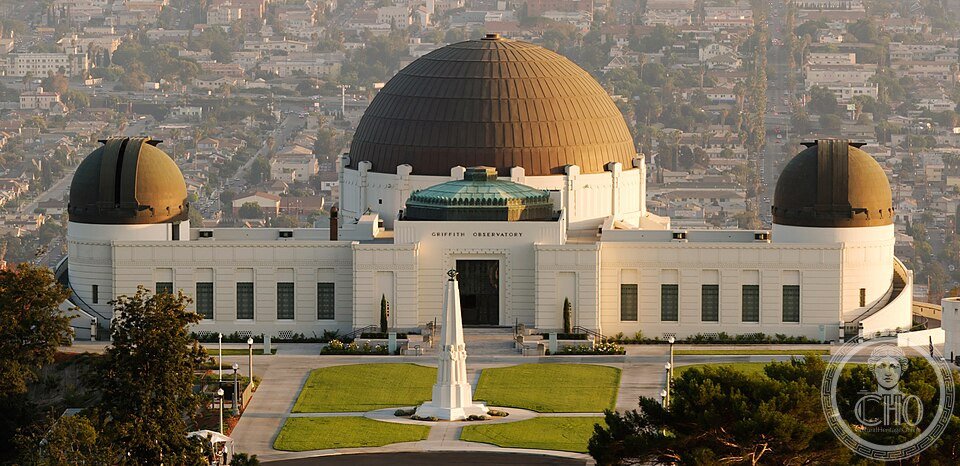
Griffith Observatory stands on the south-facing slope of Mount Hollywood in Griffith Park, Los Angeles, its three copper-clad domes turned green by a century of Pacific air, visible from much of the city below. Opened in 1935 as a gift from Welsh immigrant and millionaire Griffith J. Griffith, it is the most visited public observatory on Earth, offering free public viewing every clear night since its doors first opened. The white Art Deco building with its symmetrical composition and streamlined ornament has become one of the most recognizable silhouettes in American cinema: it appears in Rebel Without a Cause (1955), La La Land (2016), and dozens of other films. Perched at 1,134 metres above sea level, the observatory commands a panoramic view of the Los Angeles Basin and the Pacific Ocean on clear days. It houses a Zeiss refracting telescope, a solar telescope, a Foucault pendulum, and the Samuel Oschin Planetarium, which screens shows on an inner dome 75 feet in diameter.
At a glance
- Type
- Public observatory and science museum
- Period
- 1935; major renovation 2006
- Style
- Art Deco
- Location
- Griffith Park, Los Angeles, California, USA
- Coordinates
- 34.1183 N, 118.3003 W
- Architect(s)
- John C. Austin and Frederick M. Ashley
Overview
The Griffith Observatory is a civic landmark of exceptional cultural weight: simultaneously a working scientific institution, a public education center, a movie icon, and the most democratically accessible astronomical facility in the United States. Admission to the building and the telescopes is free of charge, a condition embedded in the original bequest by Griffith J. Griffith in 1912, who specified that the people of Los Angeles should forever have free access to the sky. The building sits inside Griffith Park, the largest urban park in the United States, and draws approximately 1.5 million visitors per year. The surrounding park trails give hikers direct access to the building from multiple directions, and the main terrace is a popular gathering spot for both astronomy enthusiasts and casual visitors drawn by the views over the city.
History
Griffith J. Griffith donated the land of Griffith Park to the city of Los Angeles in 1896, and in 1912 bequeathed 100,000 dollars for the construction of a public observatory. His vision was democratic and explicit: he believed that if ordinary people could look through a telescope at the stars, it would change how they thought about themselves and the universe. The city took over two decades to act on the bequest, and the observatory was not opened until 1935. Architects John C. Austin and Frederick M. Ashley designed the building in the Art Deco style then dominating civic architecture in California. The Foucault pendulum installed in the main hall was one of the first exhibited publicly in the United States. In the 1950s the observatory became an indelible part of American popular culture through its appearance in Nicholas Ray’s Rebel Without a Cause with James Dean. A major renovation and underground expansion completed in 2006 added the Leonard Nimoy Event Horizon theater and significantly increased the exhibition space without altering the historic exterior.
Architecture and Design
The observatory is designed on a strict bilateral symmetry axis, with a central block capped by the largest of the three copper domes and flanked by two matching wings each topped by a smaller dome. The exterior is clad in smooth white concrete with restrained Art Deco detailing: horizontal bands, stylised floral ornament at the cornice, and fluted pilasters framing the entry loggia. The three domes, originally bare copper and now uniformly oxidised to a distinctive verdigris, are the defining visual element visible from throughout the Los Angeles Basin. The main rotunda is entered through bronze doors and centres on the Foucault pendulum swinging from the dome above. The planetarium theater occupies the central dome, while the east and west wings house the Zeiss refractor and the solar telescope respectively. The 2006 underground expansion added 40,000 square feet of exhibition space beneath the lawn without altering the exterior.
Cultural significance
The Griffith Observatory occupies an unusual position in American cultural life: it is at once a genuine scientific institution and a Hollywood monument, a place where real astronomical observation and cinematic mythology coexist. Its appearance in more than 100 films and television productions has made it globally recognizable. The bust of James Dean outside the east wing marks the site of the climax in Rebel Without a Cause, drawing visitors who come as much for the cinema pilgrimage as for the astronomy. At the same time, the observatory’s original democratic mission remains active: on any clear night, volunteers guide members of the public through the Zeiss telescope to Saturn, Jupiter, or the Moon, free of charge, exactly as Griffith intended in 1912.
Visiting today
The Griffith Observatory is open Tuesday through Friday from noon to 10 pm, and Saturday and Sunday from 10 am to 10 pm. It is closed on Mondays. Admission to the building is free; the Samuel Oschin Planetarium shows require a ticket purchased on site. Parking in Griffith Park fills quickly on weekends; the city operates a shuttle service from the Greek Theatre parking area during peak periods. The building is wheelchair accessible. The public telescope on the main lawn is operated by the Los Angeles Astronomical Society on clear nights, free of charge. Photography is permitted throughout the building and grounds.
Getting there
The observatory is located off Vermont Canyon Road inside Griffith Park. By car, the most direct route from central Los Angeles is north on Vermont Avenue through Los Feliz, then into Griffith Park via Vermont Canyon Road. By public transport, the Metro B Line stops at Vermont and Sunset, from which local buses serve the park entrance; on weekends the observatory shuttle runs from the main park lots. Hiking trails from the Los Feliz neighbourhood and from the Fern Dell entrance offer a scenic approach on foot of about 45 minutes.
Sources and resources
Find it on the map
See this place and what’s around it →Record researched and written by Luigi De Marchi for Cultural Heritage Online, 2026.
📷 Become a Cultural Heritage Online photographer
Share your photos of places: they stay published under your name as the author. The more they're seen, the more you get noticed — and soon a contest will reward the most appreciated photos.
Log in or sign up free to add a photoIs this page about you?
This page is read by travellers and heritage enthusiasts who find it on Google. Tell us how you are connected to this place and we will take it from there.