

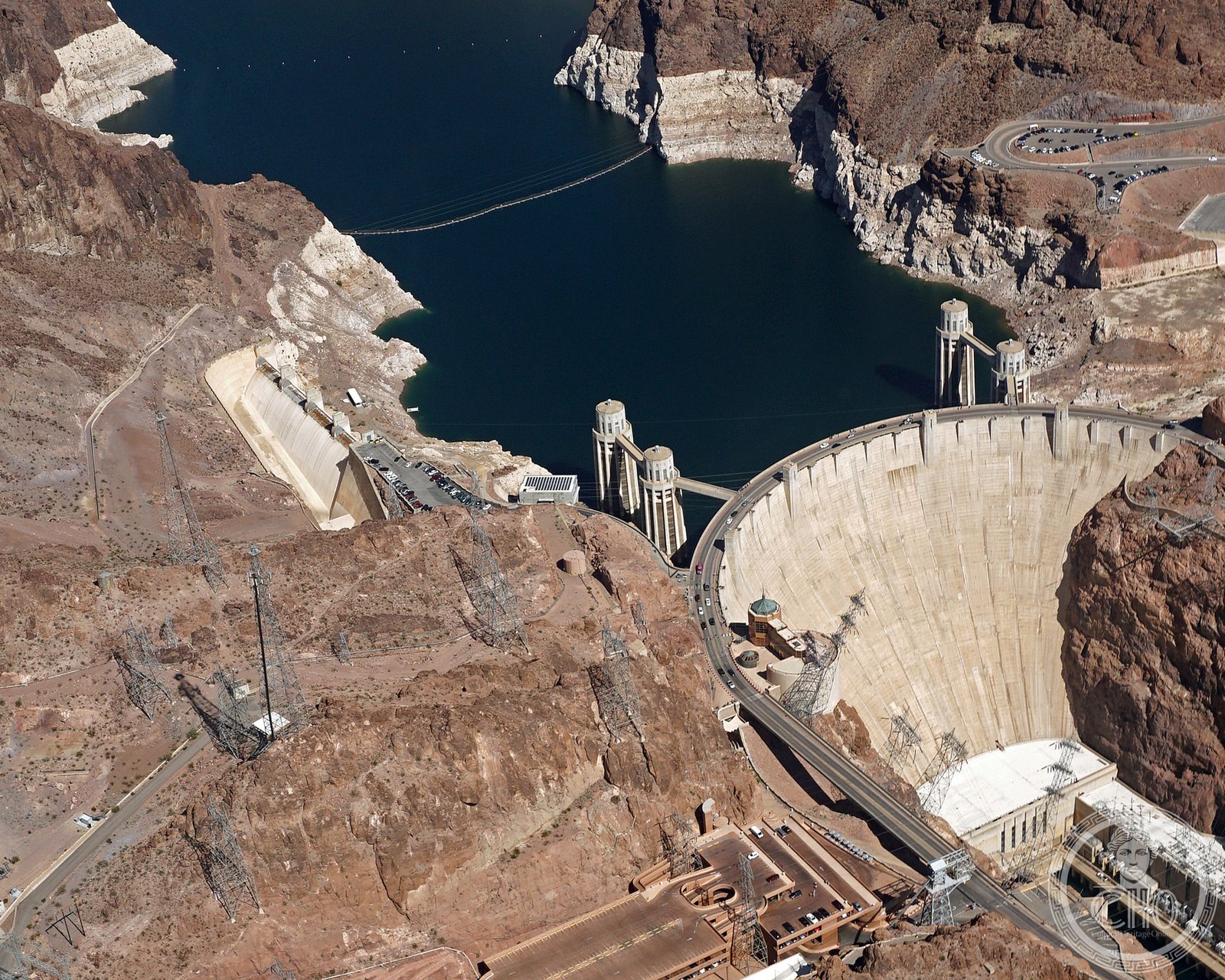
Rising 221 metres from the floor of Black Canyon on the Colorado River, Hoover Dam was the largest dam and the most ambitious public works project in American history when its construction began in 1931. Built during the depths of the Great Depression by a consortium called Six Companies, the dam employed more than 21,000 workers over five years and redefined the scale of what human engineering could accomplish. Gordon Kaufmann, the Los Angeles architect brought in to refine the Bureau of Reclamation’s utilitarian designs, stripped away the original Beaux-Arts ornament and replaced it with pure Art Deco geometry: fluted concrete pilasters, inlaid Art Deco floor mosaics, and the sweeping curved face that makes the dam one of the most photographed structures on Earth. Sculptor Oskar Hansen’s Winged Figures of the Republic stand in bronze at the visitor plaza, their polished surfaces mirroring the desert sky. A National Historic Landmark and an American Society of Civil Engineers Historic Civil Engineering Landmark, Hoover Dam remains one of the defining monuments of the twentieth century.
At a glance
- Type
- Concrete arch-gravity dam
- Period
- 1931–1936
- Style
- Art Deco / PWA Moderne
- Location
- Black Canyon, Nevada/Arizona border, USA
- Coordinates
- 36.0156° N, 114.7378° W
- Architect(s)
- Gordon Kaufmann (architectural design); Bureau of Reclamation engineers
Overview
Hoover Dam straddles the Nevada–Arizona state line on the Colorado River, impounding Lake Mead — which on completion was the world’s largest reservoir by volume. The dam provides hydroelectric power to Nevada, Arizona, and California, and its water management infrastructure underpins the growth of cities including Las Vegas, Phoenix, and Los Angeles. The Art Deco design imposed by architect Gordon Kaufmann transformed a purely utilitarian structure into an icon of industrial modernism and American national purpose.
History
Congress authorised the Boulder Canyon Project Act in 1928 after years of interstate negotiations over Colorado River water rights. Construction began in 1931 under the Hoover administration and was completed in 1936, two years ahead of schedule. The dam was originally called Boulder Dam; the name Hoover Dam was officially restored by Congress in 1947. Over 100 workers died during construction, many from heat exhaustion and carbon monoxide poisoning in the diversion tunnels. The dam’s power plant came online incrementally between 1936 and 1961, and at full capacity delivers approximately 4 billion kilowatt-hours annually. During World War II, output was diverted almost entirely to aluminium smelters and munitions plants. The dam was designated a National Historic Landmark in 1985.
Architecture & Design
Gordon Kaufmann replaced the Bureau of Reclamation’s Beaux-Arts design with a disciplined Art Deco vocabulary: vertical fluting on the intake towers, geometric relief patterns on the elevator towers, and a continuous Art Deco cornice line running the full width of the dam’s crest. The power plant downstream is arguably the finest PWA Moderne industrial interior in the United States — a soaring turbine hall with vaulted ceilings, decorative grillework, and terrazzo floors inlaid with a Navajo-inspired astronomical map by artist Allen True. Oskar Hansen’s twin Winged Figures of the Republic (1935), cast in bronze and polished to mirror finish, frame the flagpole plaza and are among the largest Art Deco sculptures in North America.
Cultural significance
Hoover Dam became an immediate symbol of American industrial optimism during the Great Depression, offering proof that the nation could master nature on a continental scale. It features prominently in the photography of Dorothea Lange and Margaret Bourke-White, in New Deal murals, and in the iconography of mid-century Americana. The dam has appeared in dozens of films, from early newsreels to the 2008 action film The Dark Knight, and is consistently listed among the Seven Wonders of the Modern World by engineering organisations worldwide.
Visiting today
The dam is open daily and free to drive across on US Highway 93. The Bureau of Reclamation operates a visitor centre with two tour levels: the Power Plant Tour (45 min, fee) and the Hoover Dam Tour (2 hours, fee, includes the penstock galleries). Tours operate year-round except Thanksgiving and Christmas. Summer temperatures in Black Canyon regularly exceed 40°C — morning visits are strongly recommended. Photography is permitted throughout the dam and visitor centre.
Getting there
Hoover Dam is 48 km (30 miles) southeast of Las Vegas via US-93 South through Boulder City. By car: approximately 45 minutes from the Las Vegas Strip. By bus: the Regional Transportation Commission of Southern Nevada operates Route 213 (Boulder City Express) from the Las Vegas Transit Center; connecting shuttle services to the dam are available from Boulder City. There is no commercial rail service. Helicopter tours depart from several Las Vegas Strip operators.
Sources & resources
Find it on the map
See this place and what’s around it →Record researched and written by Luigi De Marchi for Cultural Heritage Online, 2026.
📷 Become a Cultural Heritage Online photographer
Share your photos of places: they stay published under your name as the author. The more they're seen, the more you get noticed — and soon a contest will reward the most appreciated photos.
Log in or sign up free to add a photo