
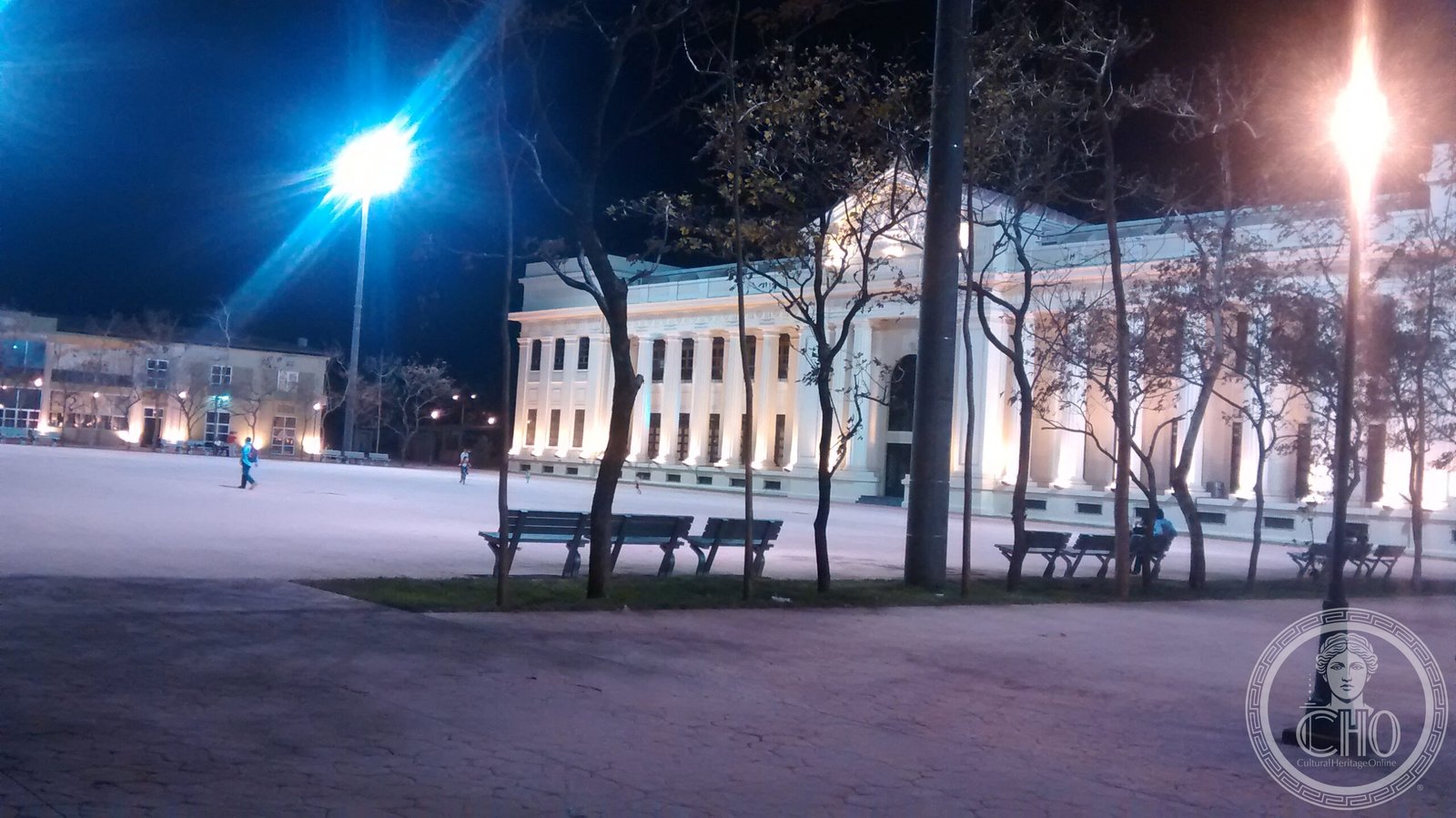
On the edge of Parque Central in Managua, the Palacio Nacional de la Cultura stands as one of Central America's most historically charged buildings. Designed in a restrained Neoclassical style inflected with Art Deco simplification, it was completed in 1935 as the political nerve centre of Nicaragua under the Somoza dynasty, housing the National Assembly and key government ministries. The building gained international fame in August 1978 when 25 Sandinista guerrillas led by Edén Pastora — "Commander Zero" — seized it in a daring 24-hour operation, extracting over 1,500 political prisoners and securing safe passage: a turning point in the revolution that swept Somoza from power the following year. Today it serves a new mission as the Palacio Nacional de la Cultura, sheltering the National Archive, a public library, the National Museum of Nicaragua, and a series of murals by artist Leoncio Sáenz depicting the full sweep of Nicaraguan history from pre-Columbian civilisations to the revolution.
At a glance
- Type
- Government palace, now cultural complex
- Period
- 1935
- Style
- Neoclassical / Art Deco
- Location
- Parque Central, Managua, Nicaragua
- Coordinates
- 12.1359° N, 86.2820° W
- Architect(s)
- Paul J. Williams
Overview
The Palacio Nacional de la Cultura occupies the eastern flank of Managua's central plaza, a two-storey Neoclassical block with Art Deco detailing whose sober authority once projected Somoza-era state power. After the 1972 earthquake levelled much of Managua, this building — though damaged — remained standing, becoming a symbol of continuity in a shattered city. Following the Sandinista revolution of 1979 it was converted from a legislative seat into a public cultural institution, placing knowledge, art, and memory at the heart of the Nicaraguan state. The murals by Leoncio Sáenz, painted across the interior walls in the 1980s, are among the most significant examples of Central American political mural art produced after the revolution.
History
Completed in 1935 under the patronage of Anastasio Somoza García, the palace was designed to anchor Managua's central plaza and express the authority of a modernising state. For four decades it served as the seat of the National Assembly and key government departments. The catastrophic 1972 earthquake that destroyed 80% of Managua left the palace structurally compromised but standing — a rare survivor in the rubble of the old city centre. On 22 August 1978, 25 Sandinista guerrillas of the FSLN stormed the building during a congressional session, taking some 2,000 hostages including several Somoza family members. After 24 hours of negotiation, Somoza agreed to release 59 political prisoners, pay a ransom, and grant the guerrillas safe passage to Panama — a spectacular propaganda victory that accelerated the collapse of the regime. In 1979, following the Sandinista triumph, the building was repurposed as a cultural palace. The murals of Leoncio Sáenz were commissioned throughout the 1980s.
Architecture & Design
Architect Paul J. Williams produced a two-storey block whose symmetrical facade, projecting central bay, and pilastered arcade reflect the Neoclassical vocabulary favoured by Latin American governments of the era. Art Deco influence appears in the geometric simplification of the mouldings, the flat roofline, and the restrained ornamental programme — a deliberate departure from the florid Beaux-Arts of earlier government buildings in the region. The interior courtyards and colonnaded loggias provide relief from the tropical heat while maintaining processional grandeur. The building's muted ochre plaster and tiled roof are characteristic of the colonial-republican hybrid that defines Managua's surviving historic fabric.
Cultural significance
The Palacio Nacional de la Cultura holds a dual significance in Nicaraguan memory: as the stage for the 1978 hostage operation that became the defining event of the insurrection against the Somoza dictatorship, and as the post-revolutionary home of the nation's archival, bibliographic, and museum heritage. The Leoncio Sáenz murals — depicting pre-Columbian life, Spanish conquest, independence struggles, and the 1979 revolution — constitute one of the most ambitious programmes of political public art in Central America. For Nicaraguans the building functions as both a lieu de mémoire and a living civic institution.
Visiting today
The Palacio Nacional de la Cultura is open to the public and houses the National Museum of Nicaragua on the ground floor, with permanent galleries covering pre-Columbian artefacts, colonial history, and 20th-century political history including the revolution. The National Archive and library are accessible by appointment. The interior murals by Leoncio Sáenz can be seen on a self-guided walk through the courtyard galleries. Admission is modest; guided tours are available in Spanish. The building faces Parque Central, adjacent to the ruins of the old Managua Cathedral.
Getting there
The Palacio Nacional de la Cultura stands on Parque Central in downtown Managua, reachable by taxi from any point in the capital (approx. 10–20 minutes depending on traffic). Public buses stop on Avenida Bolívar nearby. The site is a short walk from the lakefront Malecon and the Managua Convention Centre. Taxis and ride-hailing apps — Uber operates in the city — are the standard transport; there is no metro system.
Sources & resources
Find it on the map
See this place and what’s around it →Record researched and written by Luigi De Marchi for Cultural Heritage Online, 2026.
📷 Become a Cultural Heritage Online photographer
Share your photos of places: they stay published under your name as the author. The more they're seen, the more you get noticed — and soon a contest will reward the most appreciated photos.
Log in or sign up free to add a photoIs this page about you?
This page is read by travellers and heritage enthusiasts who find it on Google. Tell us how you are connected to this place and we will take it from there.