

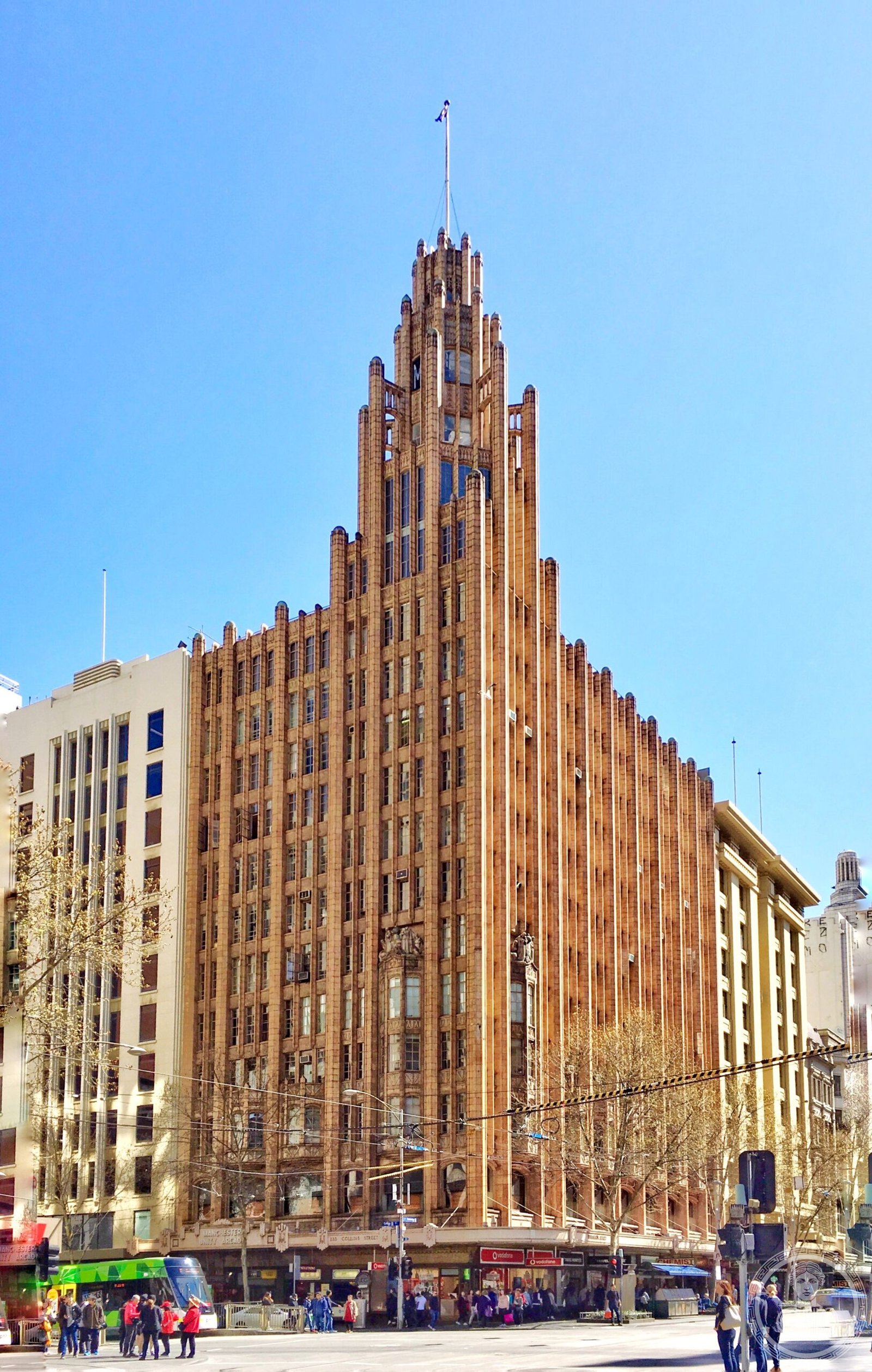
Standing at the corner of Collins and Swanston Streets in the heart of Melbourne, the Manchester Unity Building is widely regarded as Australia’s finest Art Deco skyscraper. Completed in 1932 to a design by architect Marcus Barlow, the ten-storey tower fuses the vertical drama of Venetian Gothic tracery with the streamlined setbacks and cream-and-blue-grey terracotta cladding that defined 1930s modernism. Its soaring corner tower crowned with a lantern is one of Melbourne’s most recognisable silhouettes, visible from Federation Square and the forecourt of Flinders Street Station. The building was commissioned by the Manchester Unity Independent Order of Oddfellows, a mutual benefit society, to house their headquarters above a commercial ground-floor arcade — an early and elegant example of vertical mixed-use architecture in Australia. The ornate interior arcade, rooftop medical suite, and terracotta facade survive largely intact, earning the building a place on the Heritage Victoria A list.
At a glance
- Type
- Commercial skyscraper
- Period
- 1929–1932
- Style
- Art Deco / Venetian Gothic
- Location
- 220 Collins Street, Melbourne, Victoria, Australia
- Coordinates
- 37.8136° S, 144.9660° E
- Architect(s)
- Marcus Barlow
Overview
The Manchester Unity Building rises ten storeys from one of Melbourne’s busiest intersections, its cream terracotta skin articulated with Gothic lancet panels, ornamental friezes, and a distinctive corner tower. Marcus Barlow blended the soaring verticality fashionable in American and European Art Deco with Gothic-derived ornament considered suitably prestigious for a major friendly society. The ground-floor arcade provided retail income; the upper floors housed the Oddfellows’ administrative offices and a rooftop medical suite for members. When completed in 1932 it was the tallest building in Melbourne and one of the tallest in Australia.
History
The Manchester Unity Independent Order of Oddfellows was one of Australia’s largest mutual aid societies by the 1920s, providing sickness and funeral benefits to working-class members across Victoria. Flush with reserves, they acquired the Collins–Swanston corner and engaged Marcus Barlow, who had studied Gothic architecture in Europe. Construction proceeded through the early years of the Great Depression, completing in 1932. The arcade became a fashionable shopping destination; the upper floors were progressively leased to commercial tenants as the Oddfellows’ own membership declined through the twentieth century. The building was heritage listed in the 1980s, and extensive restorations of the terracotta facade and interior arcade were carried out in the 1990s and 2010s.
Architecture & Design
Barlow’s design is notable for its three-dimensional surface quality. The lower two storeys form a base of grey granite and dark polished marble; above, cream terracotta rises in clustered pilasters separated by vertical spandrel panels decorated with Gothic tracery and floral friezes. The corner tower tapers through progressive setbacks to a lantern finial. Inside, the ground-floor arcade is lined with small shopfronts behind polished bronze frames, with a mosaic floor and coffered ceiling. The rooftop level, originally a medical centre for Oddfellows members, retains its original fitout of consulting rooms and waiting areas. Heritage Victoria’s A-list citation notes the facade’s exceptional state of preservation.
Cultural significance
The Manchester Unity Building is a landmark of Melbourne’s urban identity, regularly listed among the city’s most beloved buildings in public surveys. It represents the confidence of Melbourne’s inter-war boom and the social history of the mutual aid movement that financed it. Its position at the busiest pedestrian corner in the CBD has made it a background presence in decades of Melbourne photography, film, and fiction. The 1932 construction date — deep in the Depression — makes its ambition and quality all the more remarkable. For architectural historians it is the primary Australian example of Gothic-inflected Art Deco.
Visiting today
The ground-floor arcade is open during retail trading hours and free to enter. Upper floors contain commercial offices; the rooftop heritage suite is occasionally open for Heritage Week events. The building is privately owned but the exterior and arcade are publicly accessible at all times. Several cafes and specialty retailers operate in the arcade. The best external views are from across Swanston Street or from Federation Square to the south.
Getting there
The building occupies the corner of Collins and Swanston Streets in Melbourne CBD. Flinders Street Station is a 3-minute walk south. Trams stop directly outside on Swanston Street (Routes 1, 3, 5, 6, 16, 64, 67, 72) and on Collins Street (Routes 11, 12, 48, 109). City Circle tram stops at Collins and Swanston. No dedicated parking; Wilson and Secure car parks within 200 m.
Sources & resources
Find it on the map
See this place and what’s around it →Record researched and written by Luigi De Marchi for Cultural Heritage Online, 2026.
📷 Become a Cultural Heritage Online photographer
Share your photos of places: they stay published under your name as the author. The more they're seen, the more you get noticed — and soon a contest will reward the most appreciated photos.
Log in or sign up free to add a photoIs this page about you?
This page is read by travellers and heritage enthusiasts who find it on Google. Tell us how you are connected to this place and we will take it from there.