

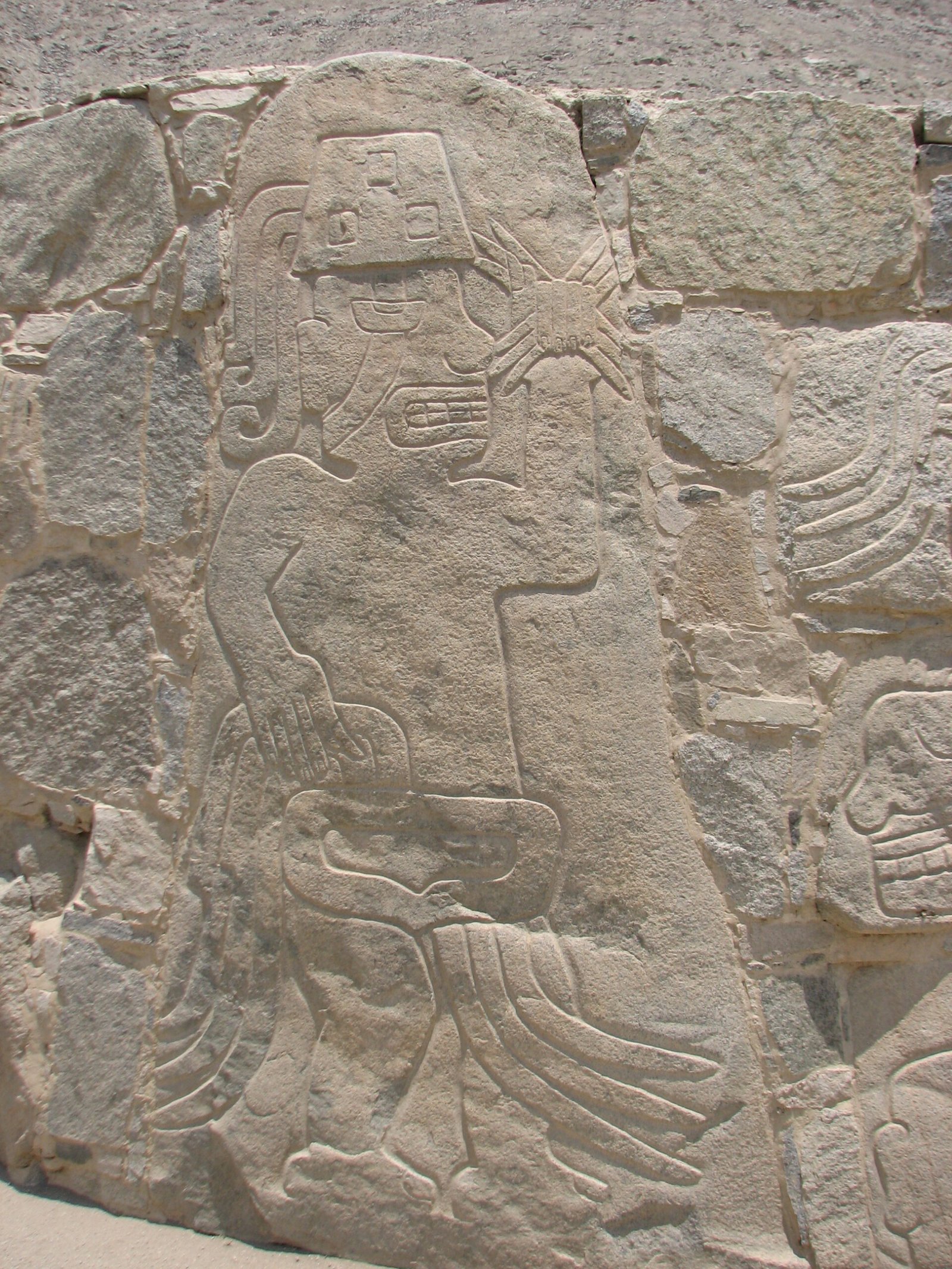
A rectangular temple platform encased by approximately 400 carved stone slabs — alternating warriors and a catalogue of human dismemberment — one of the most extraordinary and disturbing sculptural programmes in the ancient Americas, created around 1600 BC in the Casma Valley of Peru.
At a glance
In the Casma Valley approximately 370 km north of Lima, on the lower slopes of a desert hill that gives the site its name, a rectangular temple platform of approximately 50 × 55 metres — built of large granite and diorite stones and dated to approximately 1600 BC — is encased on three sides by one of the most extraordinary sculptural programmes in the ancient Americas: approximately 400 carved stone slabs set upright as a continuous frieze around the building’s exterior, depicting alternating armed warriors and a systematic catalogue of human dismemberment. Severed heads, stacked body segments, crossed femurs, and isolated internal organs are carved with an anatomical directness unique in pre-Columbian art.
Key facts
- Location: Casma Valley, Ancash region, Peru (~370 km north of Lima)
- Dated: c. 1800–900 BC (Initial Period); main frieze c. 1600 BC
- Culture: Casma-Sechín culture; independent of later Chavin or Moche traditions
- Carved stones: Approximately 400 slabs, set upright in situ, alternating warriors and dismembered body parts
- Temple platform: ~50 × 55 m, granite and diorite construction
- First excavation: Julio C. Tello, 1937; German-Peruvian joint missions since the 1960s
- Viewing: Carvings preserved in situ; some protected by modern roofing
History
Cerro Sechín was first excavated in 1937 by the Peruvian archaeologist Julio C. Tello, who identified the carved stone frieze and recognised the site’s significance as evidence of a pre-Chavin cultural florescence in coastal Peru. Subsequent excavations by German and Peruvian teams have established a long occupation sequence in the Casma Valley extending from approximately 1800 to 900 BC, of which the main carved platform represents the most dramatic phase, dated to approximately 1600 BC.
The Casma-Sechín culture that built the site appears to have been an independent development: its artistic programme has no direct predecessors in the archaeological record of the region and shows no dependence on the iconographic traditions of the better-known Chavin horizon (which post-dates Sechín by several centuries) or the later Moche. This independence makes the site difficult to interpret: the alternation of warrior figures and dismembered body parts could represent a religious sacrifice narrative, the commemoration of a specific military victory, an ideological statement about power and its consequences for the defeated, or a combination of all three.
The Casma Valley was also home to other significant Initial Period sites, notably Sechín Alto, which at its greatest extent was one of the largest monumental complexes in the Americas. The relationship between these sites and the meaning of the Sechín carving programme within its regional context remain active areas of archaeological research.
What you see
The carved stone frieze encases three sides of the temple platform, with the slabs set upright in the ground as a continuous register at approximately ground level. The carved figures alternate between two types: tall warrior figures, approximately life-size, depicted frontally with elaborate headdresses, carrying staffs or clubs; and horror-register panels of dismembered body parts — severed heads from which spinal columns still dangle, stacked body segments, crossed femurs, eyes severed from their orbits, and isolated internal organs. The carving is in shallow relief, with the figures and body parts rendered in a highly distinctive local style that has no close parallels elsewhere in the Americas.
The stones themselves are granite and diorite, dark grey to black, and the carvings are executed with considerable precision. Some sections are protected by modern metal roofing structures that shade the most vulnerable panels. The site museum (Museo de Sechín) nearby holds portable objects recovered from excavations, including ceramic vessels, stone tools, and traces of pigment that suggest the carved frieze was originally painted.
Practical information
- Access: Open daily; entrance fee; combined ticket with Museo de Sechín recommended
- Getting there: Located approximately 4 km from Casma town; accessible by mototaxi from the main square
- Best time: Morning hours; the site is in a desert valley and becomes very hot by midday
- Photography: Permitted throughout; the carvings can be photographed at close range
- Guided tours: Local guides available in Casma; English-speaking guides can be pre-arranged
Getting there
Casma is approximately 370 km north of Lima on the Pan-American Highway, approximately 4–5 hours by bus. Regular buses run from Lima’s Javier Prado terminal to Casma. The site is 4 km from the town centre, accessible by mototaxi or taxi. Chimbote (50 km to the north) is an alternative base with more hotel options and bus connections.
Nearby
- Sechín Alto — one of the largest monumental complexes of the Initial Period, in the same valley
- Chanquillo — ancient solar observatory and fortress in the Casma hinterland, a UNESCO World Heritage Site
- Museo de Sechín — site museum with portable artefacts from the Casma Valley excavations
Sources
- Tello, J.C. (1956). Arqueología del Valle de Casma. Universidad Nacional Mayor de San Marcos, Lima.
- Pozorski, T. & Pozorski, S. (1987). Early Settlement and Subsistence in the Casma Valley, Peru. University of Iowa Press.
- Wikipedia: Cerro Sechín
Find it on the map
See this place and what’s around it →📷 Become a Cultural Heritage Online photographer
Share your photos of places: they stay published under your name as the author. The more they're seen, the more you get noticed — and soon a contest will reward the most appreciated photos.
Log in or sign up free to add a photo