
Three cities built in succession over 1,000 years, home to the world’s oldest university and a crossroads where Achaemenid, Greek, Buddhist, and Kushan civilisations met.
At a glance
Taxila is not a single ruin but an entire archaeological valley 30 km across, 35 km northwest of Islamabad. Three successive cities — Bhir Mound, Sirkap, and Sirsukh — were built, inhabited, and rebuilt over a millennium on the same strategic Pothohar Plateau, where trade routes between Central Asia, the Iranian plateau, and the Indian subcontinent converge. Around them spread dozens of Buddhist monasteries, stupas, and shrines. Taxila was inscribed as a UNESCO World Heritage Site in 1980 and remains one of the most important archaeological complexes in Asia.
Key facts
- Location: Pothohar Plateau, Punjab Province, Pakistan — 35 km NW of Islamabad
- Three cities: Bhir Mound (c. 600–200 BC), Sirkap (c. 2nd c. BC – 2nd c. AD), Sirsukh (c. 1st–5th c. AD)
- UNESCO: World Heritage Site since 1980
- Famous scholars: Chanakya, Panini, Jivaka, possibly Chandragupta Maurya all studied at Takshashila
- Alexander the Great: arrived 326 BC, welcomed peacefully — first major city he entered in the Indian subcontinent without battle
- Taxila Museum: on-site government museum holding thousands of artefacts (opened 1928)
- Primary excavations: John Marshall, Archaeological Survey of India, 1913–1934
History
By the 6th century BC, Taxila (Sanskrit: Takshashila) was already a major city and centre of learning within the Achaemenid empire’s easternmost satrapy of Gandhara. Ancient texts describe students travelling from across the Indian subcontinent to study here under individual master-teachers — not in a single institution but a network of homes and workshops that collectively constituted what later traditions called a university. Subjects included the Vedas, grammar, law, medicine, military science, astronomy and philosophy. The most celebrated alumni include Chanakya, who studied and later taught statecraft here before advising Chandragupta Maurya in founding the Maurya Empire; Panini, whose 4th-century BC grammar of Sanskrit remains one of the greatest intellectual achievements of the ancient world; and Jivaka, physician to the Buddha and to the kings of Magadha.
In 326 BC, Alexander the Great crossed the Indus and arrived at Taxila, which surrendered peacefully under its king Ambhi. After Alexander’s death, Bactrian Greek kingdoms controlled the region and rebuilt Taxila’s second city, Sirkap, as a planned Hellenistic grid — streets at right angles, a central acropolis, a marketplace, and the Temple of Jandial, whose architecture combines Ionic columns with what may be a Zoroastrian fire-altar arrangement. The fusion of Greek, Persian and Indian artistic traditions produced the Gandharan style — a Buddha with a Greek face, dressed in a toga — which spread from Taxila across Central Asia.
The Kushan empire (1st–5th century AD) built the third city, Sirsukh, whose massive stone defensive walls still stand in places 5 metres high. Buddhism flourished under Kushan patronage, and the surrounding hills filled with monasteries and stupas. Repeated White Hun raids from the 5th century AD accelerated decline, and by the 6th century the city was largely abandoned.
What you see
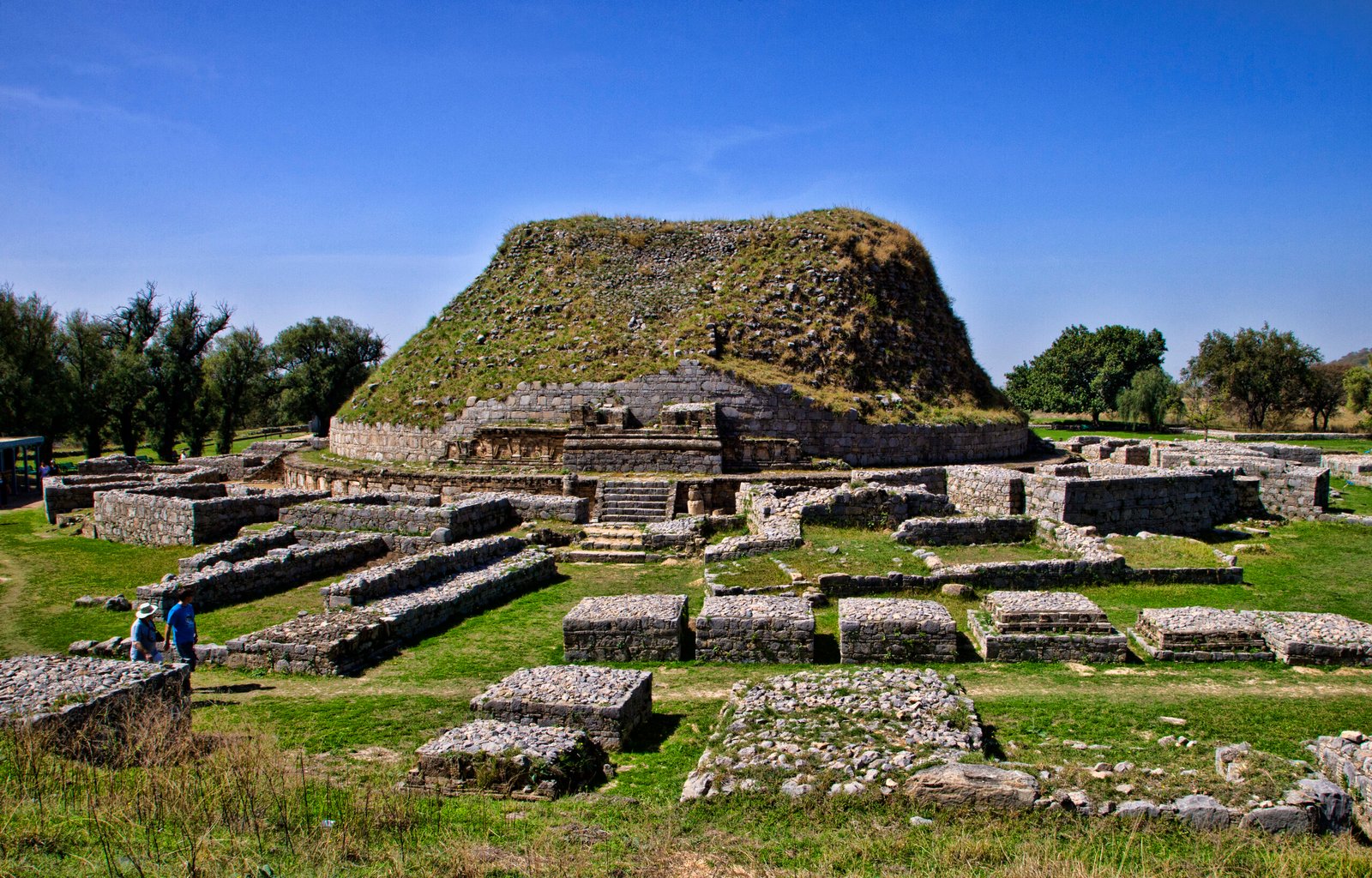
The valley holds an extraordinary density of visible archaeology. Bhir Mound presents as an eroded mass of mudbrick and rubble — excavated sections reveal irregular street layouts from the Achaemenid and early Mauryan periods. Sirkap immediately reads as a planned Hellenistic city: a long straight main street flanked by regular house blocks. The Temple of Jandial stands apart from the residential grid — its double-apsed plan, Ionic capitals and unusual inner sanctuary have generated debate about whether it served as a Zoroastrian fire temple for a Greek-speaking community. The Dharmarajika Stupa, south of Sirkap, is a massive hemispherical mound surrounded by the ruined cells of monks who lived around it for centuries.
Sirsukh’s most striking feature is its perimeter wall — a band of neatly coursed limestone blocks stretching nearly 1,400 metres, with projecting rectangular towers at regular intervals, still rising to significant height in the northwest corner. The Taxila Museum holds the material culture of all three cities: Gandharan stone sculptures of the Buddha in the Greek-inflected style, gold and silver jewellery, coins spanning Achaemenid to Kushan rulers, everyday pottery, and stone palettes used to grind cosmetics.
Practical information
The Taxila Archaeological Museum is open daily except Monday, approximately 09:00–17:00 (hours vary seasonally). A single admission fee covers both the museum and the main sites. A guide hired at the museum adds significant value given the complexity of multiple sites spread across the valley. The site restaurant near the museum serves basic meals. Best months to visit: October through March; summers on the Pothohar Plateau are very hot.
Getting there
From Islamabad (35 km): the Grand Trunk Road (N5) runs northwest to Taxila; the journey takes about 45 minutes by car or taxi. Local minibuses from Rawalpindi run frequently. The Taxila train station (Peshawar line) is adjacent to the museum. From Lahore (280 km), the Khyber Mail express takes about 3 hours. GPS: 33.7743 N, 72.8318 E.
Nearby
- Rohtas Fort (60 km south) — 16th-century Sher Shah Suri fortress, UNESCO World Heritage Site
- Hasan Abdal (30 km southeast) — Sikh pilgrimage site of Panja Sahib gurdwara
- Margalla Hills — forested ridge north of Islamabad with hiking trails
- Islamabad / Rawalpindi (35 km) — base cities with onward connections across Pakistan
Sources
- Marshall, J., Taxila: An Illustrated Account of Archaeological Excavations, 3 vols., Cambridge University Press, 1951
- Allchin, F.R. and Norman Hammond (eds.), The Archaeology of Afghanistan, Academic Press, 1978
- UNESCO World Heritage Centre, Taxila, whc.unesco.org/en/list/139
- Narain, A.K., The Indo-Greeks, Oxford University Press, 1957
- Rosenfield, J.M., The Dynastic Arts of the Kushans, University of California Press, 1967
Find it on the map
See this place and what’s around it →📷 Become a Cultural Heritage Online photographer
Share your photos of places: they stay published under your name as the author. The more they're seen, the more you get noticed — and soon a contest will reward the most appreciated photos.
Log in or sign up free to add a photo