

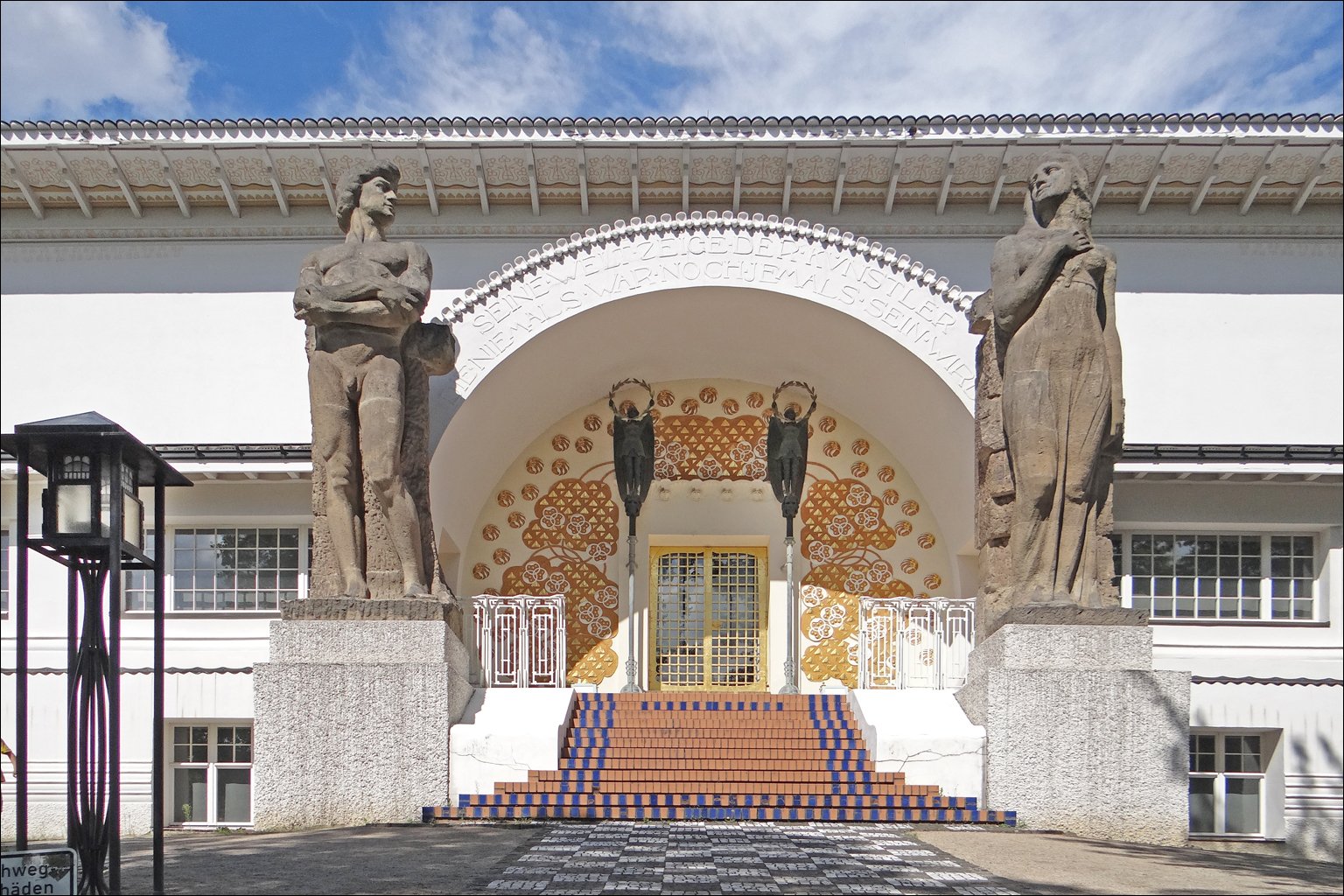
A Grand Duke gathered artists on a hill and told them to build a new way of living. The Mathildenhöhe is where German Jugendstil became a complete environment, not just a style.
At a glance
The Mathildenhöhe is the site of the Darmstadt Artists’ Colony (Künstlerkolonie), founded in 1899 by Grand Duke Ernst Ludwig of Hesse to bind art to craft and industry. Its leading designer was the Viennese architect Joseph Maria Olbrich (1867–1908), a co-founder of the Vienna Secession, who shaped much of the ensemble. Across a series of exhibitions the colony built houses, studios and monuments as a single Jugendstil landscape. It was inscribed as a UNESCO World Heritage Site in 2021.
Key facts
- Founder: Grand Duke Ernst Ludwig of Hesse, 1899
- Lead architect: Joseph Maria Olbrich
- Movement: Jugendstil / German Art Nouveau
- Key exhibitions: 1901, 1904, 1908, 1914
- Status: UNESCO World Heritage Site (2021)
History
Ernst Ludwig, a grandson of Queen Victoria, wanted Hesse to lead a reform of the applied arts. In 1899 he invited a group of artists, including Olbrich and the designer Peter Behrens, to settle on the Mathildenhöhe hill above Darmstadt and to demonstrate a modern union of art and life.
The colony presented its work through public exhibitions. The first, in 1901, was staged as a built event titled “A Document of German Art,” in which the artists’ own houses formed the show. Further exhibitions in 1904, 1908 and 1914 added buildings, gardens and the colony’s landmark tower.
Parts of the site were damaged in the Second World War and later restored. Today the Mathildenhöhe survives as one of the most coherent surviving statements of the Jugendstil reform movement, recognised by UNESCO in 2021.
What you see
The hilltop gathers the Wedding Tower, the exhibition hall, the Russian Orthodox chapel and a row of artists’ houses around a planned platform and gardens. The forms are clean and curved, with stylised ornament and bold golden detailing rather than historical decoration.
Olbrich’s buildings set the tone: simple masses, broad arches and carefully placed colour. Walking the plateau, the visitor reads the colony as the artists intended, as one designed world rather than a collection of separate monuments.
Practical information
- Access: the plateau and gardens are open; the exhibition building and museum keep their own hours
- Setting: a hilltop park east of central Darmstadt
- Time needed: 1.5–3 hours for the ensemble and museum
Getting there
Darmstadt lies about 30 km south of Frankfurt, with frequent trains to Darmstadt Hauptbahnhof. The Mathildenhöhe is east of the centre, reachable by city bus or a 25-minute walk. Frankfurt Airport is roughly 25 km north.
Nearby
- Hochzeitsturm (Wedding Tower), the colony’s landmark by Olbrich
- Russian Orthodox Chapel of St Mary Magdalene, on the same plateau
- Darmstadt — Olbrich, the Mathildenhöhe and German Jugendstil (CHO city guide)
Sources
- UNESCO World Heritage Centre, “Mathildenhöhe Darmstadt” (whc.unesco.org)
- Institut Mathildenhöhe, Darmstadt (mathildenhoehe.eu)
- Encyclopaedia Britannica, “Joseph Maria Olbrich”
Find it on the map
See this place and what’s around it →Record researched and written by Luigi De Marchi for Cultural Heritage Online, 2026.
📷 Become a Cultural Heritage Online photographer
Share your photos of places: they stay published under your name as the author. The more they're seen, the more you get noticed — and soon a contest will reward the most appreciated photos.
Log in or sign up free to add a photo