
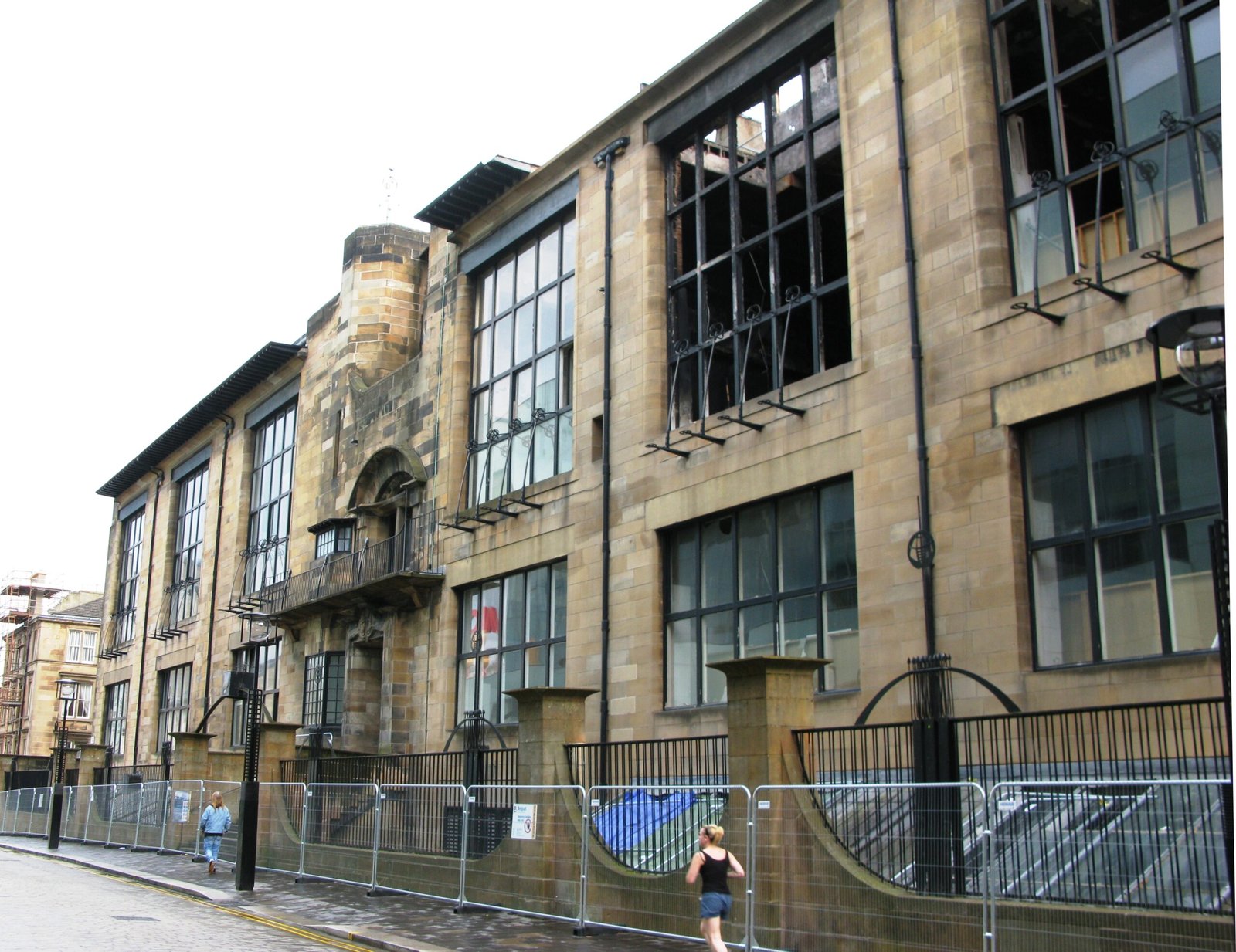
Mackintosh won the commission at twenty-eight. The building he delivered became the clearest statement of a Scottish answer to Art Nouveau, austere on the street and luminous inside.
At a glance
The Glasgow School of Art is the defining work of Charles Rennie Mackintosh (1868–1928), designed after his employer Honeyman and Keppie won the design competition in 1896. Built in two phases, it fuses Scottish baronial mass with the slender lines and stylised plant motifs of the wider Art Nouveau movement. Its west wing, completed in 1909, held a library that was among the most admired interiors in Europe. The building was twice gutted by fire, in 2014 and again in 2018, and a faithful reconstruction is under way.
Key facts
- Architect: Charles Rennie Mackintosh, for Honeyman and Keppie
- Competition won: 1896
- Built: east wing 1897–1899; west wing 1907–1909
- Style: Glasgow Style, the Scottish strand of Art Nouveau
- Status: Category A listed; under reconstruction after the 2014 and 2018 fires
History
In 1896 the school’s director Francis Newbery launched a limited competition for a new building on a steep site off Sauchiehall Street. The practice of Honeyman and Keppie submitted a design drawn largely by Mackintosh, then a junior draughtsman, and won. Money was tight, so construction was split: the eastern half opened in 1899, the western half only in 1909 once further funds were raised.
The long gap let Mackintosh rethink the second phase. The west wing he produced in 1907–1909, with its three-storey library, was bolder and more sculptural than the first, and it is usually read as the moment his vision fully matured. The school has trained generations of Scottish artists and designers since.
A fire in May 2014 destroyed the library. During the restoration that followed, a second and more severe fire in June 2018 left the building a shell. A reconstruction to Mackintosh’s drawings is in progress.
What you see
The Renfrew Street front is a wall of tall iron-framed studio windows set into rough stone, with delicate wrought-iron brackets that double as window-cleaning supports and as abstract emblems. The entrance is pushed off-centre and announced by a curving stair and carved stonework, a deliberate break from Victorian symmetry.
Inside, before the fires, the spaces ran from the cavernous studios to the hushed timber library, where clustered uprights and pierced balusters created a forest-like screen of light and shadow. The reconstruction aims to return these interiors to their 1909 state.
Practical information
- Access: the Mackintosh building is closed during reconstruction; check the school for current tours and exhibitions
- Setting: central Garnethill, a short uphill walk from Sauchiehall Street
- Time needed: 30–60 minutes for the exterior and immediate streets
Getting there
The school stands on Renfrew Street in central Glasgow, a few minutes on foot from Charing Cross and Cowcaddens stations and from Glasgow Queen Street. Glasgow Airport lies about 13 km west, linked by frequent buses to the city centre.
Nearby
- Mackintosh at the Willow, Sauchiehall Street, a short walk downhill
- The Hill House at Helensburgh, Mackintosh’s domestic masterpiece, about 40 km north-west
- Glasgow — Mackintosh and the Arts & Crafts Movement (CHO city guide)
Sources
- The Glasgow School of Art, institutional history and reconstruction updates (gsa.ac.uk)
- Historic Environment Scotland, listed building record
- Encyclopaedia Britannica, “Charles Rennie Mackintosh”
Find it on the map
See this place and what’s around it →Record researched and written by Luigi De Marchi for Cultural Heritage Online, 2026.
📷 Become a Cultural Heritage Online photographer
Share your photos of places: they stay published under your name as the author. The more they're seen, the more you get noticed — and soon a contest will reward the most appreciated photos.
Log in or sign up free to add a photoIs this page about you?
This page is read by travellers and heritage enthusiasts who find it on Google. Tell us how you are connected to this place and we will take it from there.