
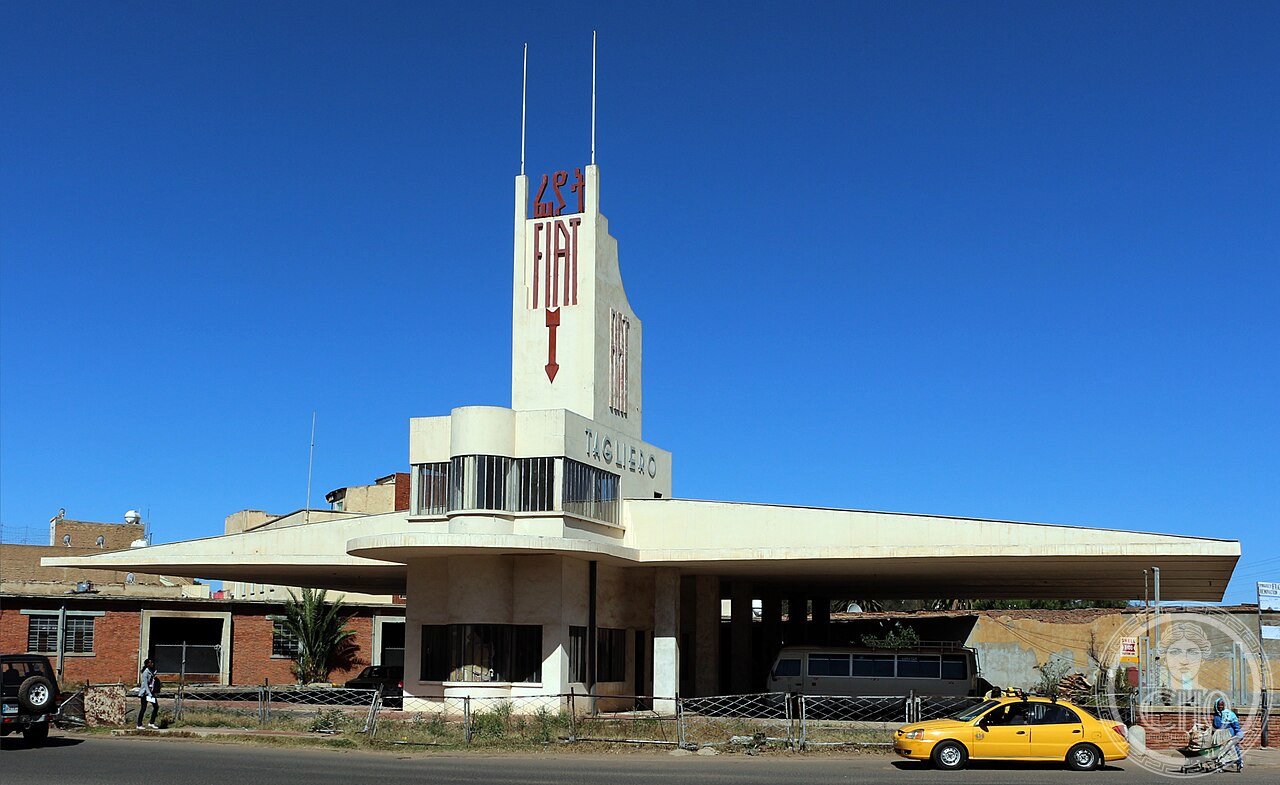
The Fiat Tagliero Building in Asmara is one of the most audacious feats of 20th-century engineering: a petrol station and garage designed to resemble an airplane, its two 30-metre concrete wings cantilevering over the service bays below without a single support column. Designed by Italian engineer Giuseppe Pettazzi in 1938 for the Fiat motor company during the period of Italian colonial rule over Eritrea, the building was rejected by colonial authorities who declared the cantilevered wings structurally impossible. Pettazzi built it anyway. Legend holds that he drew a pistol and threatened to shoot the foreman if he did not remove the temporary supports before the concrete had finished curing. The wings held, and continue to hold. The building has transcended its colonial and Fascist context to become one of the most celebrated works of modernist architecture in Africa, forming the centrepiece of Asmara’s UNESCO World Heritage ensemble.
At a glance
- Type
- Petrol station and garage
- Period
- 1938
- Style
- Italian Futurist / Art Deco
- Location
- Asmara, Eritrea
- Coordinates
- 15.3283° N, 38.9258° E
- Architect(s)
- Giuseppe Pettazzi
Overview
Rising from the streets of Asmara like a concrete aircraft frozen in flight, the Fiat Tagliero Building defies its mundane programme. A service station for Fiat automobiles, it was conceived as a sculptural manifesto of Italian Futurism: speed, flight, and machine-age optimism made permanent in reinforced concrete. The building anchors Harnet Avenue in central Asmara and remains in continuous use, still dispensing fuel beneath wings that have weathered over eighty years of Eritrean sun without structural intervention.
History
Italy colonised Eritrea from 1890, but the most intensive period of architectural investment came under Mussolini’s programme of colonial urbanism in the 1930s. Asmara was reimagined as a piccola Roma, a laboratory of modernist town planning and architectural experimentation. Fiat, Italy’s dominant automaker and a symbol of industrial modernity, commissioned Pettazzi to design a flagship service station. When colonial administrators refused to approve the structurally unorthodox plans, Pettazzi bypassed the bureaucracy and proceeded, reportedly at gunpoint. After Eritrean independence in 1993 the building passed to local ownership. It remains an active service station to this day.
Architecture & Design
The building’s plan is cruciform, anchored by a central cylindrical tower that houses the cashier and office functions. From this hub, two reinforced-concrete wings extend 15 metres to each side, a total span of 30 metres, cantilevering over the pump forecourt with no intermediate columns. The underside of each wing is finished with coffered concrete, while the leading edges taper to a blade-thin profile to emphasise the illusion of flight. The tower’s streamlined casing, horizontal banding, and porthole windows draw directly from the Futurist vocabulary of Fortunato Depero and Antonio Sant’Elia. The engineering relies on pre-stressed concrete tendons running the full length of each wing, a technique at the absolute limit of 1930s construction technology.
Cultural significance
Asmara’s modernist district, comprising over 400 buildings designed by Italian architects between 1935 and 1941, was inscribed as a UNESCO World Heritage Site in 2017 under the title “Asmara: A Modernist African City.” The Fiat Tagliero Building is its most iconic single structure. It appears in every architectural survey of 20th-century modernism and has been called the most extraordinary petrol station in the world. For Eritreans, it occupies a complex position: a relic of colonial domination that is simultaneously a source of genuine civic pride and a remarkable achievement of structural art.
Visiting today
The building is located on Harnet Avenue in central Asmara and is freely viewable from the street at all hours. It remains operational as a petrol station, so access to the forecourt is possible during business hours. The best light for photography falls in the morning, when the sun illuminates the south-facing wings. Visitors to Asmara should also take in the nearby Cinema Impero, Cinema Roma, and the Covered Market to appreciate the full scope of the city’s Art Deco ensemble. Entry to Eritrea requires a visa; check current conditions before travel.
Getting there
Asmara International Airport (ASM) is served by flights from Cairo, Dubai, Frankfurt, and several East African hubs. The building is approximately 3 kilometres from the airport by road. Within Asmara, shared taxis and minibuses run along Harnet Avenue. The building is a short walk from the central post office and the main market area, making it easy to combine with a wider walking tour of the UNESCO heritage district.
Sources & resources
See the place
Find it on the map
See this place and what’s around it →Record researched and written by Luigi De Marchi for Cultural Heritage Online, 2026.
📷 Become a Cultural Heritage Online photographer
Share your photos of places: they stay published under your name as the author. The more they're seen, the more you get noticed — and soon a contest will reward the most appreciated photos.
Log in or sign up free to add a photoIs this page about you?
This page is read by travellers and heritage enthusiasts who find it on Google. Tell us how you are connected to this place and we will take it from there.