

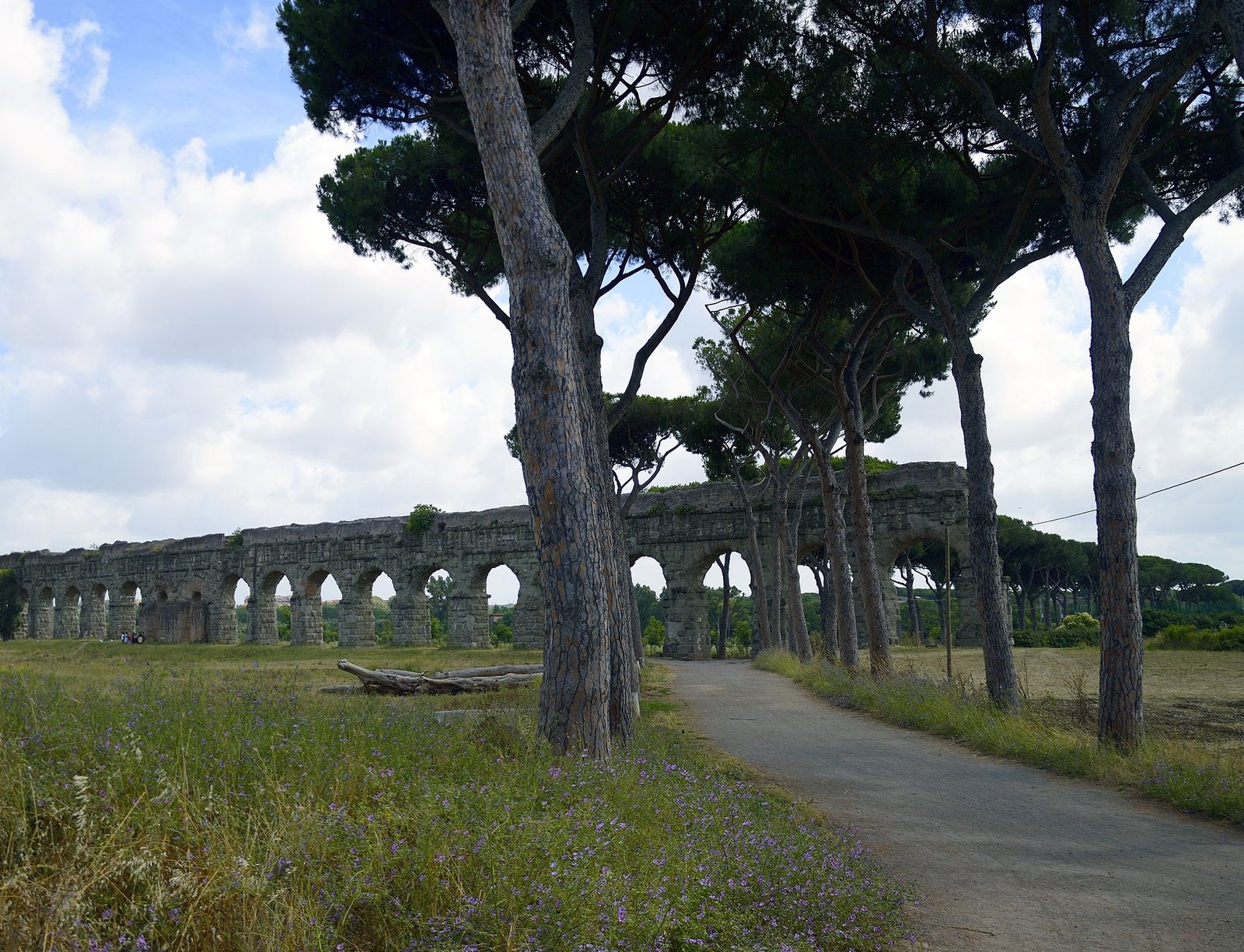
An urban green space spanning 240 hectares across seven Roman and Renaissance aqueducts that once supplied ancient Rome, now a restored landscape straddling the Appio Claudio district and the Appian Way regional park.
At a glance
The Park of the Aqueducts preserves a fragment of the Agro Romano landscape, anchored by the monumental remains of six imperial aqueducts—Anio Vetus, Marcia, Tepula, Iulia, Claudius, and Anio Novus—plus the Renaissance Felice Aqueduct. Dense pine woodland, a small lake fed by the Felice aqueduct, and meadowland characterize the terrain. The area stretches between Via delle Capannelle and the Rome-Cassino-Naples railway, encompassing approximately 240 hectares in Municipio VII.
History
The site’s name and character derive entirely from the aqueducts that crossed it. Some channels ran underground; others rose as arched superstructures, their engineering feats visible across the landscape. The area once housed Roma Vecchia farmhouse, and in the twentieth century, informal settlements grew against the Felice aqueduct despite a 1965 master plan designating it for public park use.
Degradation and unauthorized building threatened the site through the 1970s and early 1980s. In 1986, concerned citizens formed the Committee for the protection of the Parco degli Acquedotti. With support from intellectuals including Lorenzo Quilici, the committee secured the area’s inclusion in the Appia Antica Regional Park in 1988. Subsequent restoration efforts eliminated illegal structures, rehabilitated the Marrana dell’Acqua Mariana watercourse, and established cycle and pedestrian connections to neighboring zones.
What you see
Seven aqueduct lines traverse the park in various configurations. The Anio Vetus runs underground. The Marcia, Tepula, Iulia, and Felice channels stack in superposition, creating layered architectural presence. The Claudian and Anio Novus aqueducts also overlap, their arched spans and substructures punctuating the landscape.
A small lake fed by the Felice aqueduct generates a stream and waterfall that follow the course of the ancient Marrana of the Acqua Mariana. Extensive pine woodland dominates vegetation. Dirt tracks crisscross the grounds for pedestrians, cyclists, and runners. Views extend toward the Castelli Romani, though low-altitude aircraft from nearby Ciampino Airport frequently interrupt the skyline.
Cultural significance
The park embodies the engineering prowess of Roman hydraulics across four centuries—from the Anio Vetus (probably 4th century BCE) through the Renaissance Felice Aqueduct (16th century). It is the sole substantial remnant of the once-continuous Agro Romano landscape stretching to the Alban Hills.
The site has appeared in numerous films, including La dolce vita, Mamma Roma, Il marchese del Grillo, The Great Beauty, and the television series Rome. Its preservation represents a successful grassroots effort to protect archaeological and environmental heritage from urban speculation and development.
Key facts
- Address: Via Lemonia, 00174 Rome
- Coordinates: 41.852173524388824, 12.556815147399902
- Area: Approximately 240 hectares
- Aqueducts present: Anio Vetus, Marcia, Tepula, Iulia, Claudius, Anio Novus (Roman); Felice (Renaissance)
- Official website: http://www.parcoappiaantica.it/home/itinerari/acquedotti
- Phone: 06 513 5316
Practical information
The park is open to the public year-round. Facilities include dirt tracks for jogging and mountain biking, and private sports fields for football, five-a-side football, tennis, rugby, and golf operate within the grounds. Agricultural and livestock activities continue in designated areas. Opening hours and seasonal closures are not listed; check the official website for current details.
Getting there
The park lies in Municipio VII of Rome, accessible via Via Lemonia. It forms part of the Appia Antica Regional Park and connects to the Tor Fiscale area via new cycle-pedestrian routes. For directions and public transport options, consult local Rome transportation resources or the park’s official website.
Sources & resources
Find it on the map
See this place and what’s around it →Historical events at this place (23)
- 2019 Porta FURBA e l'Acquedotto FELICE
- 2019 Tramonto sugli Acquedotti di Roma Antica
- 2019 Visita guidata: Tramonto sugli Acquedotti di Roma Antica
- 2020 Roma Archeologica: Alla Scoperta del Parco degli Acquedotti
- 2020 Tramonto sugli Acquedotti di Roma Antica
- 2020 Tramonto sugli Acquedotti di Roma Antica
- 2020 Tramonto sugli Acquedotti di Roma Antica
- 2020 Tramonto sugli Acquedotti di Roma Antica
- 2021 Roma Archeologica: Il Parco degli Acquedotti
- 2021 Tramonto al Parco degli Acquedotti
- 2021 Tramonto al Parco degli Acquedotti
- 2021 Passeggiata al Parco degli Acquedotti e Tor Fiscale
- 2022 Gli ACQUEDOTTI a Porta Maggiore
- 2022 Il Parco degli Acquedotti
- 2022 Acquedotti di Romani
- 2022 Porta Furba e l'Acquedotto Felice
- 2024 Tramonto sugli Acquedotti di Roma Antica - visita guidata a piedi
- 2024 Visita dell'Acqua Marcia presso il Casale di Roma Vecchia
- 2024 Appia Antica, Caffarella, Acquedotti ebike tour piccoli gruppi IN INGLESE 8 ottobre 2024
- 2024 Appia antica, acquedotti, caffarella tour in ebike piccoli gruppi IN INGLESE 12 ottobre 2024
- 2026 Tramonto sugli Acquedotti di Roma Antica - visita guidata a piedi
- 2025 Tramonto sugli Acquedotti di Roma Antica - visita guidata a piedi
- 2025 Tramonto sugli Acquedotti di Roma Antica - visita guidata a piedi
📷 Become a Cultural Heritage Online photographer
Share your photos of places: they stay published under your name as the author. The more they're seen, the more you get noticed — and soon a contest will reward the most appreciated photos.
Log in or sign up free to add a photo