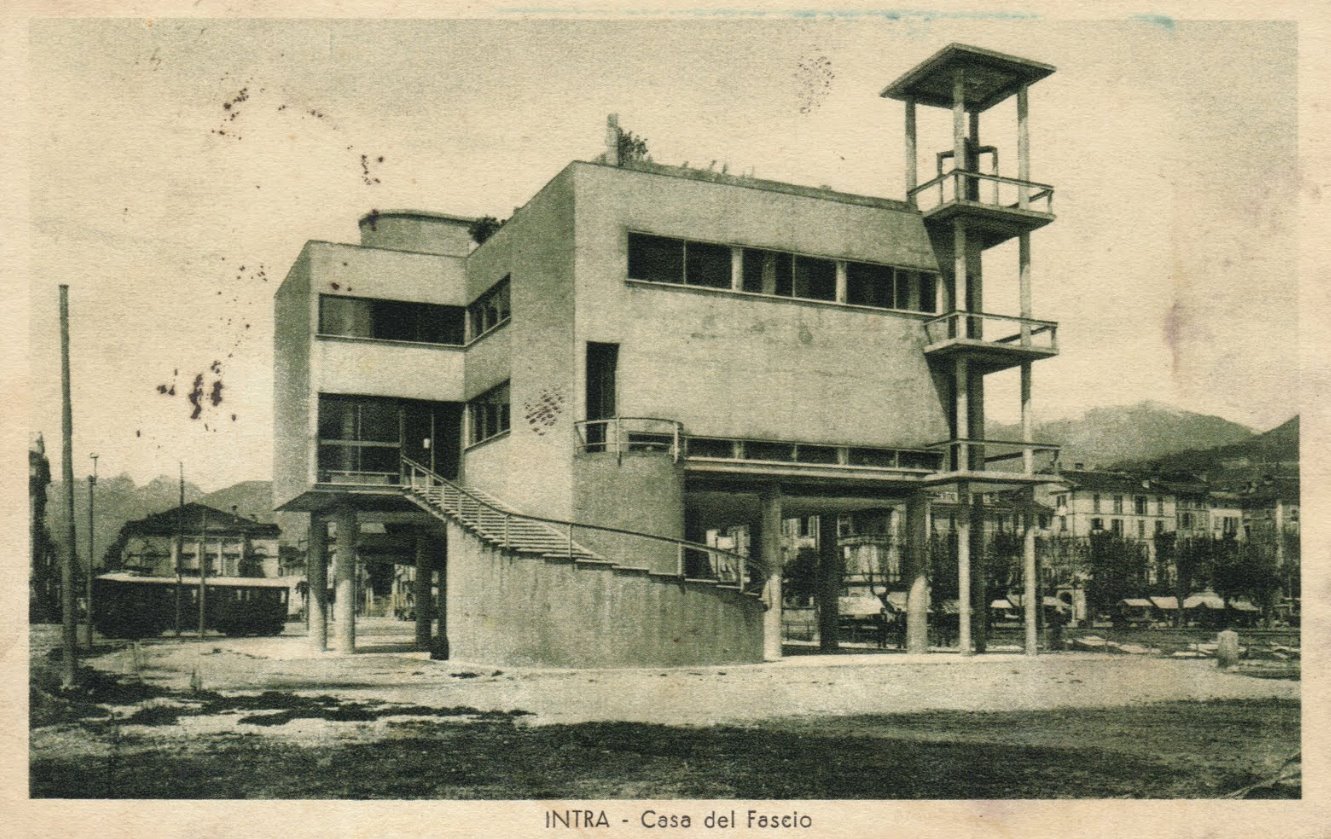
The Casa del Fascio in Intra, Verbania, was designed by architect Luigi Vietti and completed in 1933. The building stands as a document of Italian Rationalist architecture during the interwar period, reflecting the geometric clarity and functional design principles that defined the movement.
Vietti (1903–1998) was a central figure in Italian Rationalism, having studied at the Sapienza in Rome and participated in the CIAM congress in Brussels in 1930. Between 1931 and 1933, he collaborated with the Turin Superintendence office and served as Honorary Inspector for Monuments in Liguria, a period that encompassed the design of this Intra commission. His work throughout the 1930s demonstrated commitment to modernist architectural language and planning methodology.
About Luigi Vietti
Vietti trained as an engineer and architect in Milan and Rome, graduating with distinction from the Sapienza in 1928. He engaged actively with Rationalist circles, participating in the Architecture Exhibitions of 1928, 1931, and 1932, and presenting projects at the V Milan Triennale in 1933. His career spanned the twentieth century, during which he pursued both architectural design and urban planning.
Details
- Architect: Luigi Vietti
- Year: 1933
- Location: Intra, Verbania, Piedmont
- Movement: Italian Rationalism
- Period: Interwar era
Frequently asked questions
Who designed the Casa del Fascio in Intra?
Luigi Vietti, an Italian architect and urbanist born in Cannobio in 1903, designed the building. Vietti was an exponent of the Rationalist movement and participated in major architectural exhibitions and congresses of the 1930s.
When was it built?
The Casa del Fascio was completed in 1933, during a period when Vietti was collaborating with the Turin Superintendence and serving as Honorary Inspector for Monuments in Liguria.
What architectural movement does it represent?
The building exemplifies Italian Rationalism, an interwar modernist movement emphasizing geometric form, functional design, and contemporary building methods. Vietti participated in major Rationalist exhibitions throughout the early 1930s.
Sources
- S1 — Ciucci, Giorgio. Gli architetti e il fascismo: architettura e città 1922-1944. Einaudi, 2002. ISBN 978-88-06-16310-5.
- S2 — Nicoloso, Paolo. Mussolini architetto: Propaganda e paesaggio urbano nell'Italia fascista. Einaudi, 2008. ISBN 978-88-06-19086-6.
Spotted an error? Write to editorial@culturalheritageonline.com and we correct it the same day.