
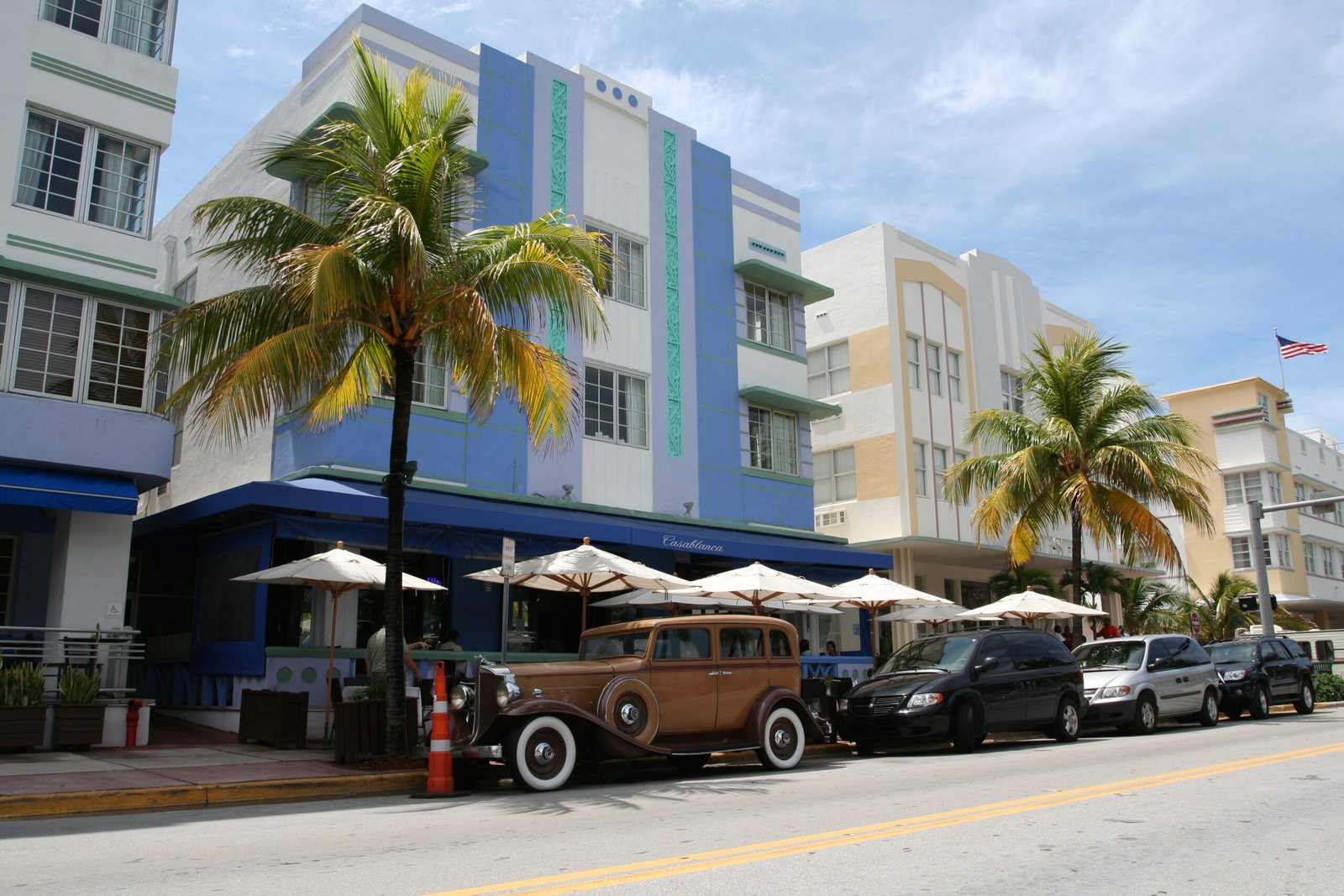
The world’s densest concentration of 1930s Art Deco: around 960 pastel hotels and apartment blocks in South Beach, saved from demolition by a preservation fight in the 1970s.
At a glance
The Miami Beach Architectural District — known popularly as the Art Deco District — covers the heart of South Beach, bounded by the Atlantic to the east, Alton Road to the west, Sixth Street to the south and Dade Boulevard to the north. It holds roughly 960 historic buildings, most of them small hotels and apartment houses built between the 1920s and the early 1940s in Art Deco, Streamline Moderne and Mediterranean Revival styles. Listed on the National Register of Historic Places on 14 May 1979, it was the first district of twentieth-century buildings to be granted that protection.
Key facts
- Period: 1920s–1940s
- Styles: Art Deco, Streamline Moderne, Mediterranean Revival
- Buildings: about 960 historic structures
- Listed: National Register of Historic Places, 14 May 1979
- Location: South Beach, Miami Beach, Florida, USA
- GPS: 25.785833, -80.134167 — Open in Google Maps
- Heart of the district: Ocean Drive, Collins Avenue and Washington Avenue
History
Miami Beach was built fast. After a 1926 hurricane and through the Depression, developers filled the barrier island with affordable hotels and apartments in the modern styles of the day — clean lines, rounded corners, nautical motifs, terrazzo floors and neon. By the 1970s the buildings were ageing and threatened with demolition for high-rise redevelopment.
The turn came through Barbara Baer Capitman and the Miami Design Preservation League, which she helped found in 1976. Their campaign secured the National Register listing in 1979 and, over the following decade, the restoration of the district building by building — repainted in the pastels now associated with South Beach. The revival made Ocean Drive one of the most photographed streetscapes in America.
What you see
The district’s vocabulary is consistent and instantly legible: three- and four-storey blocks with flat roofs, central vertical “eyebrows” and finials, porthole windows, ship’s-railing balconies and bands of colour. Streamline Moderne examples curve their corners as if shaped by wind; the earlier Deco fronts carry stepped geometric ornament and stylised flora.
Ocean Drive is the showcase, its hotels lined up behind palm trees and lit by neon after dark; Collins and Washington Avenues hold quieter, often finer examples. The scale stays domestic throughout — this is a district of small buildings working together, not of single monuments.
Practical information
- Access: A living neighbourhood; the streets are public and walkable at any time
- Tours: The Miami Design Preservation League runs guided Art Deco walking tours from the Ocean Drive welcome centre
- Best light: Early morning for the façades; dusk for the neon
- Time needed: Half a day to walk Ocean Drive, Collins and Washington
Getting there
South Beach sits at the southern end of Miami Beach, across the bay from downtown Miami. From Miami International Airport, buses and ride-shares reach the district in about 30–40 minutes; from downtown Miami, several bus routes cross the causeways to Washington Avenue. Once there, the district is best explored on foot or by bicycle.
Nearby
- The Tides — one of Ocean Drive’s tallest original Deco hotels
- The Wolfsonian–FIU, a museum of design and propaganda art on Washington Avenue
- Lummus Park and the Atlantic beachfront, along the eastern edge
Sources
- National Register of Historic Places — district nomination and listing (1979)
- Miami Design Preservation League — Art Deco district documentation
- City of Miami Beach — historic preservation records
Find it on the map
See this place and what’s around it →Record researched and written by Luigi De Marchi for Cultural Heritage Online, 2026.
📷 Become a Cultural Heritage Online photographer
Share your photos of places: they stay published under your name as the author. The more they're seen, the more you get noticed — and soon a contest will reward the most appreciated photos.
Log in or sign up free to add a photo