
In the two decades after 1913, Danish architecture refused both academic revivalism and the bare machine aesthetic. It produced instead a disciplined classicism of pure geometry, and a parallel tradition that built cathedrals out of ordinary yellow brick. Copenhagen holds the two purest examples of each.
At a glance
Copenhagen is the clearest place to read the Nordic moment between the historicism of the nineteenth century and the international functionalism of the 1930s. Two buildings define it. The Politigården, the city’s police headquarters (1918–1924), is a severe exercise in Nordic Classicism — so late and so rigorous that it has been called the last work of Neoclassical architecture in Northern Europe. A few kilometres north, Grundtvig’s Church (1921–1940) takes the opposite material — five million handmade yellow bricks — and stacks it into a Gothic silhouette of pure expressionist force. Between austerity and exaltation, the two buildings frame everything Danish architecture was attempting in the interwar years.
Key facts
- Country: Denmark
- Key period: 1913–1940 (Nordic Classicism and Brick Expressionism)
- Politigården: Hack Kampmann (1856–1920) and Aage Rafn (1890–1953); commissioned 1918, completed early 1924
- Grundtvig’s Church: Peder Vilhelm Jensen-Klint (competition won 1913; died 1930); completed by his son Kaare Klint in 1940
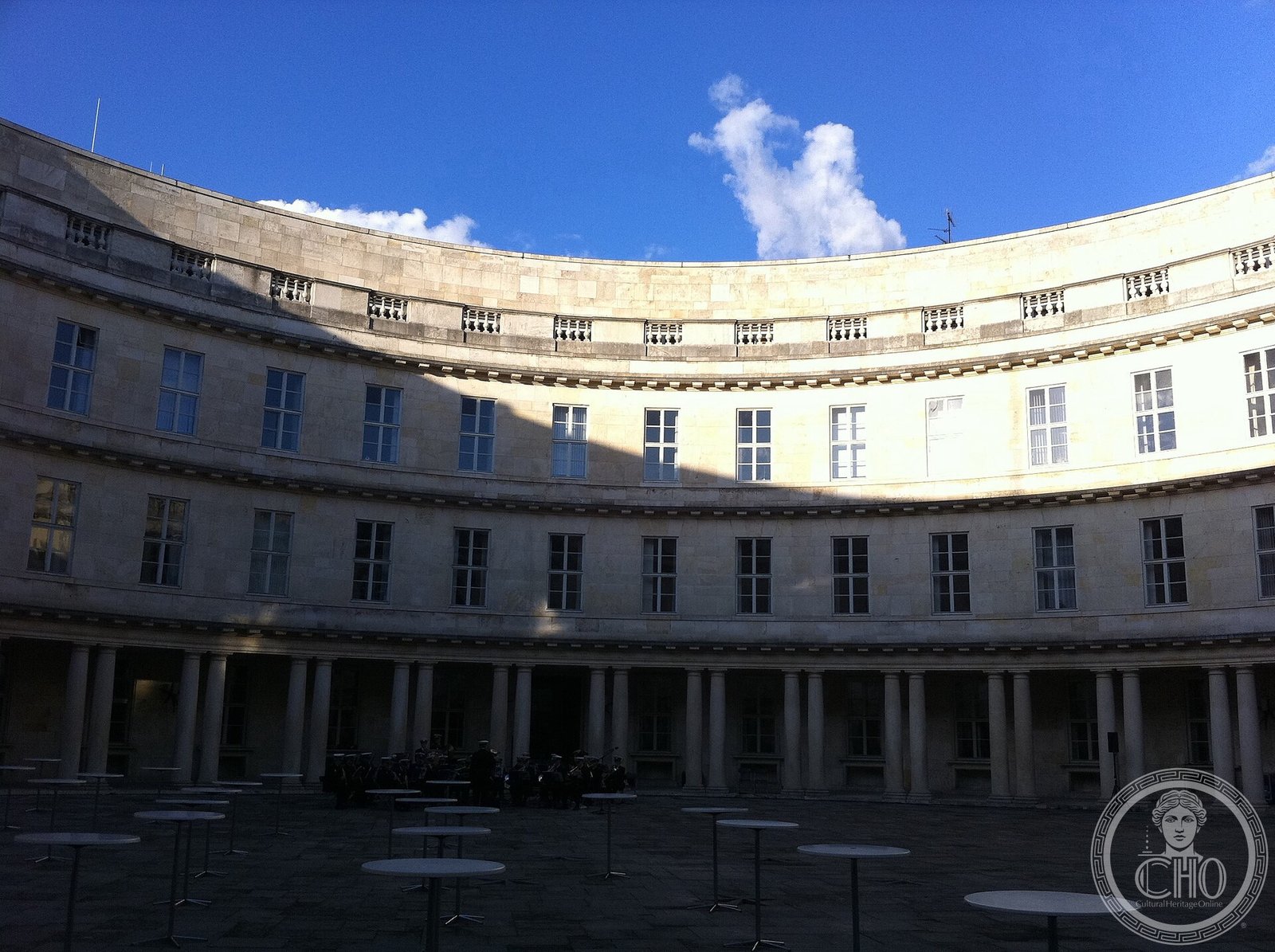
- Signature features: the Politigården’s round courtyard, 45 metres across, ringed by 44 Doric columns; Grundtvig’s Church, 49 metres high, built of roughly five million yellow bricks
- Where: Polititorvet, central Copenhagen, and the Bispebjerg district to the north
History
The Politigården was commissioned in the summer of 1918, with foundation work beginning that August. The lead architect was Hack Kampmann (1856–1920), one of the most influential Danish architects of his generation; after his death the work passed to Aage Rafn (1890–1953), who saw it through to completion in early 1924. The result is the most uncompromising statement of Nordic Classicism in Denmark: a movement that, across Scandinavia in the 1910s and 1920s, stripped the classical language down to bare geometry, smooth surfaces and severe symmetry before the modern movement arrived.
Grundtvig’s Church grew from a 1913 competition won by Peder Vilhelm Jensen-Klint, conceived as a national monument to the theologian and hymn-writer N. F. S. Grundtvig. The foundation stone was laid on 8 September 1921 — Grundtvig’s birthday. The main body and the great west tower were built between 1921 and 1926, but the project outlived its architect: Jensen-Klint died in 1930, and his son Kaare Klint, a founding figure of Danish furniture design, completed the interior and the surrounding parish buildings, with final completion reached in 1940.
The two projects belong to the same generation but pull in opposite directions. The Politigården answers a brief for state authority with cool classical order; Grundtvig’s Church answers a spiritual brief with the soaring verticality of a brick cathedral. Together they show a small national architecture working at the highest level on both registers at once.
What you see
At the Politigården the drama is hidden inside. From Polititorvet the building presents a closed, almost forbidding classical front; pass through it and you reach the round courtyard, 45 metres in diameter, ringed by a colonnade of 44 Doric columns. The proportions are exact and the surfaces deliberately bare — the effect is monumental rather than decorative, with darker terrazzo floors, oversized door and window frames, and Einar Utzon-Frank’s sculpture Slangedræberen (the Snake Killer) as one of the few figurative notes.
Grundtvig’s Church reads from a distance. Its west front rises like the pipes of a giant organ, a stepped gable of yellow brick translating the Danish village church into monumental scale. Inside, the brick is unplastered and continuous — floor, walls, vaults and piers all in the same pale material — producing a cool, even light and a verticality that recalls Gothic naves while owing nothing to historical copying. It is the defining work of Danish Brick Expressionism.
Practical information
- Politigården: a working police headquarters; the round courtyard is accessible only on occasional public tours and heritage open days — check before visiting
- Grundtvig’s Church: open to visitors outside services; free entry, with the tower and interior the main draw
- Best paired: both can be seen in a single day, the church a short metro and bus ride north of the centre
- Time needed: half a day for both, longer if you add central Copenhagen on foot
Getting there
Copenhagen Airport (CPH) is connected to the city centre by metro and train in about 15 minutes. The Politigården stands on Polititorvet, a short walk southwest of the central station and the Tivoli gardens. Grundtvig’s Church is in the Bispebjerg district to the north; from the centre it is reached by metro and bus, or by S-train to Emdrup and a short walk. Copenhagen’s public transport runs on a single integrated ticket system covering metro, train and bus.
Related in CHO
- Helsinki — Alvar Aalto and Nordic Functionalism
- Stockholm — Nordic Classicism and the Stockholm school
- Vienna — Capital of the Vienna Secession
Sources
Find it on the map
See this place and what’s around it →📷 Become a Cultural Heritage Online photographer
Share your photos of places: they stay published under your name as the author. The more they're seen, the more you get noticed — and soon a contest will reward the most appreciated photos.
Log in or sign up free to add a photo