
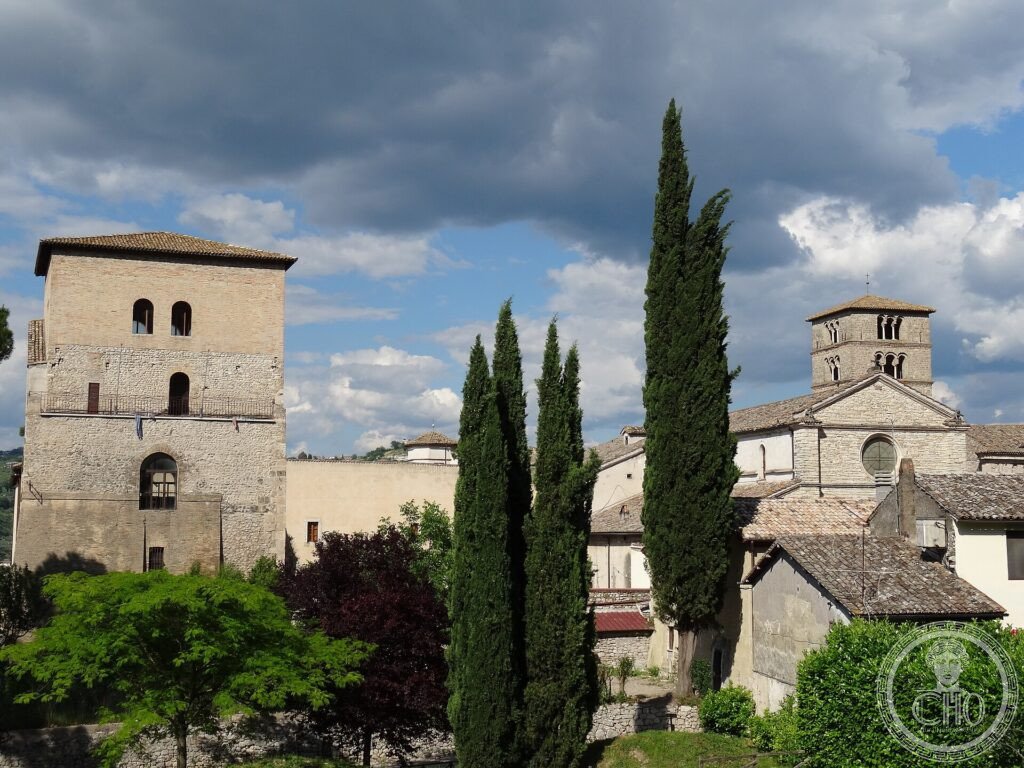
One of medieval Europe’s most powerful monastic centers, Farfa commanded an empire of hundreds of churches, castles, and villages while serving as an imperial legate defending papal territories and German imperial interests.
At a glance
Founded between 560 and 570 by Lorenzo, bishop of Forum Novum, the Benedictine Abbey of Santa Maria of Farfa rose to extraordinary influence during the Carolingian era. At its height, it controlled 683 churches or monastic communities, 132 castles, two cities including Civitavecchia, multiple ports and mines, and over 300 villages across central Italy. The abbey’s abbot functioned as a suburbicarian bishop and imperial legate, wielding authority that rivaled the papacy itself.
History
Lorenzo established the monastery in the sixth century, but its transformation into a continental powerhouse came under Charlemagne. The emperor visited Farfa mere weeks before his coronation on 25 December 800, and during his reign the abbey underwent massive expansion that fundamentally altered its original structure. By the ninth century, the monastery owned commercial vessels exempt from imperial port duties—a mark of its economic weight.
The monk Gregorio di Catino, writing in the eleventh century, documented this vast patrimony with unprecedented precision. His Regesto of Farfa comprises 1,324 documents; the Largitorium catalogued every concession to tenants; and his Chronicon Farfense provided detailed historical narrative. At 70, he compiled an index to his works—a methodical achievement that would influence medieval record-keeping.
During the investiture struggles, Farfa sided with the Ghibellines, issuing canonical defenses of imperial authority. This pro-German stance persisted through the Ottoman period, even as Cluniac reform reshaped monastic practice. Internal conflict erupted between 1119 and 1125 when rivals Abbot Guido and monk Berard contested leadership. The abbey’s fortunes declined after papal victory over Corradin of Swabia in 1268. In 1547, under Cardinal Alessandro Farnese, Farfa joined the Cassinese Congregation. A century of gradual decay followed until 1920, when monks dispatched by Alfredo Ildefonso Schuster revived the community. In 1928, Farfa was declared a national monument.
What you see
The abbey’s physical form reflects multiple centuries of construction and alteration. During Charlemagne’s era, substantial rebuilding obscured the original sixth-century layout so thoroughly that its structure was only recently recovered through archaeological analysis. Abbot Ratfredo completed the church in 913, establishing a Romanesque foundation that subsequent periods modified. The complex encompasses monastic buildings distributed across the Sabina territory, integrating defensive and ecclesiastical functions characteristic of early medieval power centers.
Cultural significance
Farfa exemplifies the intersection of spiritual authority and temporal power in medieval Europe. As an imperial abbey exempt from papal control yet aligned with the Holy See, it embodied the complex negotiation between Rome and the German Empire. The monastery’s scholars, particularly Gregorio di Catino, advanced documentary practice and historical writing. The abbey’s territorial organization and economic sophistication demonstrate how religious communities functioned as administrative states, controlling production, trade, and fortifications across entire regions.
Key facts
- Founded: 560–570
- Founder: Lorenzo, bishop of Forum Novum
- Peak period: 9th–11th centuries
- Address: Via del Monastero, 1, 02032 Castelnuovo di Farfa
- Coordinates: 42.2213856, 12.7181581
- Phone: 0765 277065
- Website: http://www.abbaziadifarfa.it/
- National monument status: 1928
Practical information
The monastery offers hospitality for individuals and groups; advance contact is recommended for larger visits. Opening hours and tour arrangements should be confirmed via the official website or phone before traveling.
Getting there
The abbey lies in the municipality of Fara in Sabina within the Rieti area of Lazio. Public transport connections to Castelnuovo di Farfa are limited; a personal vehicle is advisable. Visit the abbey’s website for detailed directions and current access information.
Sources & resources
- Official website: Abbey of Farfa
- Cultural Heritage Online
Find it on the map
See this place and what’s around it →📷 Become a Cultural Heritage Online photographer
Share your photos of places: they stay published under your name as the author. The more they're seen, the more you get noticed — and soon a contest will reward the most appreciated photos.
Log in or sign up free to add a photoIs this page about you?
This page is read by travellers and heritage enthusiasts who find it on Google. Tell us how you are connected to this place and we will take it from there.