
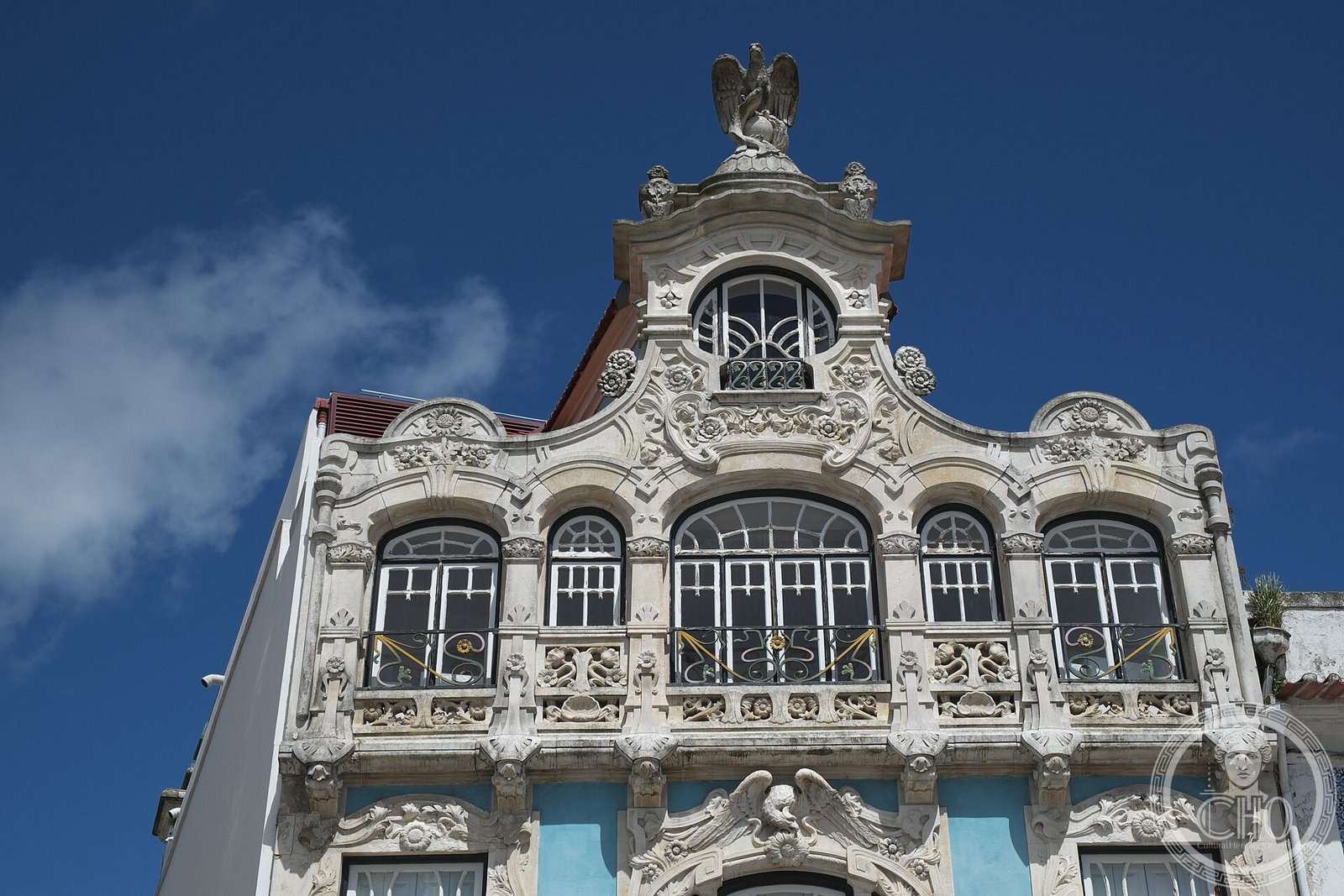
A lagoon town of canals and salt pans turned itself, in barely a decade, into the densest concentration of Art Nouveau in Portugal. The money came from families enriched in Brazil; the language came from one architect — Francisco Augusto da Silva Rocha — who gave the style its Portuguese accent in tiled façades along the water.
At a glance
Aveiro sits on a coastal lagoon in central Portugal, threaded by canals that have earned it the nickname “the Venice of Portugal” and crossed by the flat, brightly painted moliceiro boats once used to harvest seaweed. Around 1900 the town’s returning emigrants — families who had made fortunes in Brazil — commissioned a wave of houses and shops in the new international Art Nouveau idiom, here called Arte Nova. What distinguishes Aveiro from other Art Nouveau cities is its scale and concentration: the style is woven through the everyday fabric of the historic centre rather than confined to a few showpieces, which is why Aveiro is one of around twenty cities admitted to the Réseau Art Nouveau Network. The anchor of any visit is the Casa do Major Pessoa, now the Museu Arte Nova.
Key facts
- Country: Portugal (Centro Region, Aveiro district)
- Key period: 1900s–1910s (Arte Nova / Portuguese Art Nouveau)
- Key figure: Francisco Augusto da Silva Rocha (1864–1957) — architect and drawing teacher, director of Aveiro’s Escola de Desenho Industrial, nicknamed “the Portuguese Gaudí”
- Essential site: Casa do Major Pessoa / Museu Arte Nova (Rua Dr. Barbosa de Magalhães, by the Jardim do Rossio)
- Why it matters: one of around 20 cities in the Réseau Art Nouveau Network; the leading concentration of Art Nouveau in Portugal
- Setting: lagoon canals, moliceiro boats, and the historic salt pans (salinas)
History
Aveiro’s wealth had long come from its lagoon — salt harvested from the salinas and seaweed gathered by the moliceiro boats — but the building boom of the early twentieth century was financed from further away. Emigrants who had prospered in Brazil returned to invest in their home town, and they wanted houses that announced their success in the most modern manner available. Art Nouveau, then sweeping Europe, offered exactly that vocabulary, and Aveiro adopted it through the local material it knew best: glazed ceramic tile, the azulejo, pressed into floral and sinuous Art Nouveau patterns across entire façades.
The figure who set the town’s tone was Francisco Augusto da Silva Rocha. Born in Mealhada in 1864, he directed Aveiro’s Escola de Desenho Industrial (the industrial drawing school) and designed building after building in the historic centre, earning the nickname “the Portuguese Gaudí” for the originality of his work. He built his own residence on the Rua do Carmo between 1904 and 1906 and remodelled the Industrial Education building in 1903, but his best-known commission is the house of Mário Belmonte Pessoa.
The Casa do Major Pessoa was raised from 1907 to a design by Silva Rocha together with the Swiss-born architect Ernesto Korrodi. By the late twentieth century the building had fallen into severe decay; Aveiro’s municipality acquired it in 2004 and, by 2008, had restored it to house the Museu Arte Nova — a museum dedicated to the style and the era that shaped the town. The building has carried the protected status of Imóvel de Interesse Público (Property of Public Interest) since 1997.
What you see
The Casa do Major Pessoa stands beside the Jardim do Rossio, where the central canal opens toward the lagoon — a textbook example of civil architecture in the Arte Nova style, its façade organised around the flowing lines and stylised plant motifs that define the movement. Inside, the Museu Arte Nova interprets the building itself and the wider story of Aveiro’s Art Nouveau, making it the natural starting point before walking the surrounding streets.
From there the style reveals itself across the historic centre, often at first-floor height and above: tiled frontages, ironwork balconies and carved doorways scattered among ordinary shopfronts and homes. The canal embankments tie the ensemble together, so that the Art Nouveau of Aveiro is read on foot, building by building, rather than from a single vantage point.
Practical information
- Museu Arte Nova (Casa do Major Pessoa): check current opening hours and admission with the Câmara Municipal de Aveiro before visiting
- Best approach: on foot — the Art Nouveau buildings are spread through the historic centre around the central canal
- Moliceiro boat tours: depart from the central canal and give a water-level view of the canal-side façades
- Time needed: half a day for the museum and a walking circuit of the centre
Getting there
Aveiro lies on the main line between Lisbon and Porto and is served by Alfa Pendular high-speed and Intercity trains, which makes it an easy day trip from either city; Porto is the closer of the two. From Aveiro railway station the historic centre and its canals are a short walk or local bus ride to the west. The nearest international airport is Porto (OPO), roughly an hour away by road or rail.
Related in CHO
- Lisbon — Arte Nova and the Déco of the Avenidas
- Reus — Catalan Modernisme and the Birthplace of Gaudí
- Barcelona — Gaudí and the Catalan Modernisme
- Nancy — The École de Nancy and French Art Nouveau
Sources
Find it on the map
See this place and what’s around it →📷 Become a Cultural Heritage Online photographer
Share your photos of places: they stay published under your name as the author. The more they're seen, the more you get noticed — and soon a contest will reward the most appreciated photos.
Log in or sign up free to add a photo