
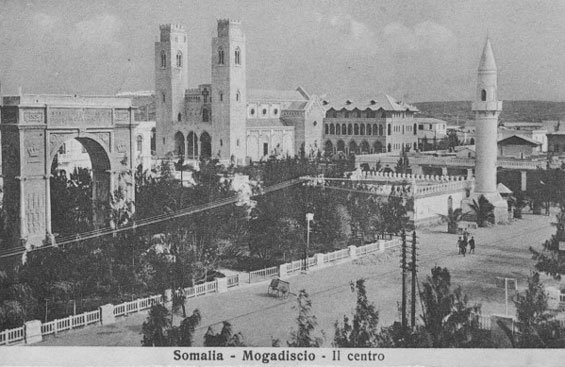
For four decades Mogadishu was the capital of Italian Somaliland, and in the 1930s its colonial administration reshaped the seafront city. Much of that fabric was later lost to war.
At a glance
Mogadishu, on the Indian Ocean coast of the Horn of Africa, was made the capital of Italian Somaliland in 1905 and remained under Italian administration until 1941. During the 1930s the colonial authorities laid out new buildings and avenues across the city, and architects associated with Italian Rationalism worked here — among them Carlo Enrico Rava (1903–1986), a leading figure of the movement, who is recorded as having designed several buildings in Mogadishu. The colonial-era city centred on the historic seafront quarters of Hamar Weyne and Shangani. Much of the architecture of this period was damaged or destroyed during the decades-long Somali Civil War that began in 1991.
Key facts
- Country: Somalia
- Key period: 1929–1941 (Italian rule; capital of Italian Somaliland from 1905, Italian administration ended 1941)
- Note: much colonial-era fabric was damaged or destroyed during the Somali Civil War (from 1991)
- Verified landmarks: Mogadishu Cathedral (1923–1928), the Arch of Triumph erected after 1936, the historic Hamar Weyne district, the Arba’a Rukun mosque (13th century)
History
Mogadishu is an old Indian Ocean trading city whose core neighbourhoods, Hamar Weyne and Shangani, long predate any European presence. The name Hamar Weyne itself combines the Somali words for “red” and “big.” Italy established a foothold on the Somali coast through protectorate treaties from 1889, and in 1905 made Mogadishu the capital of the newly organised colony of Italian Somaliland.
The most ambitious building campaign came in the late 1920s and the 1930s, when the colonial state set out to give the capital the appearance of an imperial administrative centre. New buildings and avenues were laid out, a governor’s palace was completed in 1931, and a narrow-gauge railway some 114 kilometres long was built inland from Mogadishu to Jowhar. The Mogadishu Cathedral was constructed between 1923 and 1928 on the order of Cesare Maria De Vecchi, governor of Italian Somaliland. After Italian forces took Addis Ababa in 1936 and proclaimed Italian East Africa, an Arch of Triumph was raised in Mogadishu to commemorate the victory.
This was also the period in which Italian Rationalist architecture reached the colonies. Carlo Enrico Rava, who had co-founded the Rationalist Gruppo 7 in Milan in 1926, is recorded among the architects who designed buildings in Mogadishu, alongside his colonial work in Libya and elsewhere in East Africa. Italian administration of the city ended in 1941, when British forces occupied Italian Somaliland during the Second World War.
What you see
The colonial-era city was concentrated near the old seafront quarters, where the administration inserted a governor’s palace, a cathedral, cinemas, banks and an arch among the older Somali fabric. The Mogadishu Cathedral was not itself a Rationalist building: designed by Antonio Vandone in a Norman Revival manner inspired by the cathedral of Cefalù in Sicily, it stood as the most conspicuous monument of the Italian presence. The broader 1930s programme, in which Rationalist architects such as Rava participated, favoured cleaner geometric public buildings in the modern Italian idiom of the day.
Little of this can be seen intact today. The Somali Civil War, which began in 1991, devastated central Mogadishu. The cathedral was heavily damaged and much of it was destroyed in 2008; a 2012 visit found the roof gone but the walls and stone arches still standing, and as of 2023 reconstruction had not begun. Many other colonial-era structures survive only as ruins, in old photographs, or not at all, which is why a 1930s postcard remains one of the clearest records of how the planned city once looked.
Practical information
- Mogadishu is the capital of Somalia and the country’s largest city, on the Indian Ocean coast.
- Government travel advisories for Somalia are generally at the most severe level; independent travel is widely advised against. Check your own government’s current advice before any planning.
- Surviving colonial-era sites are fragmentary and many lie in areas affected by the long conflict; access cannot be assumed.
- There is no formal heritage-tourism infrastructure for the colonial-era monuments described here.
Getting there
Mogadishu is served by Aden Adde International Airport, the city’s main airport on the southern edge of the urban area. Given the security situation, almost all visitors arrive by air rather than overland, and movement within the city is typically organised through local arrangements rather than independently.
Related in CHO
- Asmara — Africa’s Modernist City and Italian Rationalism
- Massawa — The Red Sea Port of Italian Eritrea
- Tripoli — Italian Colonial Architecture on the Mediterranean
Sources

Find it on the map
See this place and what’s around it →📷 Become a Cultural Heritage Online photographer
Share your photos of places: they stay published under your name as the author. The more they're seen, the more you get noticed — and soon a contest will reward the most appreciated photos.
Log in or sign up free to add a photo