
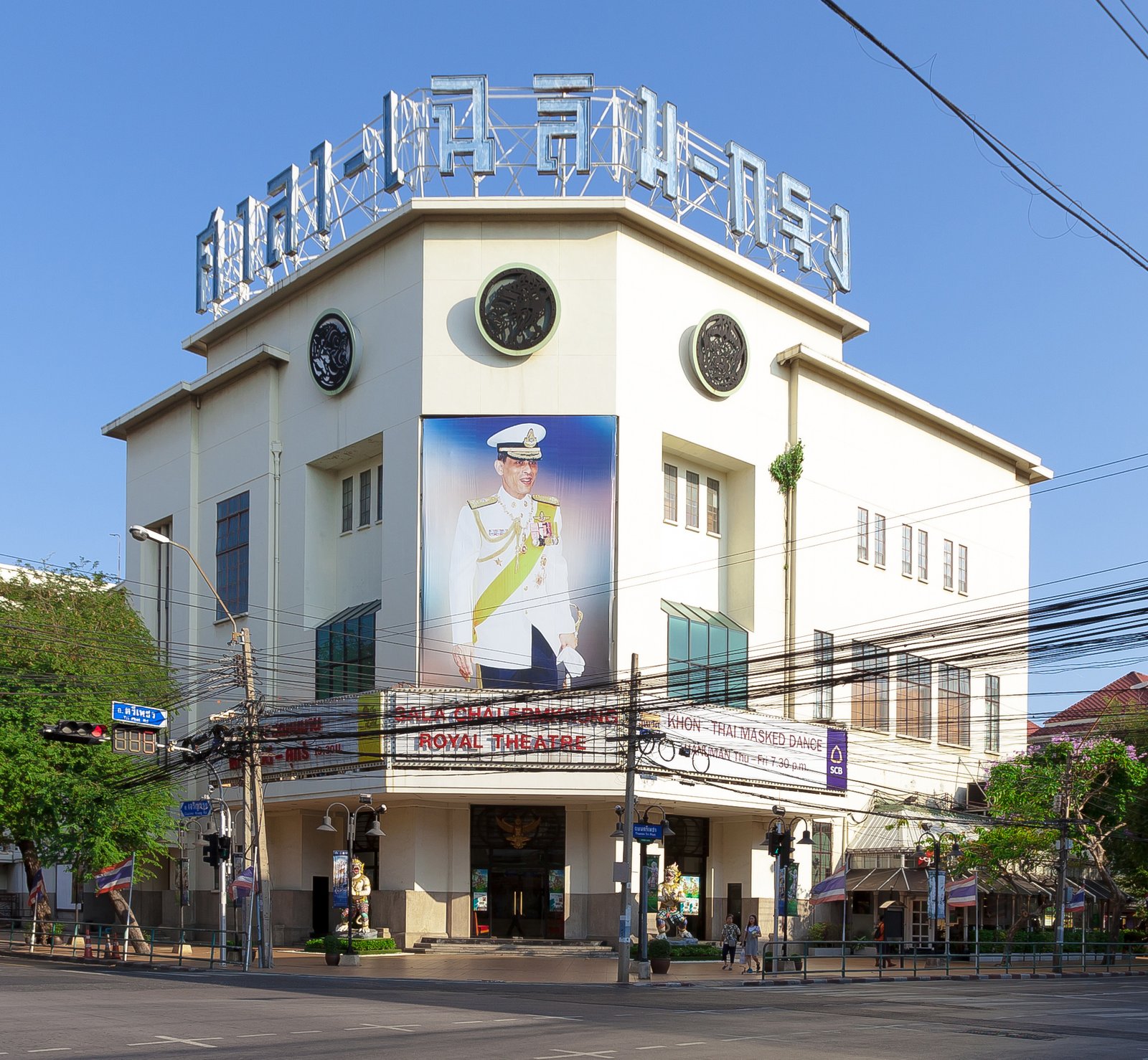
Built for Bangkok’s 150th anniversary and opened on 2 July 1933, this Art Déco landmark was among the first air-conditioned public buildings in Siam — and remains a working stage today.
At a glance
The Chalermkrung Royal Theatre (ศาลาเฉลิมกรุง, Sala Chaloem Krung) stands at the corner of Charoen Krung and Triphet Roads in Bangkok’s historic Phra Nakhon district. Commissioned by King Prajadhipok (Rama VII) to mark the 150th anniversary of the Rattanakosin era, it opened in 1933 as the largest and most technically advanced cinema and theatre in Siam. The reinforced-concrete building introduced Bangkokians to mechanical air-conditioning, a novelty that drew crowds as much as the films. Today the Royal Fine Arts Department operates it as a dedicated venue for khon — Thailand’s masked classical dance drama.
Key facts
- Opened: 2 July 1933
- Commissioned by: King Prajadhipok (Rama VII), using personal funds estimated at 9 million baht
- Architect: Mom Chao Samaichaloem Kridakorn, a Beaux-Arts-trained designer chosen directly by the king
- Original capacity: Main auditorium 1,500 seats; smaller second auditorium 350 seats; private royal screening rooms
- Renovation: 1992 — stage widened, hydraulic lift added, seating reduced to approximately 600
- Current use: Live khon (classical Thai masked dance) performances; ticketed public programme
- Heritage status: Recognised under Thai Fine Arts Department as a historic monument (ID 0005584)
History
When King Prajadhipok announced plans for a grand theatre to anchor the Rattanakosin sesquicentennial, Bangkok had no shortage of modest cinema halls — but nothing on the scale he envisioned. He selected Mom Chao Samaichaloem Kridakorn, a recently trained Beaux-Arts architect, and invested an extraordinary sum from his personal fortune. The project was both a civic gift and a statement: Siam could build in the idiom of international modernity without borrowing it from a colonial power.
The building opened on 2 July 1933 with a programme that mixed Thai classical performance with European and American films. Its two auditoriums seated nearly two thousand people combined. The mechanical air-conditioning system — one of the first in any public building in the country — became the theatre’s most discussed feature in its early years. Arriving at the Chalermkrung on a humid Bangkok evening meant passing from the street heat into a cool interior that felt genuinely theatrical before the curtain had risen.
The political rupture of 1932 — the constitutional revolution that ended absolute monarchy just months before the theatre opened — gave the building an unintended historical gravity. King Prajadhipok, who had ordered and largely financed it, abdicated in 1935 and died in exile in 1941. The theatre he built outlasted his reign and passed into state ownership, continuing to operate through mid-century as both cinema and stage. A comprehensive renovation in 1992 widened the proscenium and installed hydraulic stage machinery suited to khon productions, at the cost of roughly two-thirds of the original seating. Since then, it has functioned almost exclusively as Bangkok’s principal venue for classical masked dance, a role formalised under the Royal Fine Arts Department.
What you see
The exterior reads as streamlined Art Déco translated through a Thai sensibility: horizontal banding in off-white render, recessed windows grouped in vertical clusters, and a flat-roofed massing that announced its modernity against the older Sino-Portuguese shophouse streetscape of Charoen Krung Road. The original neon signage that wrapped the upper facade was reportedly among the largest illuminated displays in Asia at the time. The entrance canopy and surviving decorative metalwork preserve the period’s appetite for geometric ornament without the florid excess of earlier Beaux-Arts work.
Inside, the renovated main auditorium retains raked seating that focuses sharply on a deep proscenium stage. The hydraulic pit lifts built in 1992 are invisible when not in use but make the floor transformable for different khon set configurations. Gold and deep red dominate the interior palette, a post-renovation choice that reads as respectful homage to Thai royal ceremonial colour rather than a period reconstruction — the building knows it is a working theatre, not a museum of its own past.
Practical information
- Performances: Khon classical dance-drama productions run on a ticketed schedule; check the official site (salachalermkrung.com) for current programme dates
- Box office hours: Monday–Sunday, 09:00–18:00 (verify current times at salachalermkrung.com)
- Dress: Smart casual; traditional performance attire is not required of visitors
- Photography: Exterior freely photographable; interior policies vary by performance — confirm at the box office
- Allow: 2–3 hours for a full khon performance; 20 minutes for an exterior visit only
Getting there
The theatre is at 66 Charoen Krung Road (corner of Triphet Road), Wang Burapha, Phra Nakhon, Bangkok 10200 — GPS 13.7468°N, 100.5001°E. The nearest MRT station is Sanam Chai (Blue Line), about 15 minutes on foot heading north along Triphet Road. Tuk-tuks and metered taxis reach the door easily from the Grand Palace area (10 minutes by road). Chao Phraya express boats stop at Ratchawong Pier, a short walk east along Charoen Krung.
Nearby
- Chinatown / Yaowarat — Bangkok’s historic Chinese quarter begins immediately east along Charoen Krung Road; one of Asia’s most intact early-20th-century commercial streetscapes
- Grand Palace and Wat Phra Kaew — 1 km north-west; the ceremonial heart of Rattanakosin-era Bangkok, visible from the same skyline as the theatre
- Wat Pho (Temple of the Reclining Buddha) — 1.2 km north-west; Bangkok’s oldest and largest temple complex, a 15-minute walk
- Museum of Siam — 800 m north on Sanam Chai Road; permanent exhibition on Thai national identity and modernisation, directly relevant context for the theatre’s 1930s ambitions
Sources
- Fusinpaiboon, Chatri. Modernity and the Architecture of Thailand. PhD thesis, University of Sheffield, 2014. etheses.whiterose.ac.uk/5698 — primary academic source for architect, funding, and air-conditioning history
- Sala Chaloem Krung Royal Theatre — official website: salachalermkrung.com
- Thai Fine Arts Department heritage record, monument ID 0005584
- Lersakvanitchakul, Kitchana. “Long Sticks to the Fore.” The Nation, 6 July 2018. Via PressReader — details on 1992 renovation and current khon programme
- Barme, Scot. Woman, Man, Bangkok. Silkworm Books — social history of Bangkok cinema era, ISBN 9749361955
Find it on the map
See this place and what’s around it →Record researched and written by Luigi De Marchi for Cultural Heritage Online, 2026.
📷 Become a Cultural Heritage Online photographer
Share your photos of places: they stay published under your name as the author. The more they're seen, the more you get noticed — and soon a contest will reward the most appreciated photos.
Log in or sign up free to add a photoIs this page about you?
This page is read by travellers and heritage enthusiasts who find it on Google. Tell us how you are connected to this place and we will take it from there.